
History and social studies
Sociology essay planner: education and opportunity
Plan an essay that explains how sociologists could interpret a fictional difference in access to educational resources.
Read the material
Plan an essay that explains how sociologists could interpret a fictional difference in access to educational resources.
Pupil worksheet. Use the preview for diagrams and layout.
Page 1
Sociology essay planner: education and
opportunity
Pupil activity
Audience: Sociology pupils
Plan an essay that explains how sociologists could interpret a fictional difference in access to educational
resources.
Fictional case
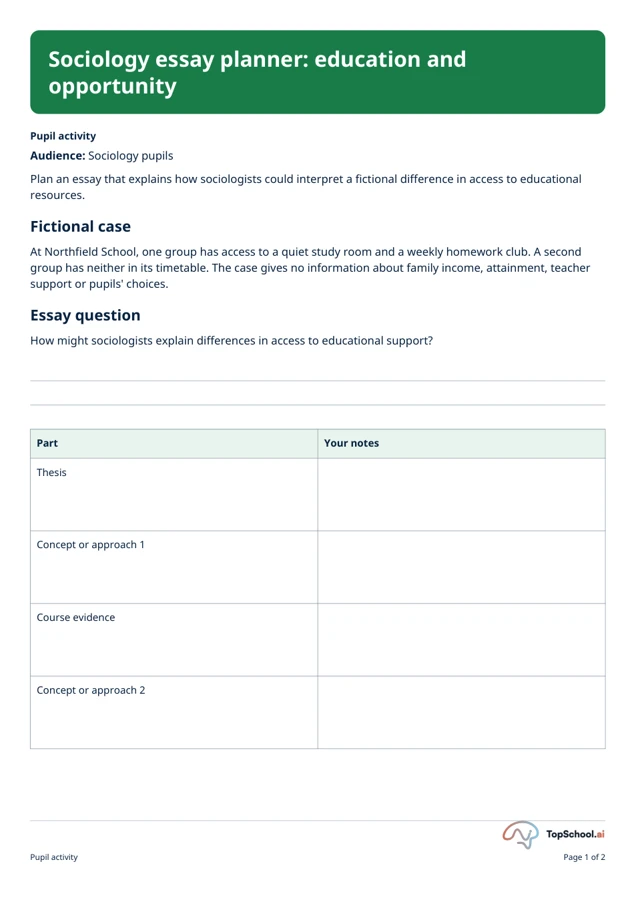
At Northfield School, one group has access to a quiet study room and a weekly homework club. A second
group has neither in its timetable. The case gives no information about family income, attainment, teacher
support or pupils' choices.
Essay question
How might sociologists explain differences in access to educational support?
Part
Your notes
Thesis
Concept or approach 1
Course evidence
Concept or approach 2
Pupil activity
Page 1 of 2
Page 2
Sociology essay planner: education and opportunity
Part
Your notes
Limitation or alternative
Conclusion
Check: distinguish what the fictional case states from the explanation you add.
Pupil activity
Page 2 of 2
A teaching sequence
Plan an essay that explains how sociologists could interpret a fictional difference in access to educational resources.
Answer the question with a bounded thesis
Write a thesis that answers the question without claiming a national pattern.
Does the thesis distinguish this fictional case from a national pattern?
Select two taught sociological concepts
Choose two course concepts that could interpret the case.
How could each concept interpret the stated access difference?
Add course evidence and reasoning
Add taught evidence for each concept and explain its relevance.
Which taught evidence supports the concept, and how is it relevant?
Include a limit and return to the question
Add a limitation and return to the question in the conclusion.
Which missing case detail prevents a broader conclusion?
Before you teach
Look for the thinking behind an answer, choose the support your class needs and leave room for an independent response.
What to look for
A defensible response treats the school comparison as one fictional example, then uses course evidence to explain what it might suggest. Ask, “What can this case not prove?”
Give a little support
Provide claim-concept-evidence frames and the approved concept list.
Take the idea further
Compare two explanations and state what additional information could test them.
Things to keep in mind
The case is invented and does not represent real attainment or research findings. Evidence must come from the course materials.
Keep the idea. Make it yours.
Bring your topic, learning goal and class context to PLAI™, then review what you create.
Ideas to try with your class
Sample teaching perspectives on what to try, what to adapt and what to watch for.
Meet The Creators
Meet a creator whose teaching interests connect with this template.

Little Lightbulbs
The fictional Northfield case gives one group a quiet room and homework club and another neither, while explicitly withholding family income, attainment, teacher support and pupil choice. That boundary is central to answering without inventing a cause.
After the Bell
Pupils can use the thesis, two concept/approach sections, limitation and conclusion to construct a sociological explanation. The task is most useful when each concept is clearly linked to the access difference described, not treated as a fact in the case.
Reread Reminder
The two-page layout separates initial explanation from limitation and conclusion. Before writing, pupils could annotate which details the case states and which explanations would require further information, giving a concrete starting point for the concept boxes.
Extra Page
The case is fictional and deliberately sparse; it does not explain why the groups have different support. A follow-up should add a cited evidence source or ask what information would be needed before making claims about structural causes.