
Religious and values education
Getting ready for First Holy Communion
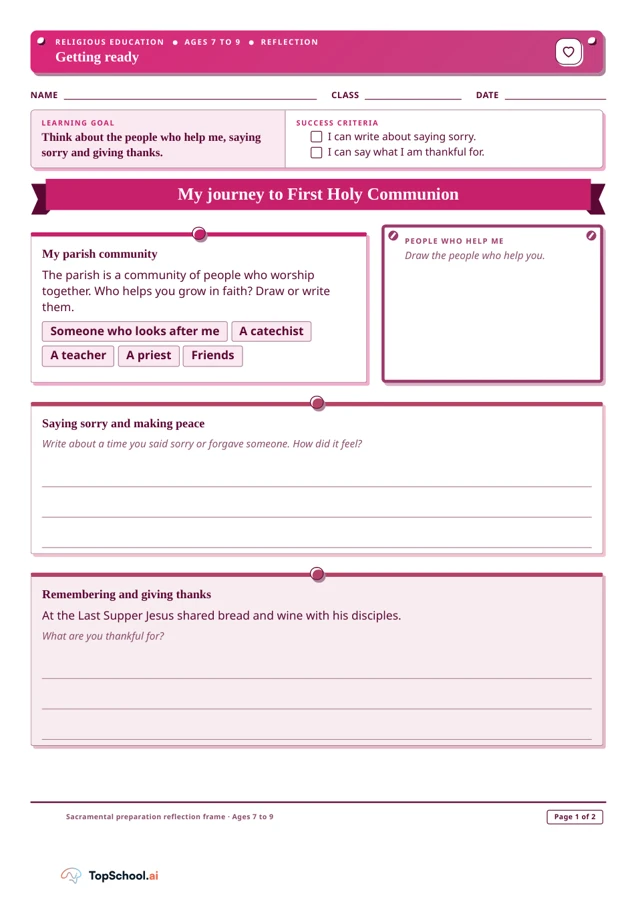
A Catholic sacramental-preparation reflection invites pupils to recognise people who support them, consider saying sorry and giving thanks, and respond to prompts about their First Holy Communion. Make room for different family, parish and faith experiences.
Read the material
A Catholic sacramental-preparation reflection invites pupils to recognise people who support them, consider saying sorry and giving thanks, and respond to prompts about their First Holy Communion. Make room for different family, parish and faith experiences.
Complete resource. Use the preview for diagrams and layout.
Page 1
NAME
CLASS
DATE
LEARNING GOAL
Think about the people who help me, saying
sorry and giving thanks.
SUCCESS CRITERIA
I can write about saying sorry.
I can say what I am thankful for.
Sacramental preparation reflection frame · Ages 7 to 9
Page 1 of 2
RELIGIOUS EDUCATION
AGES 7 TO 9
REFLECTION
Getting ready
My journey to First Holy Communion
My parish community
The parish is a community of people who worship
together. Who helps you grow in faith? Draw or write
them.
Someone who looks after me
A catechist
A teacher
A priest
Friends
PEOPLE WHO HELP ME
Draw the people who help you.
Saying sorry and making peace
Write about a time you said sorry or forgave someone. How did it feel?
Remembering and giving thanks
At the Last Supper Jesus shared bread and wine with his disciples.
What are you thankful for?
Page 2
NAME
CLASS
DATE
Sacramental preparation reflection frame · Ages 7 to 9
Page 2 of 2
RELIGIOUS EDUCATION
AGES 7 TO 9
REFLECTION
Growing in love
My own prayer
1
Dear God, thank you for...
Please help me to...
Amen.
How I can show love
2
At home
At school
In my parish
My special day
3
MY DAY
Draw your First Holy Communion day as you imagine it.
A quiet moment
4
Things I wonder about
Big questions are welcome.
A teaching sequence
Reflect on people who offer support, consider how to make peace, name something to be thankful for and respond to a Catholic prayer or special-day prompt if appropriate.
Name people if you choose
Draw or name people who help you grow in faith or care for you, using only details you are comfortable sharing.
Who would you like to draw, without sharing private details?
Reflect or pass
Choose whether to reflect on a time you said sorry or forgave someone; pupils can use an imagined example or pass.
Would an imagined example or a pass be more comfortable?
Give thanks in your chosen way
Write or draw something you are thankful for, using the Last Supper prompt if it is familiar to the group.
What would you like to write or draw about gratitude?
Choose reflection and a loving action
Complete the short prayer frame if it fits the pupil’s beliefs and preparation; otherwise use the space to draw or reflect in another way. Then choose one way to show love at home, at school or in the parish, then draw an imagined First Holy Communion day or write a question.
Which prayer, drawing or question fits your beliefs and preparation?
Before you teach
Look for the thinking behind an answer, choose the support your class needs and leave room for an independent response.
What to look for
Look for a response that connects a person, action or idea to the pupil’s own reflection. Ask open questions and avoid judging the depth of belief or requiring disclosure about family relationships, forgiveness or prayer. A pupil may pass or choose a different way to respond.
Give a little support
Read religious words aloud and explain them in age-appropriate language. Let pupils dictate, draw, choose a neutral response or skip personal questions. Provide fictional names or situations if writing about family or conflict would be uncomfortable.
Take the idea further
Invite pupils to connect an act of care with a value or teaching discussed in class, or to formulate a respectful question about the sacrament. Keep the response grounded in the tradition being studied.
Things to keep in mind
This resource reflects Catholic beliefs and First Holy Communion preparation; it does not represent every Christian tradition or every pupil’s family experience. Do not require a pupil to disclose private relationships, faith, conflict, forgiveness or prayer. Use the prompts in line with the school and parish approach.
Keep the idea. Make it yours.
Bring your topic, learning goal and class context to PLAI™, then review what you create.
Ideas to try with your class
Sample teaching perspectives on what to try, what to adapt and what to watch for.
Meet The Creators
Meet a creator whose teaching interests connect with this template.

Glue Stick Club
This two-page Catholic reflection frame for ages 7 to 9 asks who helps a child grow in faith, how to make peace, what they are thankful for and, where appropriate, how to respond to a prayer or special-day prompt.
Step by Step
The page places First Holy Communion within a parish community and connects the preparation to support, apology and gratitude. Drawing or writing gives more than one way to answer the first prompt.
Board Eraser
Use the reflection in a suitable Catholic preparation context and let a child draw, speak or write. Do not require disclosure about family or faith; make the “if appropriate” prompt genuinely optional.
Quietly Curious
The First Holy Communion and Last Supper prompts make this a Catholic preparation frame, not a general religious-education activity or a measure of sacramental readiness. Follow parish teaching and safeguarding practice, and respect a child's choice not to share.