
Wellbeing and personal development
Respect in History: listen, question and reflect
Use a fictional source discussion to practise respectful, evidence-based disagreement in History.
Read the material
Use a fictional source discussion to practise respectful, evidence-based disagreement in History.
Pupil document. Use the preview for diagrams and layout.
Page 1
Teaching template
1
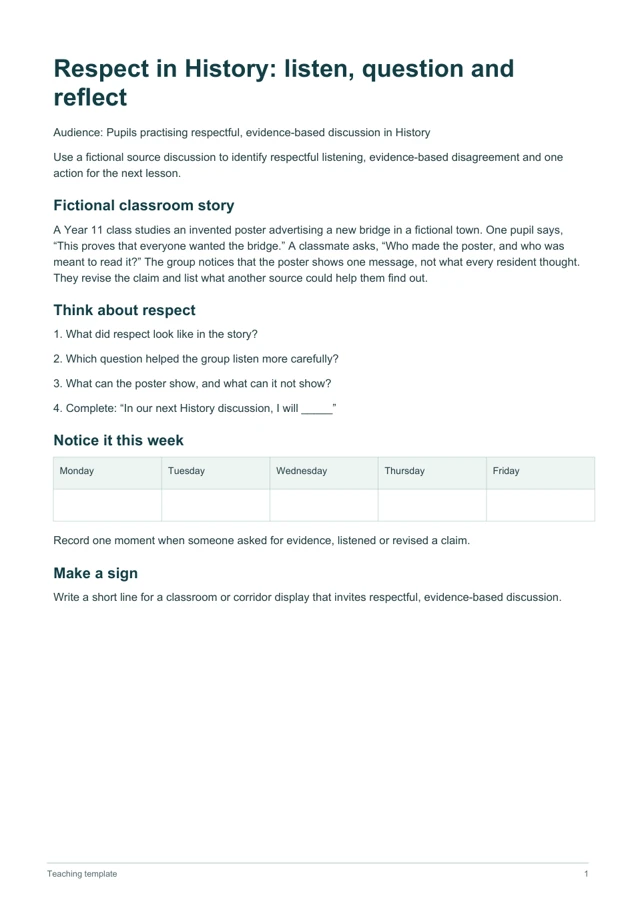
Respect in History: listen, question and
reflect
Audience: Pupils practising respectful, evidence-based discussion in History
Use a fictional source discussion to identify respectful listening, evidence-based disagreement and one
action for the next lesson.
Fictional classroom story
A Year 11 class studies an invented poster advertising a new bridge in a fictional town. One pupil says,
“This proves that everyone wanted the bridge.” A classmate asks, “Who made the poster, and who was
meant to read it?” The group notices that the poster shows one message, not what every resident thought.
They revise the claim and list what another source could help them find out.
Think about respect
1. What did respect look like in the story?
2. Which question helped the group listen more carefully?
3. What can the poster show, and what can it not show?
4. Complete: “In our next History discussion, I will _____”
Notice it this week
Monday
Tuesday
Wednesday
Thursday
Friday
Record one moment when someone asked for evidence, listened or revised a claim.
Make a sign
Write a short line for a classroom or corridor display that invites respectful, evidence-based discussion.
A teaching sequence
Use a fictional source discussion to identify respectful listening, evidence-based disagreement and one action for the next lesson.
Notice respectful discussion actions
Identify what respect looks and sounds like in the discussion.
What did pupils say or do that allowed the first claim to be reconsidered?
Check what the fictional poster can show
Name the source detail that made the group reconsider its first claim.
Why does one poster not establish what every resident thought?
Choose a next-discussion action
Write one small action for the next History discussion.
What will you ask, listen for or check in the next History discussion?
Record a respectful moment this week
Notice one example of respectful listening from Monday to Friday.
Which actual listening, evidence question or revised claim did you notice?
Before you teach
Look for the thinking behind an answer, choose the support your class needs and leave room for an independent response.
What to look for
A supported response might say, “They asked who made the poster and changed a claim that went beyond it.” Ask, “How did listening to evidence change the group's answer?”
Give a little support
Offer the frames “I heard you say _____” and “Which source detail supports that?” Pupils may draw or dictate a response.
Take the idea further
Design a corridor sign that links respectful disagreement with a useful History question.
Things to keep in mind
The poster and discussion are fictional. They make no claim about a real historical event or what a real group believed.
Keep the idea. Make it yours.
Bring your topic, learning goal and class context to PLAI™, then review what you create.
Ideas to try with your class
Sample teaching perspectives on what to try, what to adapt and what to watch for.
Meet The Creators
Meet the creators whose teaching interests connect with this template. Find an approach to try with your class.

Helena Marsh
Time is limited, so I want to remove tasks that do not help and give staff space to concentrate on the work that matters.
Meet the creator
Dr Ruth Kavanagh
I keep Year 11 History teaching in my week so leadership stays connected to pupils’ explanations, alongside clear reporting that distinguishes classroom evidence from cohort summaries.
Meet the creator
Open Book Pause
The fictional poster discussion turns on one overbroad claim, “everyone wanted the bridge”, and a peer’s question about who made the poster and for whom. Pupils then identify what the poster can and cannot show.
Pocketful of Stories
This one-page reflection joins respectful talk with source criticism: listen, ask about authorship and intended audience, revise a claim and name further evidence. The Monday-to-Friday tracker carries the discussion norm into later History lessons.
Paperclip Perspective
The four questions give a pupil several entry points, from naming a respectful action to completing one next-step sentence. A teacher can discuss the fictional poster first so pupils practise the evidence distinction without needing a real disputed issue.
Extra Page
The bridge and poster are invented, so they cannot support a claim about actual residents’ views. Keep the classroom sign focused on evidence-led disagreement and avoid using the weekly log to rank pupils’ behaviour.