
Study and learning skills
Research planning and notes
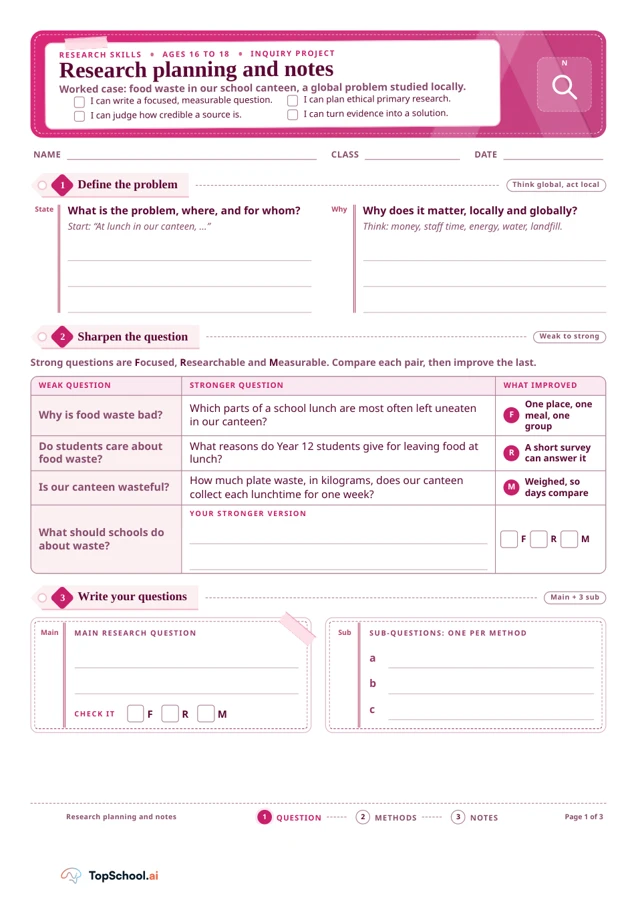
Plan a small inquiry into food waste at school: sharpen a research question, choose methods, check ethics and sources, take notes, and turn evidence into a proposal. Worked rows show the level of detail expected without supplying findings for the class.
Read the material
Plan a small inquiry into food waste at school: sharpen a research question, choose methods, check ethics and sources, take notes, and turn evidence into a proposal. Worked rows show the level of detail expected without supplying findings for the class.
Activity. Use the preview for diagrams and layout.
Page 1
NAME
CLASS
DATE
Think global, act local
Weak to strong
Strong questions are Focused, Researchable and Measurable. Compare each pair, then improve the last.
WEAK QUESTION
STRONGER QUESTION
WHAT IMPROVED
Why is food waste bad?
Which parts of a school lunch are most often left uneaten
in our canteen?
F
One place, one
meal, one
group
Do students care about
food waste?
What reasons do Year 12 students give for leaving food at
lunch?
R
A short survey
can answer it
Is our canteen wasteful?
How much plate waste, in kilograms, does our canteen
collect each lunchtime for one week?
M
Weighed, so
days compare
What should schools do
about waste?
YOUR STRONGER VERSION
F
R
M
Main + 3 sub
Research planning and notes
1
QUESTION
2
METHODS
3
NOTES
RESEARCH SKILLS
AGES 16 TO 18
INQUIRY PROJECT
Research planning and notes
Worked case: food waste in our school canteen, a global problem studied locally.
I can write a focused, measurable question.
I can plan ethical primary research.
I can judge how credible a source is.
I can turn evidence into a solution.
N
Define the problem
1
What is the problem, where, and for whom?
Start: “At lunch in our canteen, ...”
State
Why does it matter, locally and globally?
Think: money, staff time, energy, water, landfill.
Why
Sharpen the question
2
Write your questions
3
MAIN RESEARCH QUESTION
CHECK IT
F
R
M
Main
SUB-QUESTIONS: ONE PER METHOD
a
b
c
Sub
Page 1 of 3
Page 2
Model row first
Primary data: you collect it. Consent: people agree, knowing why. Anonymity: no names.
METHOD
WHAT I WILL COLLECT, HOW AND WHEN
ETHICS CHECK
Weigh plate
waste for one
week
Model
Weigh the plate-waste bin after each lunch, Monday to
Friday, on the same scales. Record kilograms in a daily
table, with that day's menu.
Catering manager's
permission first. No pupils
named or photographed.
Short survey
8 to 10 questions
Consent
Anonymous
Can stop
Interview with
catering staff
About 15 minutes
Consent
Anonymous
Can stop
Secondary research
Secondary data: others published it. Log each source; tick the checks it passes.
W
Who wrote it? An
expert?
D
Date: recent
enough?
E
Evidence: data
shown?
P
Purpose: fair, not
selling?
C
Cross-check: others
agree?
NO.
SOURCE: TITLE, AUTHOR OR ORGANISATION, WHERE FOUND
W
D
E
P
C
VERDICT
S1
A supermarket blog post, “Ten ways to waste less food”, found
online
Y
Y
N
N
Y
Use with care:
it also sells
S2
S3
S4
Model rows are examples, not real data
1
QUESTION
2
METHODS
3
NOTES
RESEARCH SKILLS
AGES 16 TO 18
METHODS AND SOURCES
Collect evidence fairly
Plan primary research
4
Write a fair survey question
5
LEADING OR FAIR?
LEADING
“Don't you agree that wasting food is wrong?”
It
pushes people to say yes.
FAIR
“How often do you leave food on your plate at lunch?”
Never, sometimes, often, always.
Ask why students leave food. Add
answer options.
Your
turn
Source log
6
Page 2 of 3
Page 3
Own words only
One point per row. Close the source first, so the words are yours. Trust: H high, M medium, L low.
NO.
KEY POINT IN MY OWN WORDS
PAGE OR LINK
RELIABILITY
S1
Offering smaller portions, with seconds if wanted, can mean less
food is scraped into the bin.
Tip 3 on the
post
M: seller's site, no
data shown
H
M
L
H
M
L
H
M
L
Two actions, each with a date.
1
2
Judge it on 3 criteria
IMPACT
What changes? How measured?
COST
Money, time, effort.
WHO ACTS
Who agrees? Who does it?
Research planning and notes
1
QUESTION
2
METHODS
3
NOTES
RESEARCH SKILLS
AGES 16 TO 18
NOTES AND SOLUTION
From notes to a solution
Take notes
7
Pull it together
8
Where do your sources and your own data agree or
disagree? Why?
“Most sources suggest ... but our canteen data shows ...”
Link
Next steps
9
Propose a solution
10
MY SOLUTION, AND THE EVIDENCE THAT SUPPORTS IT
Idea
Page 3 of 3
A teaching sequence
Write a focused, researchable and measurable question; plan primary methods with consent and anonymity in mind; judge sources; take notes in pupils’ own words; and propose an evidence-linked action.
Focus a researchable question
Improve a broad question by naming one setting, group, time or measurable outcome; use the F, R and M prompts, then write a main question and a sub-question for each method. Decide what to collect, how and when.
Which setting, group, time or measurable outcome makes the question manageable?
Agree ethical methods before collecting
Before primary research, agree permission, informed consent, anonymity, stopping choices and school procedures with a responsible adult. Choose a fair survey question and response options that do not lead participants.
Have permission, consent, stopping choices and school procedures been agreed?
Log, check and paraphrase sources
Log secondary sources and check their producer, date, evidence, purpose and agreement with other sources. Close each source before writing a key point in pupils’ own words; rate reliability and note a page or link.
What producer, date and evidence support the reliability judgement?
Compare evidence and propose actions
Compare where sources and collected data agree or differ, then propose two dated actions and consider impact, cost and who needs to act.
Which finding supports the dated action, cost and responsible role?
Before you teach
Look for the thinking behind an answer, choose the support your class needs and leave room for an independent response.
What to look for
Check that the main question can be answered with the methods available and that every method has a clear permission or consent plan. In notes, look for paraphrase rather than copied wording. Ask pupils to show which source or observation supports the proposed action.
Give a little support
Complete one F, R and M check together. Give pupils a question frame that names place, group and measure. Offer a prepared source set and a note-taking grid, and accept a spoken explanation before written notes. A teacher can model consent language using a fictional participant.
Take the idea further
Ask pupils to compare two sources that disagree, explain how method or purpose could account for the difference, and identify one improvement to the proposed study. They can add a clear measure and review date to each action.
Things to keep in mind
This is a planning resource, not an approved research protocol. Do not collect identifiable, sensitive or unnecessary data. Pupil surveys, interviews, photographs, food handling and weighing school waste require school approval and appropriate consent, supervision and hygiene arrangements. The sample blog is explicitly a model source, not evidence about this canteen.
Keep the idea. Make it yours.
Bring your topic, learning goal and class context to PLAI™, then review what you create.
Ideas to try with your class
Sample teaching perspectives on what to try, what to adapt and what to watch for.
Meet The Creators
Meet the creators whose teaching interests connect with this template. Find an approach to try with your class.
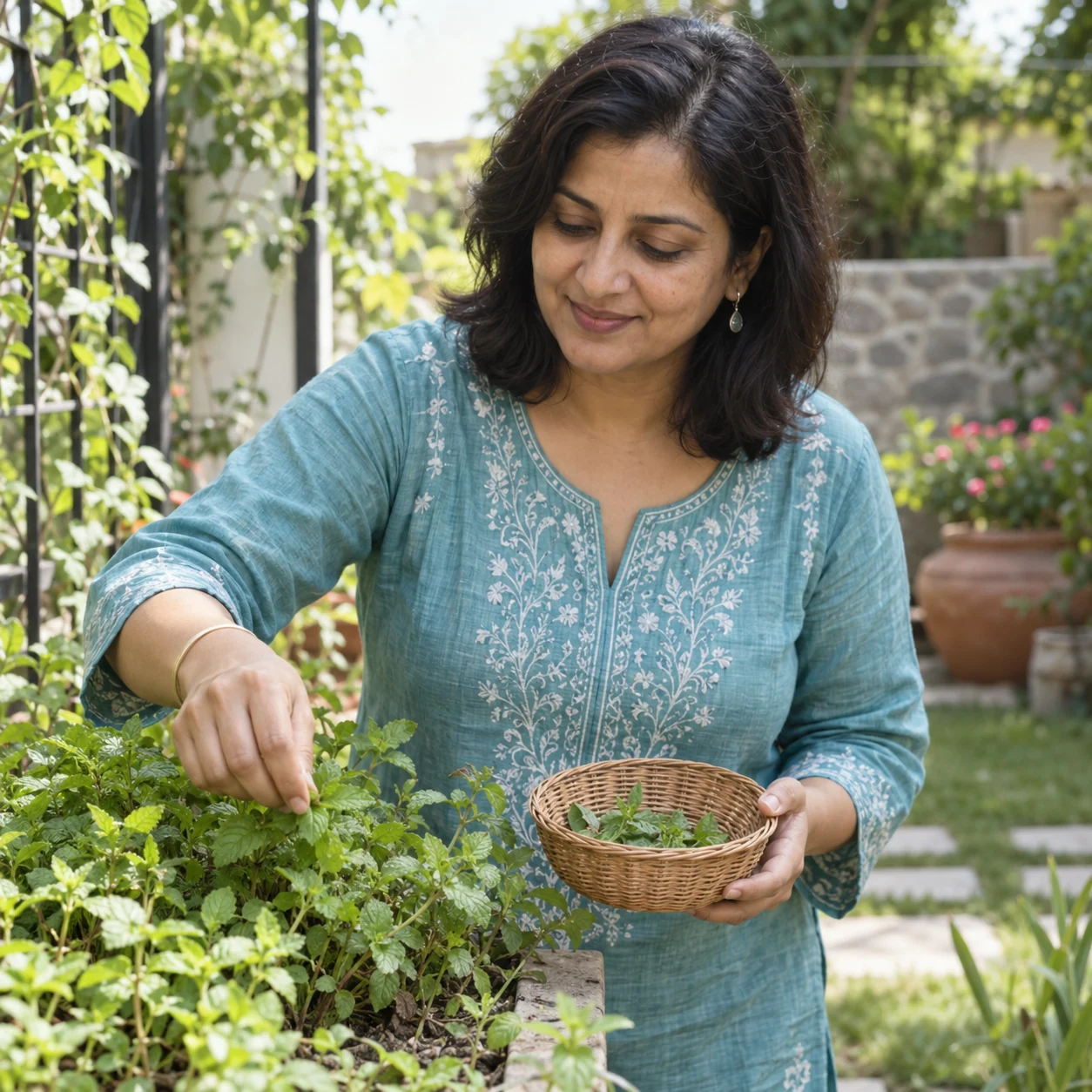
Priya Menon
I ask sixth-form English Literature pupils to support interpretations with details, consider another reader’s view and develop thoughtful responses as they take more responsibility for their reading.
Meet the creator
Kanya Buranasiri
I teach research through source comparison and evidence checks, asking pupils who produced information, how it answers their question and what limitations they need to record.
Meet the creator
One More Question
This three-page research planner contrasts weak and stronger questions, including food waste in a school canteen, then prompts pupils to plan a primary method, assess sources, take notes in their own words and propose an action linked to evidence.
Kind Check-In
The focused, researchable and measurable criteria make question quality inspectable. Examples also connect a question to a practical method, while consent and anonymity prompts bring ethics into the planning stage.
Bright Idea Break
Have pupils refine one question before choosing a method and identify whose consent is needed. Model separating a source note from a paraphrase so the final action can be traced back to evidence.
Pocketful of Stories
A worksheet cannot itself provide consent, anonymity or data protection. Review the proposed survey or observation under school policy, avoid collecting unnecessary personal data and check sources before acting on a finding.