
Music and performing arts
Rehearsal and practice log
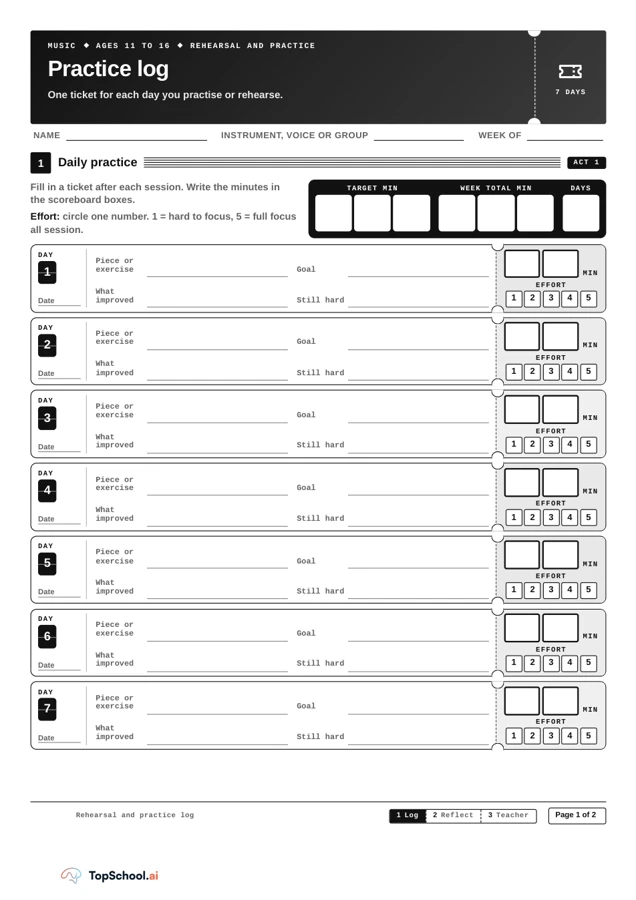
Track up to seven practice sessions with minutes, effort, a piece or exercise, a goal and a reflection on what improved or remains hard. A second page supports weekly review, slow-practice strategies and a target for the next lesson.
Read the material
Track up to seven practice sessions with minutes, effort, a piece or exercise, a goal and a reflection on what improved or remains hard. A second page supports weekly review, slow-practice strategies and a target for the next lesson.
Shared activity record. Use the preview for diagrams and layout.
Page 1
NAME
INSTRUMENT, VOICE OR GROUP
WEEK OF
1
Daily practice
ACT 1
Fill in a ticket after each session. Write the minutes in
the scoreboard boxes.
Effort: circle one number. 1 = hard to focus, 5 = full focus
all session.
TARGET MIN
WEEK TOTAL MIN
DAYS
DAY
Date
Piece or
exercise
Goal
What
improved
Still hard
DAY
Date
Piece or
exercise
Goal
What
improved
Still hard
DAY
Date
Piece or
exercise
Goal
What
improved
Still hard
DAY
Date
Piece or
exercise
Goal
What
improved
Still hard
DAY
Date
Piece or
exercise
Goal
What
improved
Still hard
DAY
Date
Piece or
exercise
Goal
What
improved
Still hard
DAY
Date
Piece or
exercise
Goal
What
improved
Still hard
Rehearsal and practice log
1 Log
2 Reflect
3 Teacher
MUSIC
AGES 11 TO 16
REHEARSAL AND PRACTICE
Practice log
One ticket for each day you practise or rehearse.
7 DAYS
1
MIN
EFFORT
1
2
3
4
5
2
MIN
EFFORT
1
2
3
4
5
3
MIN
EFFORT
1
2
3
4
5
4
MIN
EFFORT
1
2
3
4
5
5
MIN
EFFORT
1
2
3
4
5
6
MIN
EFFORT
1
2
3
4
5
7
MIN
EFFORT
1
2
3
4
5
Page 1 of 2
Page 2
NAME
WEEK OF
LEARNING GOAL
Practise with a purpose, then reflect and plan.
2
Weekly reflection
ACT 2
Which session helped you most? Use your minutes, effort and "what improved" to explain.
Look at "still hard". What kept coming back?
3
Slow practice menu
ACT 3
Pick a strategy for a tricky passage. Try it, then tick and circle on its stub.
A
Chunking
1. Work in chunks of 2 to 4 bars.
2. Secure one, then join it to the next.
B
Slow then faster
1. Play slowly, with no mistakes.
2. Right 3 times? Go a little faster.
C
Repeat the tricky bar
1. Play only the notes that go wrong.
2. Add the bars either side to join up.
D
Record and listen
1. Record one short section.
2. Listen with the music. Note one fix.
4
Target for next lesson
FINALE
My target (what, which bars, how well):
Strategy (A, B, C or D) and which bars:
Tutor check
Target met?
Yes
Partly
Not yet
Rehearsal and practice log
1 Log
2 Reflect
3 Teacher
MUSIC
PRACTICE LOG
Look back, plan ahead
SUCCESS CRITERIA
I can set a clear, small goal for each session.
I can choose a strategy that fits the problem.
I can use my log to set my next target.
TRIED
HELPED?
Yes
No
TRIED
HELPED?
Yes
No
TRIED
HELPED?
Yes
No
TRIED
HELPED?
Yes
No
TEACHER OR TUTOR INITIALS
Page 2 of 2
Page 1
Rehearsal and practice log
Teacher companion
Music | Pupils aged 11 to 16
Use with the exact 2-page original file. Keep pupil or staff activity pages separate from this teacher companion.
When to use it
Use this alongside music practice or rehearsal over a week. Help pupils set a small, specific
goal for each session, then use the reflection page to consider what helped. The strategies are
options to try on a difficult passage, not a prescribed routine for every musician.
Purpose
Record practice, choose a strategy for a musical challenge and set a specific target for the
next lesson or rehearsal.
Start here
Agree a realistic practice target and identify the instrument, voice or group. Explain the effort
scale and how pupils will use the minutes and reflections.
A teaching sequence
1. After each session, complete a ticket with the date, piece or exercise, goal, minutes, effort,
what improved and what remains hard.
2. At the end of the week, review the entries and choose which session helped most, using the
recorded details.
3. Select a strategy for a tricky passage: chunking, slow then faster, repeating a bar or
recording and listening.
4. Write a next-lesson target that names what to practise, which bars and how to judge it; use
the tutor check if appropriate.
Checking guidance
Look for a target that identifies a piece or passage and a way to check progress. Ask, “Which
practice strategy did you try, and what did you notice?” If the pupil records only minutes,
invite them to add one observation about the music.
A specific target names a passage, strategy and check: “Practise bars 9-12 slowly, then listen
for an even pulse.” Minutes and effort ratings alone do not show what improved.
Support
Use one practice ticket together and write a short goal such as a named bar or phrase. A tutor
can suggest a strategy for the difficulty, then let the pupil choose whether to try it.
Take it further
Ask pupils to compare two strategies for the same passage and describe which gave them a
useful observation. They can revise the next target using a specific bar, tempo or musical
detail agreed with their tutor.
Things to keep in mind
The effort scale is a self-rating, not a measure of practice quality or musical progress. Use the
strategy menu as optional guidance alongside the pupil’s instrument teacher.
Rehearsal and practice log
Teacher companion | Page 1
A teaching sequence
Record practice, choose a strategy for a musical challenge and set a specific target for the next lesson or rehearsal.
Record each practice session
After each session, complete a ticket with the date, piece or exercise, goal, minutes, effort, what improved and what remains hard.
What goal, minutes and specific observation belong to this session?
Review the week's useful practice
At the end of the week, review the entries and choose which session helped most, using the recorded details.
Which recorded detail supports the session you found helpful?
Choose a strategy for a passage
Select a strategy for a tricky passage: chunking, slow then faster, repeating a bar or recording and listening.
Would chunking, slow practice, repetition or listening address this difficulty?
Set a precise next-lesson target
Write a next-lesson target that names what to practise, which bars and how to judge it; use the tutor check if appropriate.
Which bars, strategy and checking point will you discuss with the tutor?
Before you teach
Look for the thinking behind an answer, choose the support your class needs and leave room for an independent response.
What to look for
Look for a target that identifies a piece or passage and a way to check progress. Ask, “Which practice strategy did you try, and what did you notice?” If the pupil records only minutes, invite them to add one observation about the music. A specific target names a passage, strategy and check: “Practise bars 9-12 slowly, then listen for an even pulse.” Minutes and effort ratings alone do not show what improved.
Give a little support
Use one practice ticket together and write a short goal such as a named bar or phrase. A tutor can suggest a strategy for the difficulty, then let the pupil choose whether to try it.
Take the idea further
Ask pupils to compare two strategies for the same passage and describe which gave them a useful observation. They can revise the next target using a specific bar, tempo or musical detail agreed with their tutor.
Things to keep in mind
The effort scale is a self-rating, not a measure of practice quality or musical progress. Use the strategy menu as optional guidance alongside the pupil’s instrument teacher.
Keep the idea. Make it yours.
Bring your topic, learning goal and class context to PLAI™, then review what you create.
Another starting point
Explore a different teaching task from this selection.
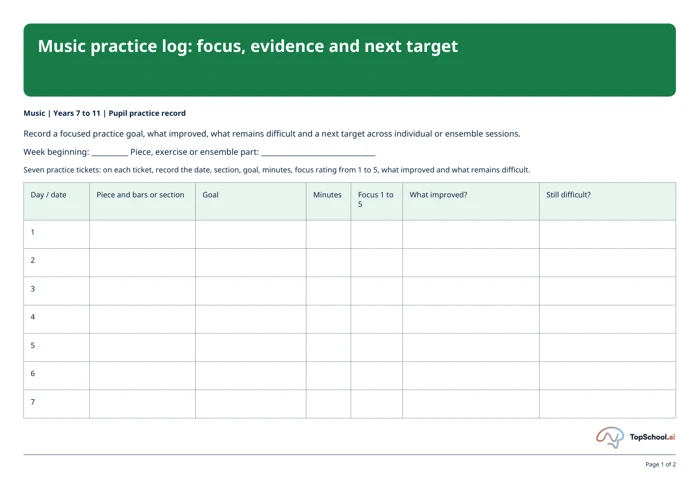
Music practice log: focus, evidence and next target
Choose a piece or exercise and a small section to practise; write a goal that can be heard or observed.
Explore resourceIdeas for using this resource
Sample teaching perspectives on what to try, what to adapt and what to watch for.
Meet The Creators
Meet the creators whose teaching interests connect with this template. Find an approach to try with your class.
Amara Nwosu
I get pupils playing early in a mixed-experience ensemble, using shared rhythm and sound to make participation meaningful before introducing notation to record what they are doing.
Meet the creator
Owen Beddows
I make composition feedback specific enough for students to choose their next musical step independently, while ensemble work gives them opportunities to practise and play with others.
Meet the creator
Book and Biscuit
This two-page practice log has daily tickets for date, piece or exercise, goal, minutes, what improved and what remains hard, plus an effort rating and weekly totals. It asks pupils to choose a next target.
Kind Check-In
The repeated daily entries can make a practice routine visible across the week and connect minutes to a specific musical goal. Recording what remains difficult keeps the log from treating practice time alone as progress.
Storytime Sidekick
Help the pupil choose one manageable passage or technique to focus on, then complete the ticket after practice. Use the effort scale as a prompt for reflection rather than a judgement of character.
Planning List
A practice log records self-reported sessions and does not verify quality, duration or musical progress. Set a realistic target with the pupil and use an observed performance or recording separately when evidence of change is needed.