
Wellbeing and personal development
Recognition and reward tracker
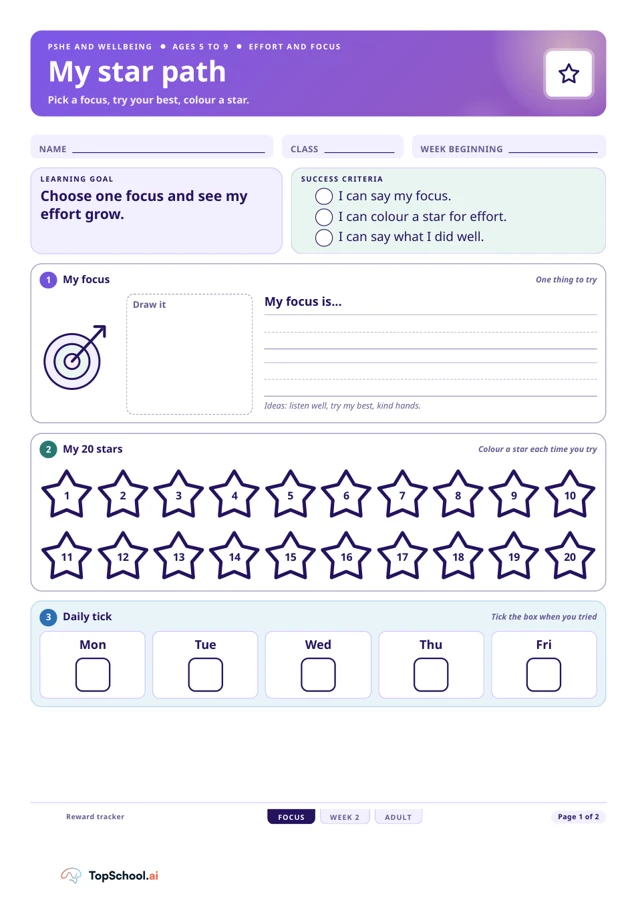
Choose one focus, notice when effort is made and reflect on what went well. A second page helps pupils choose a focus for another week, while an adult fills in possible reward choices. Use the record during a weekly check-in.
Read the material
Choose one focus, notice when effort is made and reflect on what went well. A second page helps pupils choose a focus for another week, while an adult fills in possible reward choices. Use the record during a weekly check-in.
Complete resource. Use the preview for diagrams and layout.
Page 1
NAME
CLASS
WEEK BEGINNING
LEARNING GOAL
Choose one focus and see my
effort grow.
SUCCESS CRITERIA
I can say my focus.
I can colour a star for effort.
I can say what I did well.
Reward tracker
FOCUS
WEEK 2
ADULT
Page 1 of 2
PSHE AND WELLBEING
AGES 5 TO 9
EFFORT AND FOCUS
My star path
Pick a focus, try your best, colour a star.
1
My focus
One thing to try
My focus is...
Ideas: listen well, try my best, kind hands.
Draw it
2
My 20 stars
Colour a star each time you try
1
2
3
4
5
6
7
8
9
10
11
12
13
14
15
16
17
18
19
20
3
Daily tick
Tick the box when you tried
Mon
Tue
Wed
Thu
Fri
Page 2
Reward tracker
FOCUS
WEEK 2
ADULT
Page 2 of 2
PSHE AND WELLBEING
AGES 5 TO 9
WEEK TWO
My next week
1
My new focus
Same one, or a new one
2
My reward choice
An adult fills the list
Adult ideas: choose a game, be line leader, read a story with a friend.
3
Daily tick
Tick the box when you tried
Mon
Tue
Wed
Thu
Fri
4
What I did well
Finish the sentences
I did well when...
I am proud because...
Next time I will...
Well done!
I tried hard at
Signed
A teaching sequence
Name one chosen focus, notice attempts during the week and describe something the pupil did well towards an agreed next step.
Choose a focus and mark an attempt
Complete the focus and draw-it sections, then use one star when the pupil tries the chosen focus.
What did the pupil try before colouring a star?
Tick effort during the week
Tick the daily box when the pupil has tried, not only when they have met a target.
Does this tick record trying rather than only meeting the target?
Reflect on one specific moment
At the end of the week, use the reflection prompts to name something done well and a next step.
What did the pupil do well, and what would they like to try next?
Agree next week's focus
Choose whether to keep or change the focus for the next week; an adult completes the reward-choice list if the class uses it. Keep the review brief and focused on effort.
Would the pupil prefer to keep the focus or change it?
Before you teach
Look for the thinking behind an answer, choose the support your class needs and leave room for an independent response.
What to look for
Look for the pupil to name their focus and describe an attempt or something they are proud of. Ask, “What did you try today?” If the pupil did not meet the focus, reflect on what made it difficult and whether the focus should change.
Give a little support
Choose one clear and achievable focus, and let the pupil draw it or say it aloud. An adult can scribe the pupil's words and recognise effort without making the reward conditional on a particular performance.
Take the idea further
Invite the pupil to compare two weeks and explain whether the focus still matters to them. They can choose a new small step or describe another way to notice their effort.
Things to keep in mind
A star tracker is a reflection aid, not an assessment or guarantee of behaviour change. Keep the focus pupil-centred and avoid ranking or publicly comparing pupils. Ensure any reward is appropriate and does not replace ordinary encouragement or support.
Keep the idea. Make it yours.
Bring your topic, learning goal and class context to PLAI™, then review what you create.
Ideas for using this resource
Sample teaching perspectives on what to try, what to adapt and what to watch for.
Meet The Creators
Meet a creator whose teaching interests connect with this template.
Tea Break Notes
The two-page tracker for ages 5 to 9 asks a pupil to choose one focus, name something to try, colour a star for effort across a week and describe what went well. Suggested focuses include listening, trying and kind hands.
Clear Example
The track links recognition to a pupil-selected next step rather than a broad behaviour score. Recording what the child did well can make an effort visible for a short adult conversation.
Thoughtful Pause
Agree a small, observable focus with the pupil and explain what counts as an attempt before the week begins. Offer drawing or oral reflection for the “what I did well” prompt if writing is a barrier.
Chalk Dust & Checklists
Stars record adult-pupil judgements about a chosen focus; they are not a diagnostic or objective measure of motivation. Avoid public comparison, and check that recognition remains encouraging if a day is missed.