
Maths
What comes next? Early-years number and pattern
Continue shape patterns, make a pattern of your own and count pictured groups once. Adult prompts support young children who notice the repeat by speaking, pointing or marking. The sheet is for early-years practice.
Say the pattern, then draw what comes next. The empty spaces are part of the pupil task.
Read the complete materialRead the material
Continue shape patterns, make a pattern of your own and count pictured groups once. Adult prompts support young children who notice the repeat by speaking, pointing or marking. The sheet is for early-years practice.
Shared activity record. Use the preview for diagrams and layout.
Page 1
NAME
DATE
LEARNING GOAL
Spot a pattern and say what
comes next.
I CAN ...
say a pattern out loud.
draw what comes next.
see how many dots.
1
Pattern trains
READ ALOUD
Say each pattern. Draw what comes next in the empty boxes.
2
Make your own train
Choose two shapes. Draw your own pattern. Say it to a grown-up.
Number and pattern
1
PATTERNS
2
DOTS
3
GUIDE
MATHS
AGES 4 TO 5
PAT TERNS AND NUMBERS
What comes next?
Finish the pattern trains, then play with dots and numbers.
LEVEL
1
LEVEL
2
LEVEL
3
Page 1 of 2
Page 2
3
Dice match
READ ALOUD
How many dots? Draw a line to the number. One is done for you.
4
How many?
READ ALOUD
Count the pictures. Touch each one. Circle the number.
a
How many apples?
b
How many stars?
c
How many fish?
d
How many flowers?
e
How many hearts?
f
How many balls?
Number and pattern
1
PATTERNS
2
DOTS
3
GUIDE
MATHS
AGES 4 TO 5
SEEING HOW MANY
Dots and numbers
1
2
3
4
5
6
1
3
5
5
6
8
2
3
4
6
7
9
8
9
10
6
8
10
Page 2 of 2
Page 1
What comes next? Early-years number and
pattern
Teacher companion
Mathematics | Pupils aged 4 to 5 with an adult reading prompts
Use with the exact 2-page original file. Keep pupil or staff activity pages separate from this teacher companion.
When to use it
Use the activity with an adult during early number or pattern practice. Read the prompts
aloud and let the child point, say, draw or count at a comfortable pace.
Purpose
Recognise a repeating pattern, predict what comes next and connect counted quantities with
numerals.
Start here
Say each pattern aloud while pointing to its items, then ask the child what may come next.
A teaching sequence
1. Complete each pattern train by noticing what repeats, then draw the next item in the
empty box.
2. Choose two shapes and make a pattern of your own; say it aloud to a grown-up.
3. Match each dice pattern to a numeral, then count each group of pictures once.
4. Circle the numeral that matches each total and describe how you counted. Ask, “What part
repeats?” Have the child point to the unit, then predict the next item. Try another pattern.
Checking guidance
Pattern train completions: level 1 square, circle; level 2 sun, moon; level 3 triangle, star. Ask
the child to identify the repeating unit rather than copy a neighbour.
Dice pictures from left to right match 3, 1, 5, 2, 6, 4. Picture totals a-f: 3 apples, 5 stars, 4 fish,
7 flowers, 8 hearts, 10 balls.
The child’s own train has no single required pattern. Check that a chosen unit repeats
consistently and invite the child to say or point to that unit.
Support
Use manipulatives or point to each shape while saying its name. Begin with the simplest
pattern and offer a verbal answer, drawing or adult scribing rather than requiring all tasks at
once. Give the child time to inspect the whole pattern before naming the part that repeats. If
an answer is unclear, ask the child to point to the repeated shapes or count the pictures again
with an adult.
Take it further
Ask the child to invent a longer pattern and explain its repeating part, then find a matching
pattern in the classroom. Keep the extension playful rather than timed. Try the same pattern
with objects such as blocks or counters, then invite the child to continue it using a different
colour or shape.
Things to keep in mind
These short activities support early pattern and counting practice rather than formal
assessment. Check the visual matches between dot patterns and numerals, and use a calm
pace that lets each child count once.
What comes next? Early-years number and pattern
Teacher companion | Page 1
A teaching sequence
Recognise a repeating pattern, predict what comes next and connect counted quantities with numerals.
Say the pattern, then draw what comes next. The empty spaces are part of the pupil task.
Read the complete materialFind the repeating part
Complete each pattern train by noticing what repeats, then draw the next item in the empty box.
What part repeats before the empty box?
Make and say a pattern
Choose two shapes and make a pattern of your own; say it aloud to a grown-up.
Can the grown-up predict your next shape from the unit you repeat?
Match dots and numerals
Match each dice pattern to a numeral, then count each group of pictures once.
Which numeral names the dots you can see?
Count each picture once
Circle the numeral matching each total. Ask the child to touch each picture once and explain how they kept count.
How did you keep track of the pictures you had counted?
Before you teach
Look for the thinking behind an answer, choose the support your class needs and leave room for an independent response.
What to look for
Pattern train completions: level 1 square, circle; level 2 sun, moon; level 3 triangle, star. Ask the child to identify the repeating unit rather than copy a neighbour. Dice pictures from left to right match 3, 1, 5, 2, 6, 4. Picture totals a-f: 3 apples, 5 stars, 4 fish, 7 flowers, 8 hearts, 10 balls. The child’s own train has no single required pattern. Check that a chosen unit repeats consistently and invite the child to say or point to that unit.
Give a little support
Use manipulatives or point to each shape while saying its name. Begin with the simplest pattern and offer a verbal answer, drawing or adult scribing rather than requiring all tasks at once. Give the child time to inspect the whole pattern before naming the part that repeats. If an answer is unclear, ask the child to point to the repeated shapes or count the pictures again with an adult.
Take the idea further
Ask the child to invent a longer pattern and explain its repeating part, then find a matching pattern in the classroom. Keep the extension playful rather than timed. Try the same pattern with objects such as blocks or counters, then invite the child to continue it using a different colour or shape.
Things to keep in mind
These short activities support early pattern and counting practice rather than formal assessment. Check the visual matches between dot patterns and numerals, and use a calm pace that lets each child count once.
Keep the idea. Make it yours.
Bring your topic, learning goal and class context to PLAI™, then review what you create.
Another starting point
Explore a different teaching task from this selection.
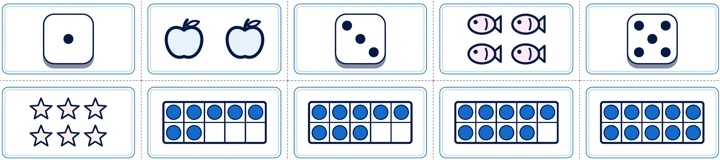
Quantity matching cards
Choose the numbers 1 to 5 first. Point to one numeral, say its number name and place that many counters in its ten frame, beginning with the top row.
Explore resourceIdeas for using this resource
Sample teaching perspectives on what to try, what to adapt and what to watch for.
Meet The Creators
Meet a creator whose teaching interests connect with this template.

Tea Break Notes
The two pages move from repeating pattern trains to making a two-shape pattern, matching dice dots to numerals and counting pictured groups. The instruction to touch each item before circling a number makes the count action explicit.
Helpful Highlighter
Saying a pattern aloud before predicting what comes next links recognition with quantity. The levels offer a progression from visual repetition to counting groups of apples, stars, fish and other pictures.
Book and Biscuit
Read the pattern together and let the child draw the next shape before moving to number tasks. Touch-counting each picture gives an adult a way to notice whether a child is matching one spoken number to one item.
Calm Table
The sheet offers brief practice, not a complete assessment of number or pattern understanding. If a child’s answer differs, ask them to show how they counted or saw the repeat rather than treating the circled numeral alone as evidence.