
History and social studies
Psychology debate: does music help recall?
For Years 9 to 13 Psychology pupils, build and challenge an evidence-based claim about memory while identifying what a small fictional demonstration cannot establish.
Read the material
For Years 9 to 13 Psychology pupils, build and challenge an evidence-based claim about memory while identifying what a small fictional demonstration cannot establish.
Pupil worksheet. Use the preview for diagrams and layout.
Page 1
Psychology debate: does music help recall?
Pupil activity
Audience: Years 9 to 13 Psychology pupils
Build and challenge an evidence-based claim about memory while identifying what a small fictional
demonstration cannot establish.
Fictional demonstration
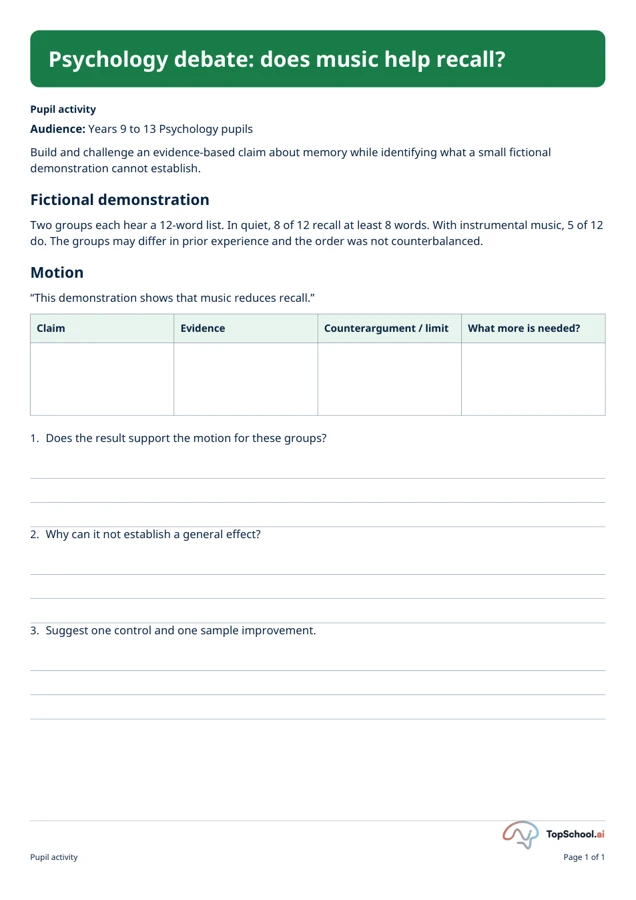
Two groups each hear a 12-word list. In quiet, 8 of 12 recall at least 8 words. With instrumental music, 5 of 12
do. The groups may differ in prior experience and the order was not counterbalanced.
Motion
“This demonstration shows that music reduces recall.”
Claim
Evidence
Counterargument / limit
What more is needed?
1. Does the result support the motion for these groups?
2. Why can it not establish a general effect?
3. Suggest one control and one sample improvement.
Pupil activity
Page 1 of 1
A teaching sequence
Build and challenge an evidence-based claim about memory while identifying what a small fictional demonstration cannot establish.
State a claim about the fictional groups
Write a claim about the two recall scores.
Does your claim remain about these two recorded groups?
Use the supplied counts as evidence
Use the counts as evidence without generalising beyond them.
How do eight of twelve and five of twelve support the claim?
Challenge sample and procedure
Build a counterargument about sample or procedure.
Could prior experience or the unbalanced order offer another explanation?
Qualify the verdict and improve the study
Give a verdict and one improved study control.
What control and sample change would help investigate the question further?
Before you teach
Look for the thinking behind an answer, choose the support your class needs and leave room for an independent response.
What to look for
The fictional result is 8 of 12 versus 5 of 12, but small groups and an unreported order effect limit the conclusion. Ask, “What else could explain the difference?”
Give a little support
Use claim-evidence-limit frames and define recall as words remembered.
Take the idea further
Design a larger, counterbalanced comparison and state what should stay the same.
Things to keep in mind
All results are invented for practice. They do not establish an effect of music on memory or make a claim about real learners.
Keep the idea. Make it yours.
Bring your topic, learning goal and class context to PLAI™, then review what you create.
Ideas to try with your class
Sample teaching perspectives on what to try, what to adapt and what to watch for.
Meet The Creators
Meet a creator whose teaching interests connect with this template.

Pocketful of Stories
The demonstration reports 8 of 12 recalling at least eight words in quiet and 5 of 12 with instrumental music. The questions move from whether this supports the motion to why it cannot establish a general effect.
Tea at Breaktime
The fictional music test reports 8 of 12 pupils recalling at least eight words in quiet and 5 of 12 with instrumental music. Prior experience and the uncounterbalanced order are alternative explanations, so this small group difference cannot establish a general causal effect.
Paperclip Perspective
A comparison table with condition, count, design issue and possible control would make the evidence easier to organise before debate. Pupils can then propose one sample improvement and one control, as the final question requests.
Spare Pencil
This fictional demonstration has only 12 people in each group and notes two design limitations. It cannot show that music generally reduces recall; any extension should improve controls and sampling before making a broader claim.