
Design and technology
Product testing and evaluation
Test a prototype against its specification, ask two users for feedback and use results to evaluate what worked and what could change. The pages include eight design criteria, a product annotation task and a structured evaluation paragraph.
Read the material
Test a prototype against its specification, ask two users for feedback and use results to evaluate what worked and what could change. The pages include eight design criteria, a product annotation task and a structured evaluation paragraph.
Complete resource. Use the preview for diagrams and layout.
Page 1
NAME
CLASS
DATE
LEARNING GOAL
Test a prototype fairly, then judge it using
evidence.
SUCCESS CRITERIA
I can test each specification point and record a result.
I can use results and feedback to evaluate.
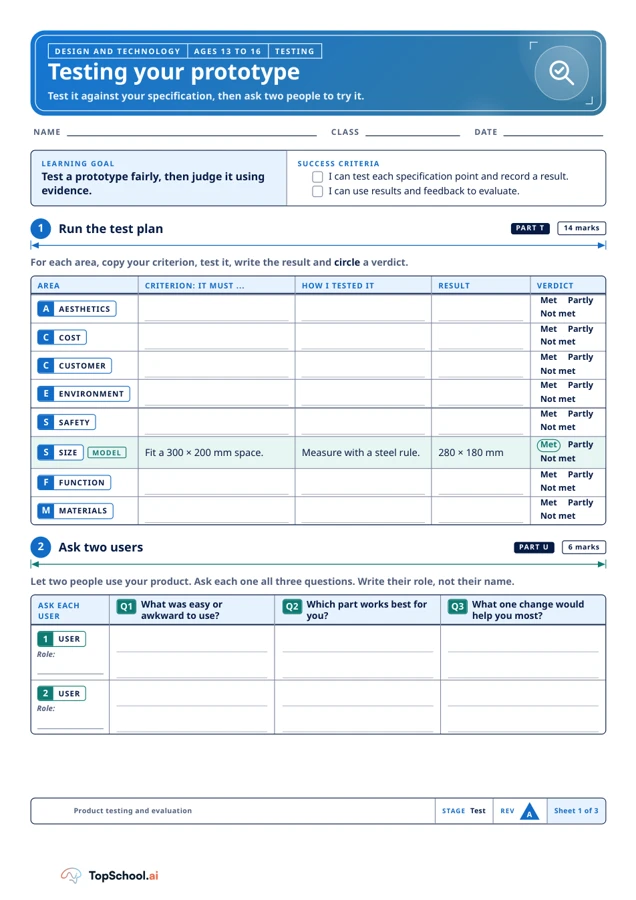
For each area, copy your criterion, test it, write the result and circle a verdict.
AREA
CRITERION: IT MUST ...
HOW I TESTED IT
RESULT
VERDICT
A
AESTHETICS
Met
Partly
Not met
C
COST
Met
Partly
Not met
C
CUSTOMER
Met
Partly
Not met
E
ENVIRONMENT
Met
Partly
Not met
S
SAFETY
Met
Partly
Not met
S
SIZE
MODEL
Fit a 300 × 200 mm space.
Measure with a steel rule.
280 × 180 mm
Met
Partly
Not met
F
FUNCTION
Met
Partly
Not met
M
MATERIALS
Met
Partly
Not met
Let two people use your product. Ask each one all three questions. Write their role, not their name.
ASK EACH
USER
Q1
What was easy or
awkward to use?
Q2
Which part works best for
you?
Q3
What one change would
help you most?
1
USER
Role:
2
USER
Role:
Product testing and evaluation
STAGE Test
REV
Sheet 1 of 3
DESIGN AND TECHNOLOGY
AGES 13 TO 16
TESTING
Testing your prototype
Test it against your specification, then ask two people to try it.
1
Run the test plan
PART T
14 marks
2
Ask two users
PART U
6 marks
A
Page 2
Sketch your finished product. Add three strengths (+) and three
improvements (→) with leaders.
Colour in the stars it earns. Use your
test results.
A
Aesthetics
1
2
3
4
5
C
Cost
1
2
3
4
5
C
Customer
1
2
3
4
5
E
Environment
1
2
3
4
5
S
Safety
1
2
3
4
5
S
Size
1
2
3
4
5
F
Function
1
2
3
4
5
M
Materials
1
2
3
4
5
1 not met at all · 3 partly met · 5 fully met
Write one paragraph. Use all four steps in order, with at least one number from your tests.
1
MET
My product met the ... criterion
because the test showed ...
2
NOT MET
It did not fully meet ... because ...
3
EVIDENCE
User feedback / my result of ... shows
that ...
4
IMPROVE
To improve it, I would ... so that ...
Product testing and evaluation
TESTED BY
SCALE Not to scale
Sheet 2 of 3
DESIGN AND TECHNOLOGY
AGES 13 TO 16
EVALUATION
Evaluate your prototype with evidence
3
Annotate your prototype
6 marks
VIEW A: FINISHED PROTOTYPE (5 MM GRID)
+ STRENGTH (EXAMPLE)
Six pens stand upright
→ IMPROVE (EXAMPLE)
Add a finger notch
4
Rate each area
5
Evaluation paragraph
PART E
8 marks
A teaching sequence
Test a prototype against specified criteria, record results and use evidence from tests and user feedback to justify an evaluation.
Test against a specification point
Copy a criterion into the test table, record how it was tested, note the result and select a verdict.
What method and result support the verdict for this criterion?
Gather permitted user feedback
Ask two users the three printed questions. Record their role rather than their name, as the worksheet directs.
Have you recorded the role and answers without unnecessary personal details?
Annotate and rate through evidence
Annotate a sketch with strengths and improvements, then rate each area using the stated scale.
Which test supports this strength, improvement or star rating?
Write an evidence-based evaluation
Write the evaluation in the order met, not met, evidence and improve, including a test number. Name one design change to test next.
Where does a test number support the proposed next design change?
Before you teach
Look for the thinking behind an answer, choose the support your class needs and leave room for an independent response.
What to look for
Look for a judgement supported by a recorded result or user comment. Ask, “Which test shows that the criterion was met or not met?” If pupils make a broad claim without evidence, return to the specification and identify a result that could support or challenge it.
Give a little support
Complete one test row together and model a measurable result. Let pupils use sentence starters for the evaluation paragraph and choose one area to annotate before adding more. Offer the feedback prompts aloud first.
Take the idea further
Ask pupils to compare user comments with test results and explain where the evidence agrees or differs. They can propose a design change and a follow-up test that would show whether the change addressed the identified issue.
Things to keep in mind
The star scales and categories are prompts, not a validated product standard. Follow school consent and privacy procedures when gathering user feedback, record roles rather than names and avoid unnecessary personal details in the evaluation.
Keep the idea. Make it yours.
Bring your topic, learning goal and class context to PLAI™, then review what you create.
Ideas to try with your class
Sample teaching perspectives on what to try, what to adapt and what to watch for.
Meet The Creators
Meet the creators whose teaching interests connect with this template. Find an approach to try with your class.

Daniel Lee
I teach debugging through working artefacts: pupils compare what they expected with what happened, change one part at a time and explain what they tested and improved.
Meet the creator
Nathan Boateng
When something does not stand up or function as intended, we can ask why, identify a constraint and try another solution.
Meet the creator
Josh Renshaw
The wording has to fit the work underway, whether a student is setting up equipment or following a sequence in a computing task.
Meet the creator
Steven Marsh
I value build logs that capture a design choice, its reason and what a student may reconsider, adapting the record to the evidence each practical or technical task needs.
Meet the creatorPatrick Nkemelu
I use clear scoring rubrics for design-and-build challenges, making criteria visible in advance so student judges can compare entries fairly while allowing different ideas and solutions.
Meet the creator
Coffee Before Copies
This two-page design activity asks pupils to copy a product criterion, record how they tested it, enter the result and judge whether it was met, partly met or not met. Areas include aesthetics, cost, customer and environment.
One More Question
The record links the original specification to a test and a verdict, then asks pupils to evaluate using evidence and feedback. That helps keep an evaluation attached to intended criteria rather than general preference.
Pencil Case Pal
Choose one criterion at a time and agree what result would count as meeting it before testing. Add user feedback beside the observed result so the pupil can distinguish a measurement from an opinion.
Quietly Curious
The sheet cannot establish whether a test is fair unless the criterion and method are clear. Check that each test is safe and suitable for the actual prototype, and avoid treating a single verdict as proof of product quality.