
Science
Words that grow: Frayer model for photosynthesis
Use word parts, a worked producer model and a blank Frayer model to explore photosynthesis vocabulary. Two pupil pages connect definition, characteristics, examples and non-examples, then ask for a sentence and three reasoned judgements. The separate companion gives answers and clarifies the scope of the green-plant examples.
Target wordproducer
- Definition
- An organism that makes its own food. Green plants and algae are producers: they use light energy to make glucose by photosynthesis.
- Green plant examples
- Green plants and the algae in these examples contain chlorophyll in chloroplasts; use light, carbon dioxide and water for photosynthesis.
- Examples
- Grass in a meadow. An oak tree. Seaweed (an alga). Phytoplankton in the sea.
- Non-examples
- Rabbit: eats plants, so it is a consumer.
Mushroom: a fungus that feeds on dead material.
Human: we must eat other organisms.
The worked producer model from page 1. Read all four parts together.
Read the complete materialRead the material
Use word parts, a worked producer model and a blank Frayer model to explore photosynthesis vocabulary. Two pupil pages connect definition, characteristics, examples and non-examples, then ask for a sentence and three reasoned judgements. The separate companion gives answers and clarifies the scope of the green-plant examples.
Pupil worksheet. Use the preview for diagrams and layout.
Page 1
NAME
CLASS
DATE
LEARNING GOAL
I can explain what photosynthesis means
and use the word accurately in science
writing.
SUCCESS CRITERIA
I can split a science word into parts to unlock its meaning.
I can fill all four squares of a Frayer model.
I can judge true or false ideas about plant food, with a reason.
1
Meet the words
Say it, split it, see it
Say each word aloud (capitals show the stressed part), then see how its parts build the meaning.
photosynthesis
SAY foh-toh-SIN-thuh-sis
photo
light
+
synthesis
putting together
From Greek: using light to put together food.
chlorophyll
SAY KLOR-uh-fil
chloro
pale green
+
phyll
leaf
From Greek: the green substance in
leaves that absorbs light.
producer
SAY pruh-DYOO-ser
pro
forward
+
ducere
to lead
From Latin producere, to bring forth:
it makes its own food.
2
A Frayer model, done for you
WORKED MODEL
Read all four squares. Notice that each Non-example says why it does not fit.
O2 out
CO2 in
SCIENCE YOU WILL NEED ON PAGE 2
carbon dioxide
+
water
light energy
chlorophyll
glucose
+
oxygen
It happens in chloroplasts (the dots), which contain green chlorophyll. Most are in leaf cells.
SCIENCE
AGES 11 TO 14
PHOTOSYNTHESIS AND PLANT NUTRITION
Words that grow
Own a science word: what it means, what it is like, what it is not.
D
Definition
An organism that makes its own food. Green plants and
algae are producers: they use light energy to make glucose
by photosynthesis.
C
E
Examples
YES
grass in a meadow
YES
an oak tree
YES
seaweed (an alga)
YES
phytoplankton in the sea
Non-examples
N
NO
rabbit: eats plants, so it is a consumer
NO
mushroom: a fungus that feeds on dead material
NO
human: we must eat other organisms
TARGET WORD
producer
noun
Green plant examples
Green plants and the algae in these examples:
contain chlorophyll in chloroplasts; use light,
carbon dioxide and water for photosynthesis.
Pupil activity | Page 1 of 2
Page 2
3
Example or non-example?
4 marks
Is photosynthesis happening? Write E (example) or N (non-example) in each box.
A sunflower leaf making
glucose in sun
A rabbit digesting grass
Pondweed bubbling
oxygen in light
A mushroom on a
rotting log
Roots taking up water
from soil
Seaweed in sunlit
shallow water
Yeast fermenting sugar
A green cactus stem in
sunlight
4
Build your Frayer model
8 marks
WORD BANK
light energy
chlorophyll
chloroplasts
carbon dioxide
water
glucose
oxygen
5
Use it in a sentence: include the word producer
2 marks
Animals depend on photosynthesis because
6
Quick check: circle T or F, then say why
3 marks
a
Plants get their food
from the soil.
T
F
Because
b
Oxygen is made during
photosynthesis.
T
F
Because
c
Plants only
photosynthesise; they do
not respire.
T
F
Because
WORDS THAT GROW
YOUR TURN
Your Frayer model: photosynthesis
D
Definition Start: Photosynthesis is the process ...
Needs? Where? Makes? Characteristics
C
E
Examples
Say why Non-examples
N
TARGET WORD
photosynthesis
noun
Pupil activity | Page 2 of 2
Page 1
Teacher companion
Words that grow: Frayer model for
photosynthesis
Scope
Producer means an organism that makes its own food. The characteristics in this worked model describe
green plants and the photosynthesising algae used here, not every producer. Keep photosynthesis and
respiration distinct.
Questions and marks
Section 3, in printed order: sunflower leaf in sun E; rabbit digesting grass N; pondweed bubbling oxygen in
light E; mushroom on a rotting log N; roots taking up water N; seaweed in sunlit shallow water E; yeast
fermenting sugar N; green cactus stem in sunlight E. Half a mark each, 4 marks. Section 4: four Frayer
squares for photosynthesis, 2 marks each, 8 marks. Section 5: explain producers making glucose and
transfer through feeding to animals, 2 marks. Section 6: a False, plants make glucose rather than take food
from soil; b True, oxygen is produced during photosynthesis; c False, plants respire as well. Correct
judgement and reason, 1 mark each, 3 marks. Total 17.
Answer detail
Photosynthesis in green plants/algae uses light energy to make glucose from carbon dioxide and water,
releasing oxygen. Chlorophyll absorbs light; it is in chloroplasts in these examples. Mineral uptake and
respiration are not photosynthesis. Light is energy, not a material reactant. In bright light net oxygen release
can occur while respiration continues.
Source-specific check
Accept a valid example and a non-example with a reason. Do not mark “producer” as meaning only an
organism with chloroplasts.
Teacher companion | Page 1 of 1
A teaching sequence
Pupils should explain photosynthesis using the relevant inputs and outputs, complete all four Frayer sections and justify an example and a non-example. Their final sentence should explain how animals depend on producers rather than treating soil as a plant’s food.
Connect word parts with science meaning
Say and split the target words, connecting their parts with meaning. Read the science diagram and distinguish light energy from the material inputs, carbon dioxide and water.
Which diagram labels distinguish light energy from material inputs?
The worked producer model from page 1. Read all four parts together.
Read the complete materialCompare the producer model's four squares
Compare the four squares of the producer model. Ask pupils to explain why a green plant fits and why the rabbit or mushroom does not fit that model.
What reason makes the green plant an example and rabbit or mushroom a non-example?
Classify situations and build a Frayer model
Classify the eight situations and build the photosynthesis Frayer model using the word bank. Require reasons for examples and non-examples rather than labels alone.
Which reason distinguishes photosynthesis from another plant or organism process?
Use producer and explain true or false
Write the sentence about animals and producers, then discuss the true-or-false items. Return to the model when a reason confuses mineral uptake or respiration with photosynthesis.
Does the reason confuse mineral uptake, respiration or photosynthesis?
Before you teach
Look for the thinking behind an answer, choose the support your class needs and leave room for an independent response.
What to look for
A useful response describes green plants using light energy to make glucose from carbon dioxide and water, releasing oxygen. Roots taking up water is not itself photosynthesis. If a pupil says plants only photosynthesise, ask how the final true-or-false statement should be corrected: plants respire as well.
Give a little support
Build the definition orally from the word bank before writing it. Compare one clear example, a sunlit sunflower leaf, with one clear non-example, a rabbit digesting grass. Keep both reasons visible while pupils complete the other squares, so the model becomes a comparison rather than copied vocabulary.
Take the idea further
Revisit the green cactus stem and roots taking up water. Explain why one is an example of photosynthesis and the other is not, then refine the characteristics section so it does not imply that only leaves can photosynthesise or that every producer has chloroplasts.
Things to keep in mind
The worked characteristics describe green plants and the stated algae, not every producer.
Keep the idea. Make it yours.
Bring your topic, learning goal and class context to PLAI™, then review what you create.
Another starting point
Explore a different teaching task from this selection.
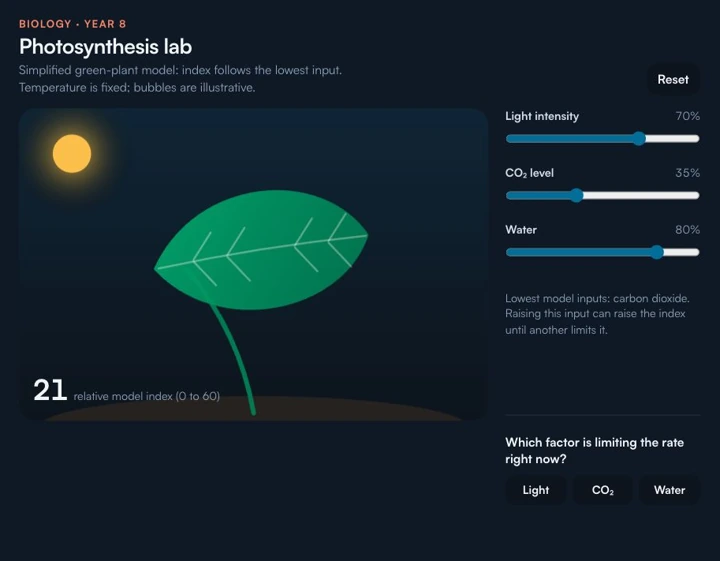
Photosynthesis lab
Select Reset and read the three starting levels. Identify the lowest input before changing a slider, then predict what increasing a different input will do.
Explore resourceIdeas to try with your class
Sample teaching perspectives on what to try, what to adapt and what to watch for.
Meet The Creators
Meet the creators whose teaching interests connect with this template. Find an approach to try with your class.
Hannah Goldberg
I plan secondary learning adjustments as familiar tools in everyday classroom practice before examinations, discussing what helps and checking that teachers can apply the agreed approach consistently.
Meet the creator
Dr Anjali Menon
I coordinate Science practicals with the lead technician, linking activity-specific preparation and review with shared laboratory time so the department can notice and respond to gaps early.
Meet the creator
Tea Break Notes
The two-page Frayer model distinguishes definition, characteristics, examples and non-examples, then asks pupils to explain photosynthesis with inputs and outputs. Its final idea corrects a common misconception: plants make glucose rather than taking food from soil.
Kindly Red Pen
For ages 11 to 14, the word-part introduction links photo to light and synthesis to putting together before returning to the science process. The completed model gives a structure for explaining producers and how animals depend on them.
Clear Example
Use the worked squares to compare an example with a reasoned non-example, then ask pupils to complete each section for the target word. Keeping carbon dioxide, water, light, chlorophyll, glucose and oxygen visible supports accurate sentence building.
Paperclip Perspective
Word origins are a memory aid, not a full scientific explanation. Check that pupils distinguish soil minerals and water from food, and use the organism examples as evidence for the definition rather than treating every green thing as identical.