
Music and performing arts
Performance reflection
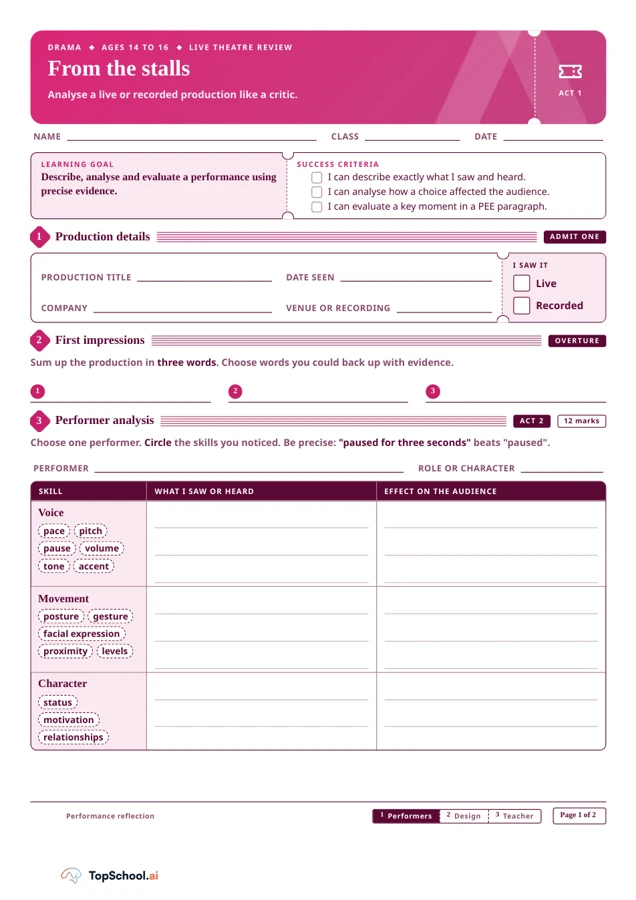
Record production details, then analyse performers and design choices using specific observations. Choose a key moment and explain its effect on an audience in a Point, Evidence, Explain paragraph.
Read the material
Record production details, then analyse performers and design choices using specific observations. Choose a key moment and explain its effect on an audience in a Point, Evidence, Explain paragraph.
Activity. Use the preview for diagrams and layout.
Page 1
NAME
CLASS
DATE
LEARNING GOAL
Describe, analyse and evaluate a performance using
precise evidence.
Production details
ADMIT ONE
PRODUCTION TITLE
DATE SEEN
COMPANY
VENUE OR RECORDING
First impressions
OVERTURE
Sum up the production in three words. Choose words you could back up with evidence.
1
2
3
Performer analysis
ACT 2
12 marks
Choose one performer. Circle the skills you noticed. Be precise: "paused for three seconds" beats "paused".
PERFORMER
ROLE OR CHARACTER
SKILL
WHAT I SAW OR HEARD
EFFECT ON THE AUDIENCE
Voice
pace
pitch
pause
volume
tone
accent
Movement
posture
gesture
facial expression
proximity
levels
Character
status
motivation
relationships
Performance reflection
1 Performers
2 Design
3 Teacher
DRAMA
AGES 14 TO 16
LIVE THEATRE REVIEW
From the stalls
Analyse a live or recorded production like a critic.
ACT 1
SUCCESS CRITERIA
I can describe exactly what I saw and heard.
I can analyse how a choice affected the audience.
I can evaluate a key moment in a PEE paragraph.
1
I SAW IT
Live
Recorded
2
3
Page 1 of 2
Page 2
Design elements
ACT 3
10 marks
For each element, describe one specific detail, then say what it made the audience think or feel.
ELEMENT
WHAT I SAW OR HEARD
EFFECT ON THE AUDIENCE
Set
levels, scale, colour,
period
Lighting
colour, brightness,
direction, changes
Sound
music, effects,
volume, silence
Costume
colour, fabric, fit,
period
Props
size, use, what they
stand for
Key moment
FINALE
8 marks
Pick the moment that stayed with you. Write one paragraph: Point, Evidence, Explain.
POINT
The most powerful
moment was when...
EVIDENCE
For example, the
performer...
EXPLAIN
This made the
audience feel...
because...
Performance reflection
1 Performers
2 Design
3 Teacher
DRAMA
FROM THE STALLS
Design and the key moment
4
5
P
E
E
Page 2 of 2
Page 1
Performance reflection
Teacher companion
Drama | Pupils aged 14 to 16
Use with the exact 2-page original file. Keep pupil or staff activity pages separate from this teacher companion.
When to use it
Use this after pupils have watched a live or recorded performance they can identify. The first
page focuses on a performer; the second considers design elements and a key moment. Ask
pupils to take notes from what they actually saw or heard rather than rely on a plot summary.
Purpose
Describe a performance choice with precise evidence, analyse its possible audience effect and
evaluate a key moment in a PEE paragraph.
Start here
Record the production title, date, company, venue or recording, then mark whether it was live
or recorded. Clarify that pupils should describe observable details before interpreting their
effect.
A teaching sequence
1. Choose one performer and record a precise detail about voice, movement or character,
then explain a possible audience effect.
2. Select design elements from set, lighting, sound, costume and props. Describe a specific
detail for each chosen element and its possible effect.
3. Choose a moment that stayed with you. Write a Point, Evidence and Explain paragraph
using a detail from the performance.
4. Re-read the paragraph and check that evidence describes the chosen performance rather
than a general opinion. Ask what the audience noticed.
Checking guidance
Look for precise observation before interpretation, such as naming a pause, gesture, colour or
sound. Ask, “What exactly did you see or hear, and how might it affect an audience?” If the
response says only that the scene was powerful, ask for one detail that supports the view.
Separate observation from interpretation: name the light, sound, gesture or pause first, then
describe a possible audience effect. Different supported interpretations are acceptable.
Support
Offer a short list of observable verbs and let pupils select one performance moment. Model
the difference between “the scene was sad” and a detail that could support that
interpretation. Pupils can discuss an observation aloud before writing.
Take it further
Compare how one production choice changes across two moments or between a live
performance and a recording, if both are available. Ask pupils to qualify their interpretation
and consider whether another audience member might respond differently.
Things to keep in mind
Audience effects are interpretations, so phrase them as possible responses rather than
universal facts. Choose a production or recording the class can identify and check any context
given to pupils. This sheet does not provide a sample analysis.
Performance reflection
Teacher companion | Page 1
A teaching sequence
Describe a performance choice with precise evidence, analyse its possible audience effect and evaluate a key moment in a PEE paragraph.
Notice voice and movement
Choose one performer and record a precise detail about voice, movement or character, then explain a possible audience effect.
Which exact detail might explain the audience effect you describe?
Connect design with a possible effect
Select design elements from set, lighting, sound, costume and props. Describe a specific detail for each chosen element and its possible effect.
Which set, lighting, sound, costume or prop choice supports your interpretation?
Explain one key moment
Choose a moment that stayed with you. Write a Point, Evidence and Explain paragraph using a detail from the performance.
Where are the point, performance evidence and explanation in your paragraph?
Check evidence against the performance
Re-read the paragraph and check that evidence describes the chosen performance rather than a general opinion. Ask what the audience noticed.
Does each detail belong to the production or recording you watched?
Before you teach
Look for the thinking behind an answer, choose the support your class needs and leave room for an independent response.
What to look for
Look for precise observation before interpretation, such as naming a pause, gesture, colour or sound. Ask, “What exactly did you see or hear, and how might it affect an audience?” If the response says only that the scene was powerful, ask for one detail that supports the view. Separate observation from interpretation: name the light, sound, gesture or pause first, then describe a possible audience effect. Different supported interpretations are acceptable.
Give a little support
Offer a short list of observable verbs and let pupils select one performance moment. Model the difference between “the scene was sad” and a detail that could support that interpretation. Pupils can discuss an observation aloud before writing.
Take the idea further
Compare how one production choice changes across two moments or between a live performance and a recording, if both are available. Ask pupils to qualify their interpretation and consider whether another audience member might respond differently.
Things to keep in mind
Audience effects are interpretations, so phrase them as possible responses rather than universal facts. Choose a production or recording the class can identify and check any context given to pupils. This sheet does not provide a sample analysis.
Keep the idea. Make it yours.
Bring your topic, learning goal and class context to PLAI™, then review what you create.
Ideas to try with your class
Sample teaching perspectives on what to try, what to adapt and what to watch for.
Meet The Creators
Meet the creators whose teaching interests connect with this template. Find an approach to try with your class.

Rachel Sim
I use roles, movement, voice and short improvisation to give quieter pupils a way into Drama, with supported participation and room to build on one another’s ideas.
Meet the creatorPriscilla Amoah
As Head of Drama, I look for devising stimuli that give students something to respond to and help them move into practical exploration.
Meet the creator
Extra Page
The two-page review records production details, three evidence-backed first impressions, a performer choice and design elements before a PEE paragraph on the key moment. It accepts a live or recorded production.
Thoughtful Pause
For ages 14 to 16, pupils move from precise observation (such as a three-second pause) to possible audience effect. The design table covers set, lighting, sound, costume and props as distinct choices.
Spare Pencil
The prompt separates observed words or actions from a possible audience effect, supporting an evidence-based explanation. The point, evidence and explanation frames can follow a selected moment that stayed with the pupil.
After the Bell
An audience effect is an interpretation and should be linked to an observed detail, not claimed as everyone’s reaction. Record whether the work was live or recorded and include production details before evaluating it.