
Music and performing arts
Performance peer assessment
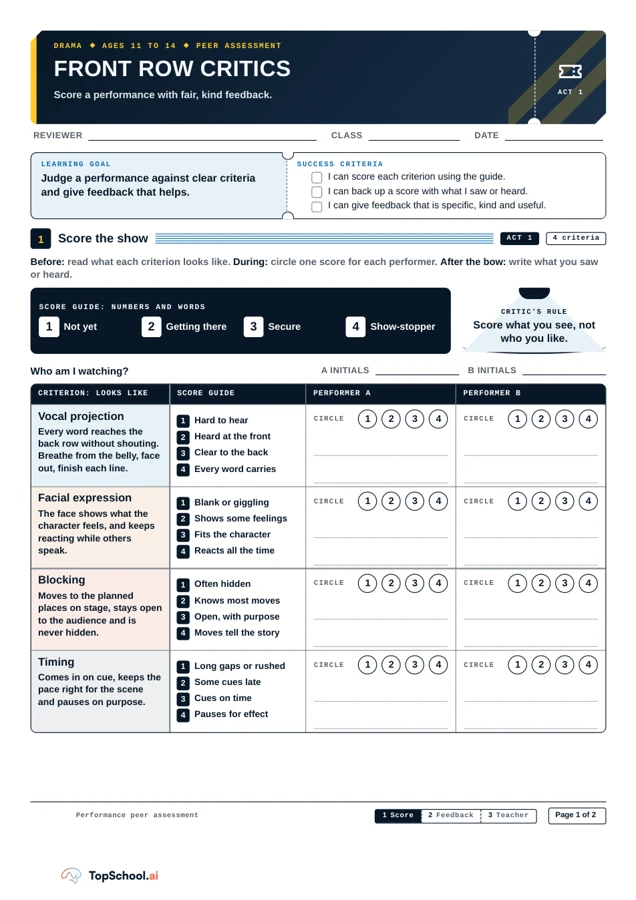
Use four drama criteria to assess a performance: vocal projection, facial expression, blocking and timing. Pupils can record evidence for two performers, follow the audience house rules and write a specific two-stars-and-a-wish response for discussion.
Read the material
Use four drama criteria to assess a performance: vocal projection, facial expression, blocking and timing. Pupils can record evidence for two performers, follow the audience house rules and write a specific two-stars-and-a-wish response for discussion.
Activity. Use the preview for diagrams and layout.
Page 1
REVIEWER
CLASS
DATE
LEARNING GOAL
Judge a performance against clear criteria
and give feedback that helps.
1
Score the show
ACT 1
4 criteria
Before: read what each criterion looks like. During: circle one score for each performer. After the bow: write what you saw
or heard.
SCORE GUIDE: NUMBERS AND WORDS
1
Not yet
2
Getting there
3
Secure
4
Show-stopper
Who am I watching?
A INITIALS
B INITIALS
CRITERION: LOOKS LIKE
SCORE GUIDE
PERFORMER A
PERFORMER B
Vocal projection
Every word reaches the
back row without shouting.
Breathe from the belly, face
out, finish each line.
1
Hard to hear
2
Heard at the front
3
Clear to the back
4
Every word carries
CIRCLE
1
2
3
4
CIRCLE
1
2
3
4
Facial expression
The face shows what the
character feels, and keeps
reacting while others
speak.
1
Blank or giggling
2
Shows some feelings
3
Fits the character
4
Reacts all the time
CIRCLE
1
2
3
4
CIRCLE
1
2
3
4
Blocking
Moves to the planned
places on stage, stays open
to the audience and is
never hidden.
1
Often hidden
2
Knows most moves
3
Open, with purpose
4
Moves tell the story
CIRCLE
1
2
3
4
CIRCLE
1
2
3
4
Timing
Comes in on cue, keeps the
pace right for the scene
and pauses on purpose.
1
Long gaps or rushed
2
Some cues late
3
Cues on time
4
Pauses for effect
CIRCLE
1
2
3
4
CIRCLE
1
2
3
4
Performance peer assessment
1 Score
2 Feedback
3 Teacher
DRAMA
AGES 11 TO 14
PEER ASSESSMENT
FRONT ROW CRITICS
Score a performance with fair, kind feedback.
ACT 1
SUCCESS CRITERIA
I can score each criterion using the guide.
I can back up a score with what I saw or heard.
I can give feedback that is specific, kind and useful.
CRITIC'S RULE
Score what you see, not
who you like.
Page 1 of 2
Page 2
2
Audience house rules
FRONT OF HOUSE
Read these before curtain up. A great audience helps every performer do their best.
Eyes on the stage,
phones away.
Sit still and quiet
while they
perform.
React honestly:
laugh, gasp, listen.
Save your
feedback for after
the bow.
Clap every
performer, every
time.
3
Two stars and a wish
ENCORE
2 cards
Write one card for each performer. Use initials only. Make every comment specific, kind and useful. Cut along the dashed
lines and hand it over after the bow.
STARTERS
I noticed that you...
It worked well when...
Next time, try...
It would be even better if...
BEFORE YOU HAND IT OVER
I named a moment.
It is kind.
My wish gives a next step.
Performance peer assessment
1 Score
2 Feedback
3 Teacher
DRAMA
FRONT ROW CRITICS
BE A GREAT AUDIENCE
FOCUS
1
STILL
2
REACT
3
WAIT
4
APPLAUSE
5
TO (INITIALS)
FROM (INITIALS)
Star
Star
Wish
TO (INITIALS)
FROM (INITIALS)
Star
Star
Wish
PERFORMER
ADMIT ONE
A
PERFORMER
ADMIT ONE
B
Page 2 of 2
Page 1
Performance peer assessment
Teacher companion
Drama | Pupils aged 11 to 14
Use with the exact 2-page original file. Keep pupil or staff activity pages separate from this teacher companion.
When to use it
Use this after pupils have rehearsed a short scene and understand the performance criteria.
Read the audience expectations before curtain up, then keep scoring focused on what can be
seen or heard. Give feedback after the bow, as the worksheet directs.
Purpose
Use performance criteria to record an observation, assign a supported score, and give a
performer feedback that is specific, kind and useful.
Start here
Read the four score levels and the critic's rule to assess what is seen, not who is liked. Explain
how pupils will use initials on feedback cards.
A teaching sequence
1. Before the scene, review vocal projection, facial expression, blocking and timing with the
score descriptors.
2. During the performance, note an example for each selected criterion for performer A or B.
3. After the bow, use the two-star and wish prompts to describe two effective moments and
one next step.
4. Complete the feedback check before handing over a card: name a moment, keep it kind
and make the wish useful. Agree what pupils can try next, then ask which detail supports their
response.
Checking guidance
Look for a comment tied to an observable moment, such as a clear voice or an entrance on
cue. Ask, “Which part of the scene showed that?” If feedback comments on popularity or
personality, redirect it to a choice made during the performance.
Model “At the entrance, your pause made the audience look towards the door” rather than
“You were great”. A wish should name one rehearsal action the performer can try.
Support
Let pupils focus on one criterion and rehearse feedback aloud with a sentence starter before
writing. Offer a private handover or adult support for feedback that may feel difficult to
receive.
Take it further
Ask a performer to choose one piece of feedback and identify a rehearsal action that could
test it. A reviewer can explain how a specific performance choice shaped the audience's
understanding without assuming every audience member reacted in the same way.
Things to keep in mind
Scores are prompts for structured peer discussion, not validated grades. Follow school policy
for feedback records, use initials only and keep comments on observable performance rather
than identity or popularity. Offer a private feedback route where needed.
Performance peer assessment
Teacher companion | Page 1
A teaching sequence
Use performance criteria to record an observation, assign a supported score, and give a performer feedback that is specific, kind and useful.
Review the performance criteria
Before the scene, review vocal projection, facial expression, blocking and timing with the score descriptors.
What would projection, expression, blocking or timing look or sound like here?
Record each performer's evidence
During the performance, note an example for each selected criterion for performer A or B.
Which moment belongs to performer A and which to performer B?
Write two stars and a wish
After the bow, use the two-star and wish prompts to describe two effective moments and one next step.
What observed moment supports each strength and the next step?
Check and share useful feedback
Complete the feedback check before handing over a card: name a moment, keep it kind and make the wish useful. Agree what pupils can try next, then ask which detail supports their response.
Is the comment specific, kind and possible to act on?
Before you teach
Look for the thinking behind an answer, choose the support your class needs and leave room for an independent response.
What to look for
Look for a comment tied to an observable moment, such as a clear voice or an entrance on cue. Ask, “Which part of the scene showed that?” If feedback comments on popularity or personality, redirect it to a choice made during the performance. Model “At the entrance, your pause made the audience look towards the door” rather than “You were great”. A wish should name one rehearsal action the performer can try.
Give a little support
Let pupils focus on one criterion and rehearse feedback aloud with a sentence starter before writing. Offer a private handover or adult support for feedback that may feel difficult to receive.
Take the idea further
Ask a performer to choose one piece of feedback and identify a rehearsal action that could test it. A reviewer can explain how a specific performance choice shaped the audience's understanding without assuming every audience member reacted in the same way.
Things to keep in mind
Scores are prompts for structured peer discussion, not validated grades. Follow school policy for feedback records, use initials only and keep comments on observable performance rather than identity or popularity. Offer a private feedback route where needed.
Keep the idea. Make it yours.
Bring your topic, learning goal and class context to PLAI™, then review what you create.
Ideas to try with your class
Sample teaching perspectives on what to try, what to adapt and what to watch for.
Meet The Creators
Meet a creator whose teaching interests connect with this template.

Open Book Pause
The two-page drama tool rates vocal projection, facial expression, blocking and timing for two performers, then provides audience rules and a two-stars-and-a-wish slip. It requires a moment from the performance to support each comment.
Bright Margins
Feedback follows a clear order: read the criteria, observe the scene and comment after the bow. “Score what you see, not who you like” makes fairness an explicit part of the task.
Tea Break Notes
The starters prompt pupils to notice a moment, identify when it worked and suggest a next step. Initials-only cards limit personal information while the audience rules protect the performance space.
One Last Sticky Note
Scores describe this performance against the listed drama criteria, not the performer’s worth. Keep each wish specific and kind, and do not use facial expression or vocal projection to rank personality.