
Languages and literacy
Paragraph planning frame
Study a model opinion paragraph, then use PEEL to plan both sides of a question about lunch breaks before writing one complete paragraph. The frame labels Point, Evidence, Explain and Link, and supplies sentence starters.
Read the material
Study a model opinion paragraph, then use PEEL to plan both sides of a question about lunch breaks before writing one complete paragraph. The frame labels Point, Evidence, Explain and Link, and supplies sentence starters.
Activity. Use the preview for diagrams and layout.
Page 1
NAME
CLASS
DATE
LEARNING GOAL
Write one persuasive paragraph that
makes a clear point and backs it up.
SUCCESS CRITERIA
I can name the four parts of a PEEL paragraph.
I can back up a point with a reason or a school-life
example.
I can plan both sides, then write one paragraph in full.
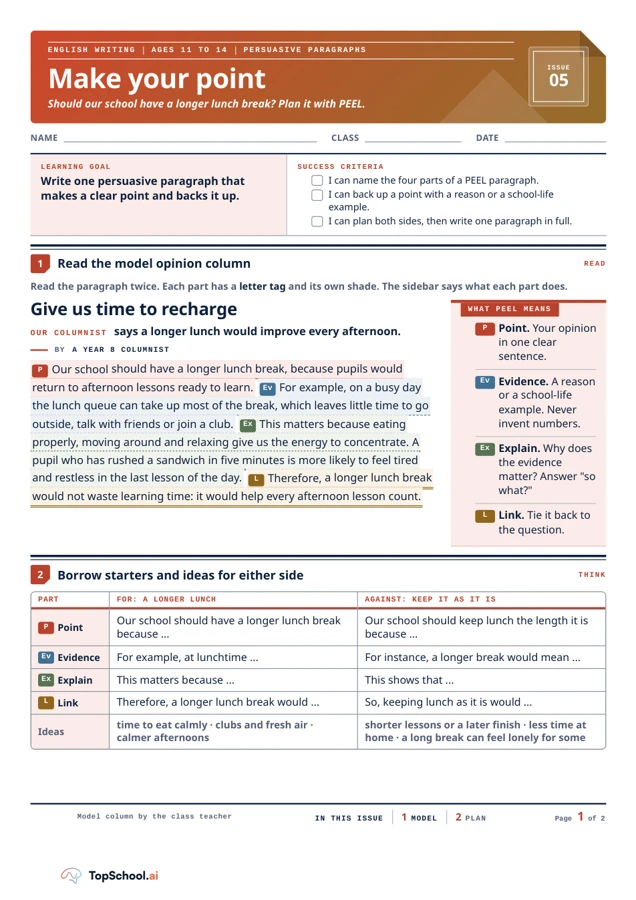
Read the paragraph twice. Each part has a letter tag and its own shade. The sidebar says what each part does.
Give us time to recharge
OUR COLUMNIST says a longer lunch would improve every afternoon.
BY
A YEAR 8 COLUMNIST
P
Our school should have a longer lunch break, because pupils would
return to afternoon lessons ready to learn. Ev For example, on a busy day
the lunch queue can take up most of the break, which leaves little time to go
outside, talk with friends or join a club. Ex This matters because eating
properly, moving around and relaxing give us the energy to concentrate. A
pupil who has rushed a sandwich in five minutes is more likely to feel tired
and restless in the last lesson of the day.
L
Therefore, a longer lunch break
would not waste learning time: it would help every afternoon lesson count.
WHAT PEEL MEANS
P
Point. Your opinion
in one clear
sentence.
Ev
Evidence. A reason
or a school-life
example. Never
invent numbers.
Ex
Explain. Why does
the evidence
matter? Answer "so
what?"
L
Link. Tie it back to
the question.
PART
FOR: A LONGER LUNCH
AGAINST: KEEP IT AS IT IS
P
Point
Our school should have a longer lunch break
because ...
Our school should keep lunch the length it is
because ...
Ev Evidence
For example, at lunchtime ...
For instance, a longer break would mean ...
Ex Explain
This matters because ...
This shows that ...
L
Link
Therefore, a longer lunch break would ...
So, keeping lunch as it is would ...
Ideas
time to eat calmly · clubs and fresh air ·
calmer afternoons
shorter lessons or a later finish · less time at
home · a long break can feel lonely for some
Model column by the class teacher
IN THIS ISSUE
1 MODEL
2 PLAN
E N G L I S H W R I T I N G
A G E S 1 1 T O 1 4
P E R S U A S I V E P A R A G R A P H S
Make your point
Should our school have a longer lunch break? Plan it with PEEL.
ISSUE
05
Read the model opinion column
R E A D
1
Borrow starters and ideas for either side
T H I N K
2
Page 1 of 2
Page 2
NAME
CLASS
DATE
PART
FOR: A LONGER LUNCH
AGAINST: KEEP IT AS IT IS
P
Point
Ev Evidence
Ex Explain
L
Link
My side (circle):
For
Against
Then tick each part you used:
P
Ev
Ex
L
Paragraph planning frame · Opinion desk
I S S U E 0 5
P E R S U A S I V E P A R A G R A P H S
O P I N I O N D E S K
Plan both sides, then write
Plan both sides: make each one strong
P L A N
3
Our school should ...
Our school should keep ...
For example, ...
For instance, ...
This matters because ...
This shows that ...
Therefore, ...
So, ...
Write your paragraph in full
W R I T E
10 marks
4
Page 2 of 2
A teaching sequence
Plan and write a persuasive paragraph with a clear point, relevant evidence, an explanation of why it matters and a link back to the question.
Identify the PEEL parts
Annotate one PEEL sentence in the model and use the sidebar to name what each part does.
Which sentence explains why the example matters?
Plan both sides
Complete the planning table for and against a longer lunch. Ask pupils to make each side plausible before choosing one.
What is the strongest reason for keeping lunch as it is?
Choose and support a point
Select a side and use the printed starters to draft a Point, Evidence, Explain and Link sequence.
Is your school-life example observed, sourced or only imagined?
Link back to the question
Write the paragraph with reasons or school-life examples supporting each point. Check that the ending returns to the question and identify any point needing more evidence.
Which point still needs evidence before it can persuade the reader?
Before you teach
Look for the thinking behind an answer, choose the support your class needs and leave room for an independent response.
What to look for
Look for one paragraph whose evidence supports its point and whose explanation answers “So what?” Ask, “How does this example help prove your point?” If pupils rely on an unsupported factual claim, have them find a source or recast it clearly as an example rather than presenting it as a measured fact.
Give a little support
Provide a paragraph with the four PEEL labels already marked and rehearse one sentence for each part. Pupils can first explain their idea aloud, then use a starter from the page to record it.
Take the idea further
Ask pupils to strengthen the evidence for their chosen side, address one counterpoint and revise the explanation so it follows from the evidence. Compare how the same example might be interpreted differently by the opposing side.
Things to keep in mind
The model is presented as a sample column, but its lunch-queue statements have no sources. Treat them as an example of paragraph structure, not verified evidence about a real school or pupil group. Pupils should source factual claims in their own work.
Keep the idea. Make it yours.
Bring your topic, learning goal and class context to PLAI™, then review what you create.
Ideas to try with your class
Sample teaching perspectives on what to try, what to adapt and what to watch for.
Meet The Creators
Meet a creator whose teaching interests connect with this template.

Five More Minutes
The PEEL model argues for a longer lunch, then contrasts it with keeping the current length. Pupils plan both positions through point, evidence, explanation and link before choosing a side and writing one paragraph.
Step by Step
The example and idea bank make the four paragraph jobs visible, while the “never invent numbers” instruction sets an evidence boundary. The second page gives parallel sentence frames for both sides.
Thoughtful Pause
Read the model twice and identify how the school-life example connects to the explanation before using the empty boxes. Pupils can choose one prompt for each PEEL component, then turn those notes into full sentences.
Reread Reminder
The model is an illustrative opinion column, not evidence that a longer lunch improves every afternoon. For a real persuasive paragraph, use a checked example or source and distinguish it from the writer’s reasoning.