
Music and performing arts
Music listening and appraisal
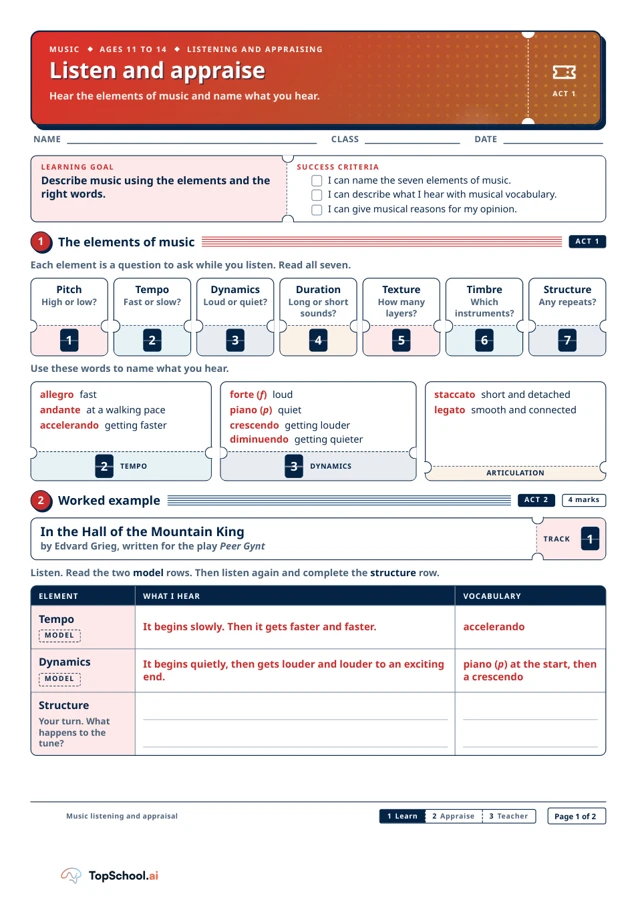
Use a listening grid to describe pitch, tempo, dynamics, duration, texture, timbre and structure. Pupils study a worked example based on Grieg, then choose four elements to record in a piece and write a short appraisal. Choose the music in advance, as no audio is included.
Read the material
Use a listening grid to describe pitch, tempo, dynamics, duration, texture, timbre and structure. Pupils study a worked example based on Grieg, then choose four elements to record in a piece and write a short appraisal. Choose the music in advance, as no audio is included.
Activity. Use the preview for diagrams and layout.
Page 1
NAME
CLASS
DATE
LEARNING GOAL
Describe music using the elements and the
right words.
1
The elements of music
ACT 1
Each element is a question to ask while you listen. Read all seven.
Pitch
High or low?
Tempo
Fast or slow?
Dynamics
Loud or quiet?
Duration
Long or short
sounds?
Texture
How many
layers?
Timbre
Which
instruments?
Structure
Any repeats?
Use these words to name what you hear.
allegro fast
andante at a walking pace
accelerando getting faster
forte (f) loud
piano (p) quiet
crescendo getting louder
diminuendo getting quieter
staccato short and detached
legato smooth and connected
2
Worked example
ACT 2
4 marks
In the Hall of the Mountain King
by Edvard Grieg, written for the play Peer Gynt
Listen. Read the two model rows. Then listen again and complete the structure row.
ELEMENT
WHAT I HEAR
VOCABULARY
Tempo
MODEL
It begins slowly. Then it gets faster and faster.
accelerando
Dynamics
MODEL
It begins quietly, then gets louder and louder to an exciting
end.
piano (p) at the start, then
a crescendo
Structure
Your turn. What
happens to the
tune?
Music listening and appraisal
1 Learn
2 Appraise
3 Teacher
MUSIC
AGES 11 TO 14
LISTENING AND APPRAISING
Listen and appraise
Listen and appraise
Hear the elements of music and name what you hear.
ACT 1
SUCCESS CRITERIA
I can name the seven elements of music.
I can describe what I hear with musical vocabulary.
I can give musical reasons for my opinion.
1
2
3
4
5
6
7
TEMPO
2
DYNAMICS
3
ARTICULATION
TRACK
1
Page 1 of 2
Page 2
NAME
PIECE
COMPOSER
3
Your listening grid
ACT 3
8 marks
Listen twice. Choose four elements. Write what you hear and the words that name it.
ELEMENT
WHAT I HEAR
VOCABULARY
4
Describe, compare, explain
FINALE
8 marks
Write one paragraph. Use a
starter from each ticket.
At the start, the music is ...
Compared with In the Hall of
the Mountain King, my piece
is ...
The composer uses ... to
make it feel ...
My response: I like / dislike this piece because ... (circle one)
Music listening and appraisal
1 Learn
2 Appraise
3 Teacher
MUSIC
LISTEN AND APPRAISE
Appraise a piece of your choice
Appraise a piece of your choice
DESCRIBE
COMPARE
EXPLAIN
YOUR VERDICT
Give a musical reason.
Page 2 of 2
Page 1
Music listening and appraisal
Teacher companion
Music | Pupils aged 11 to 14
Use with the exact 2-page original file. Keep pupil or staff activity pages separate from this teacher companion.
When to use it
Use this when pupils can listen for more than one feature and are ready to support an opinion
with musical vocabulary. The worked example introduces descriptive terms before pupils
appraise their own selected piece. Choose and prepare an accessible recording in advance;
the worksheet does not provide audio.
Purpose
Describe and compare selected musical elements using appropriate vocabulary, and support
an opinion with a specific observation from a piece.
Start here
Read the seven element prompts and vocabulary together. Tell pupils which recording they
will hear, and check that it is available before beginning the listening task.
A teaching sequence
1. Use the first page to connect each element with a listening question, such as whether the
tempo is fast or slow or whether the texture has several layers.
2. Read the worked example about In the Hall of the Mountain King. Ask pupils to identify the
change in tempo and dynamics described on the page.
3. Play a teacher-selected piece twice. Ask pupils to choose four elements and record what
they hear alongside a useful vocabulary term.
4. Use the sentence starters on page 2 for a short appraisal. Ask pupils to compare, explain a
musical choice and support their verdict with one observation.
Checking guidance
Look for a statement that joins a musical feature to an observation, such as a tempo changing
or a repeated section being heard. Ask, “Which moment in the recording supports that
description?” If a pupil gives only a preference, invite them to add one feature they heard as a
reason.
An appraisal needs a heard feature and a located moment, such as a repeated passage or a
change in dynamics. Accept differing opinions when the pupil can connect the reason to the
recording.
Support
Offer two elements to listen for first, such as tempo and dynamics. Pause the recording at a
clear point and model a sentence that names what changed. Keep the vocabulary list visible,
and let pupils rehearse a spoken observation before writing it.
Take it further
Ask pupils to compare two short excerpts using the same four elements, then explain which
observation best supports their view. They could annotate a repeated listening moment with a
time marker, provided the teacher has a recording and playback method.
Things to keep in mind
Choose a recording before the lesson because none is included. The page names Grieg's piece
but does not supply it. Use a teacher-selected recording and check subject-specific
interpretations with a music educator before discussing pupils' interpretations.
Music listening and appraisal
Teacher companion | Page 1
A teaching sequence
Describe and compare selected musical elements using appropriate vocabulary, and support an opinion with a specific observation from a piece.
Listen for named elements
Use the first page to connect each element with a listening question, such as whether the tempo is fast or slow or whether the texture has several layers.
Which listening question helps describe texture rather than tempo?
Inspect the Grieg model
Read the worked example about In the Hall of the Mountain King. Ask pupils to identify the change in tempo and dynamics described on the page.
Where does the model describe changes in tempo and dynamics?
Record what your piece does
Play a teacher-selected piece twice. Ask pupils to choose four elements and record what they hear alongside a useful vocabulary term.
What did you hear on the second listening that supports the vocabulary?
Write a musical appraisal
Use the sentence starters on page 2 for a short appraisal. Ask pupils to compare, explain a musical choice and support their verdict with one observation.
Which observation supports your comparison or verdict?
Before you teach
Look for the thinking behind an answer, choose the support your class needs and leave room for an independent response.
What to look for
Look for a statement that joins a musical feature to an observation, such as a tempo changing or a repeated section being heard. Ask, “Which moment in the recording supports that description?” If a pupil gives only a preference, invite them to add one feature they heard as a reason. An appraisal needs a heard feature and a located moment, such as a repeated passage or a change in dynamics. Accept differing opinions when the pupil can connect the reason to the recording.
Give a little support
Offer two elements to listen for first, such as tempo and dynamics. Pause the recording at a clear point and model a sentence that names what changed. Keep the vocabulary list visible, and let pupils rehearse a spoken observation before writing it.
Take the idea further
Ask pupils to compare two short excerpts using the same four elements, then explain which observation best supports their view. They could annotate a repeated listening moment with a time marker, provided the teacher has a recording and playback method.
Things to keep in mind
Choose a recording before the lesson because none is included. The page names Grieg's piece but does not supply it. Use a teacher-selected recording and check subject-specific interpretations with a music educator before discussing pupils' interpretations.
Keep the idea. Make it yours.
Bring your topic, learning goal and class context to PLAI™, then review what you create.
Ideas to try with your class
Sample teaching perspectives on what to try, what to adapt and what to watch for.
Meet The Creators
Meet the creators whose teaching interests connect with this template. Find an approach to try with your class.

Amara Nwosu
I get pupils playing early in a mixed-experience ensemble, using shared rhythm and sound to make participation meaningful before introducing notation to record what they are doing.
Meet the creator
Owen Beddows
I make composition feedback specific enough for students to choose their next musical step independently, while ensemble work gives them opportunities to practise and play with others.
Meet the creator
The Curious Pencil
The worksheet introduces seven listening elements, models tempo and dynamics with Grieg’s “In the Hall of the Mountain King”, then asks pupils to choose four elements in a piece of their own. A final paragraph must compare and justify a response.
Glue Stick Club
For ages 11 to 14, pupils move from vocabulary such as accelerando and crescendo to describing what they hear and how it affects a piece. The opening model gives a reference point for the later comparison.
Clear Example
The listening grid separates “what I hear” from vocabulary, which supports a sound-first response before naming a term. Pupils can choose four elements that are clearest in the selected piece rather than forcing all seven into one paragraph.
Tea Break Notes
The sheet does not identify a single piece for the final appraisal, so the teacher must select suitable listening material. Support opinions with an audible feature; liking a piece alone does not meet the musical-reason prompt.