
Languages and literacy
French school subjects: vocabulary and sentences
Learn ten French school-subject words, choose an opinion and build sentences with parce que c’est plus an adjective. Worked models support six original sentences; a teacher should check the target language pattern and adjective agreement.
Read the material
Learn ten French school-subject words, choose an opinion and build sentences with parce que c’est plus an adjective. Worked models support six original sentences; a teacher should check the target language pattern and adjective agreement.
Complete resource. Use the preview for diagrams and layout.
Page 1
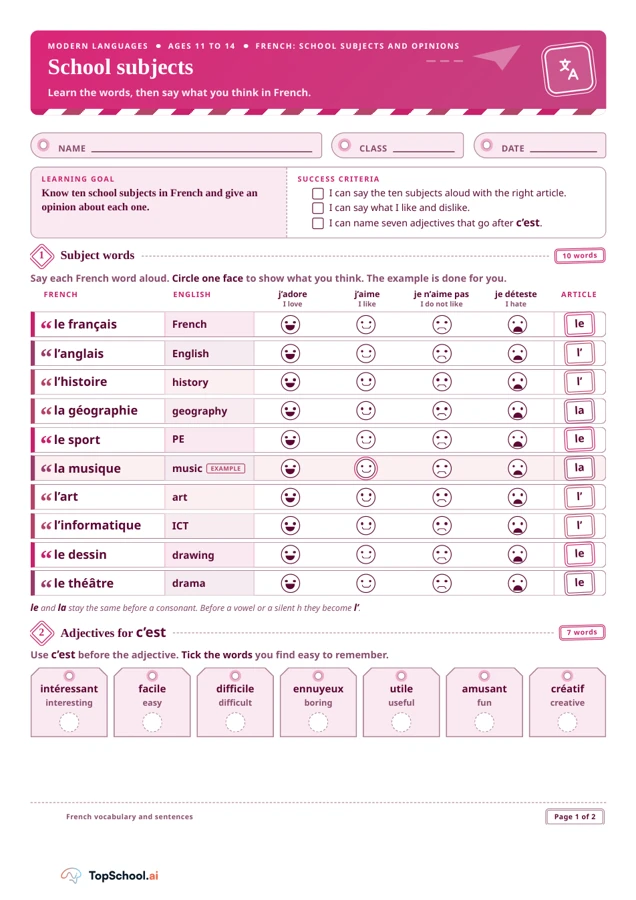
LEARNING GOAL
Know ten school subjects in French and give an
opinion about each one.
SUCCESS CRITERIA
I can say the ten subjects aloud with the right article.
I can say what I like and dislike.
I can name seven adjectives that go after c’est.
Subject words
Say each French word aloud. Circle one face to show what you think. The example is done for you.
FRENCH
ENGLISH
j’adore
I love
j’aime
I like
je n’aime pas
I do not like
je déteste
I hate
ARTICLE
le and la stay the same before a consonant. Before a vowel or a silent h they become l’.
Adjectives for c’est
Use c’est before the adjective. Tick the words you find easy to remember.
French vocabulary and sentences
Page 1 of 2
MODERN LANGUAGES
AGES 11 TO 14
FRENCH: SCHOOL SUBJECTS AND OPINIONS
School subjects
Learn the words, then say what you think in French.
NAME
CLASS
DATE
1
10 words
French
le français
“
le
English
l’anglais
“
l’
history
l’histoire
“
l’
geography
la géographie
“
la
PE
le sport
“
le
music
EXAMPLE
la musique
“
la
art
l’art
“
l’
ICT
l’informatique
“
l’
drawing
le dessin
“
le
drama
le théâtre
“
le
2
7 words
intéressant
interesting
facile
easy
difficile
difficult
ennuyeux
boring
utile
useful
amusant
fun
créatif
creative
Page 2
Four pieces, one sentence
Read across each row. The four pieces join into one sentence. These are your models.
J’aime
la musique
parce que c’est
créatif
Je déteste
le sport
parce que c’est
ennuyeux
J’adore
l’histoire
parce que c’est
intéressant
Je n’aime pas
l’informatique
parce que c’est
difficile
Build your own
Write six different sentences: an opinion from section 1 + subject + parce que c’est + adjective.
1
2
3
4
5
6
Accents are in the right
places.
Article: le, la or l’ fits.
j’ or je: j’aime but je
déteste.
parce que c’est
before the adjective.
Translate into English
French vocabulary and sentences
Page 2 of 2
FRENCH
AGES 11 TO 14
SENTENCE BUILDER
Build your sentences
1
OPINION
le, la OR l’ + SUBJECT
parce que c’est
ADJECTIVE
2
6 sentences
3
3 marks
1
Je déteste le sport parce que c’est ennuyeux.
2
J’adore l’histoire parce que c’est intéressant.
3
Je n’aime pas l’informatique parce que c’est
difficile.
A teaching sequence
Use French school-subject vocabulary, an opinion phrase and an adjective to form a short reasoned sentence.
Choose subject and opinion words
Read the ten subject words, meanings and le, la or l' articles, noticing the printed elision examples. Circle an opinion for each subject using a genuine or invented preference.
Which article belongs with this subject in the model?
Check adjective meanings
Read the adjective list and mark words that are easy to remember. Check the meaning and pronunciation with the teacher.
What checked meaning fits the opinion you want to express?
Read the four sentence parts
On page 2, read the four sentence models from left to right. Notice the opinion, article and subject, parce que c’est, and the adjective.
Where does parce que c'est connect the reason to the opinion?
Build and review sentences
Build six sentences and translate the three supplied French sentences into English. Review accents, articles, j'/je and adjective choices with the language teacher.
Have you checked accents, articles and j' or je in the complete sentence?
Before you teach
Look for the thinking behind an answer, choose the support your class needs and leave room for an independent response.
What to look for
Check the subject article, opinion phrase, spelling and meaning. Review whether the adjective gives a clear reason and whether pupils can translate the sentence accurately. French forms and agreement depend on the construction, so check the target pattern with a language teacher.
Give a little support
Provide a pronunciation model and a subject-word bank. Let pupils build a sentence orally with cards before writing. Use a small number of subjects first and keep the adjective translations visible.
Take the idea further
Ask pupils to write two contrasting opinions about the same subject and explain how the adjective changes the reason. They can add a connector or a second clause using language already taught.
Things to keep in mind
The sheet practises a limited pattern and vocabulary set. Some adjective agreement and article choices depend on the full sentence, not an isolated word. It is not a complete French grammar reference or speaking assessment.
Keep the idea. Make it yours.
Bring your topic, learning goal and class context to PLAI™, then review what you create.
Another starting point
Explore a different teaching task from this selection.
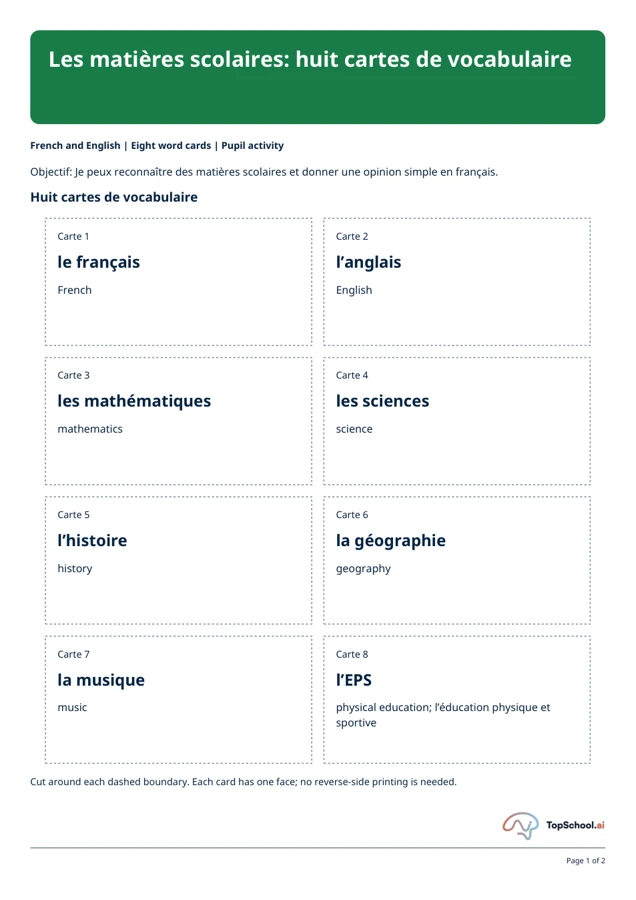
Les matières scolaires: French vocabulary cards
Read the French word and English meaning. Say the article with the noun, then cover the English side and recall the subject.
Explore resourceIdeas to try with your class
Sample teaching perspectives on what to try, what to adapt and what to watch for.
Meet The Creators
Meet a creator whose teaching interests connect with this template.

Storytime Sidekick
The French grid pairs ten school subjects with articles, opinion phrases and seven adjectives, then asks pupils to assemble six sentences from four pieces. The examples show agreement in “c’est créatif” and “c’est ennuyeux” before pupils create their own combinations.
Open Book Pause
For ages 11 to 14, this moves from vocabulary recognition to reasoned preferences using parce que. The article note about le/la becoming l’ before a vowel or silent h gives an explicit form check for subjects such as histoire and anglais.
Planning List
Read the subject with its article, select an opinion and adjective, then join the pieces in the printed order. The examples can be practised orally before pupils write six different sentences.
Helpful Highlighter
The worksheet covers the listed subjects and adjectives, not every agreement pattern in French. Check the article and adjective form in each pupil-created sentence rather than assuming the model rows apply unchanged.