
Languages and literacy
Les matières scolaires: French vocabulary cards
Read eight French school-subject words as separate vocabulary cards, check each article and use one in a short opinion sentence with a reason.
Read the material
Read eight French school-subject words as separate vocabulary cards, check each article and use one in a short opinion sentence with a reason.
Pupil word cards and follow-up task. Use the preview for diagrams and layout.
Page 1
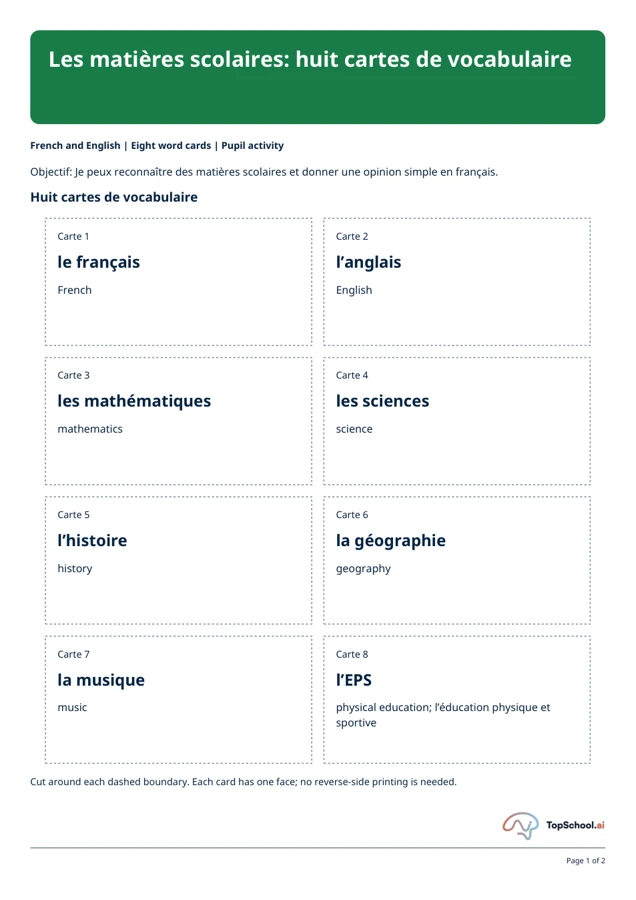
Les matières scolaires: huit cartes de vocabulaire
French and English | Eight word cards | Pupil activity
Objectif: Je peux reconnaître des matières scolaires et donner une opinion simple en français.
Huit cartes de vocabulaire
Carte 1
le français
French
Carte 2
l’anglais
English
Carte 3
les mathématiques
mathematics
Carte 4
les sciences
science
Carte 5
l’histoire
history
Carte 6
la géographie
geography
Carte 7
la musique
music
Carte 8
l’EPS
physical education; l’éducation physique et
sportive
Cut around each dashed boundary. Each card has one face; no reverse-side printing is needed.
Page 1 of 2
Page 2
Les matières scolaires: classe et parle
French and English | Follow-up activity
1. Classe les cartes
Underline le, la, les or l’ with each subject. The l’ in l’anglais, l’histoire and l’EPS is an elided singular article; les
is plural. Say or write each card number under singulier or pluriel, keeping the article with the subject.
Singulier: __________________________________________
Pluriel: __________________________________________
2. Dis ton opinion
J’aime l’histoire parce qu’elle est intéressante.
J’aime la musique parce qu’elle est créative.
J’aime les sciences parce qu’elles sont intéressantes.
3. À toi
Choose a card and complete “J’aime ______ parce que ______.” Read your sentence aloud. Then cover the
English gloss and say the French subject again.
4. Défi
Compare two cards with “Je préfère… parce que…”. Add a second reason and check whether each model
uses elle est or elles sont.
Page 2 of 2
Page 1
Les matières scolaires: teacher key
Teacher key | Supports the eight cards and follow-up task
1. Teacher sorting key
Singulier: cards 1, 2, 5, 6, 7 and 8. Cards 2 (l’anglais), 5 (l’histoire) and 8 (l’EPS) use l’, the elided singular
article.
Pluriel: cards 3 and 4. Les is plural.
2. Teacher check
Keep each article attached to its noun. In the models, elle refers to a singular feminine subject and elles
to the plural sciences.
Page 1 of 1
A teaching sequence
Recognise eight French school-subject words with their articles and use one in a French opinion sentence.
Read articles with subject names
Read each subject card aloud and underline le, la, les or l’ as part of the noun phrase.
Have you kept le, la, les or l' with each subject?
Sort singular and plural
Remember that l’ is the elided singular article used before a vowel or silent h: l’anglais, l’histoire and l’EPS are singular. Sort those with the other singular cards; les sciences and les mathématiques are plural.
Why are l'anglais and l'histoire singular while les sciences is plural?
Build an opinion with agreement
Choose one subject and complete “J’aime… parce que…” with a reason that agrees with the subject.
Does your reason follow the singular or plural model?
Listen and respond to a partner
Swap with a partner. The partner listens for a clear subject word and a reason.
Can you identify the subject and the reason in the whole sentence?
Before you teach
Look for the thinking behind an answer, choose the support your class needs and leave room for an independent response.
What to look for
Expected sort: singular cards 1, 2, 5, 6, 7 and 8; plural cards 3 and 4. The article l’ is singular in l’anglais, l’histoire and l’EPS; les is plural. Expected models: “J’aime l’histoire parce qu’elle est intéressante” and “J’aime les sciences parce qu’elles sont intéressantes.” Follow up: cover the gloss, recall one l’ subject with its article, then make a matching opinion sentence.
Give a little support
Keep the article attached to the noun. Point out l’ as a singular elided article, then model one singular opinion and one plural opinion. Allow pupils to use the printed English gloss before recalling the French.
Take the idea further
Compare two subjects using “Je préfère… parce que…” and give a second reason. Check agreement in “elle est intéressante” and “elles sont intéressantes”.
Things to keep in mind
This set practises French school-subject names and short opinions. Treat l’anglais, l’histoire and l’EPS as singular noun phrases; use a plural model with les sciences or les mathématiques.
Keep the idea. Make it yours.
Bring your topic, learning goal and class context to PLAI™, then review what you create.
Another starting point
Explore a different teaching task from this selection.
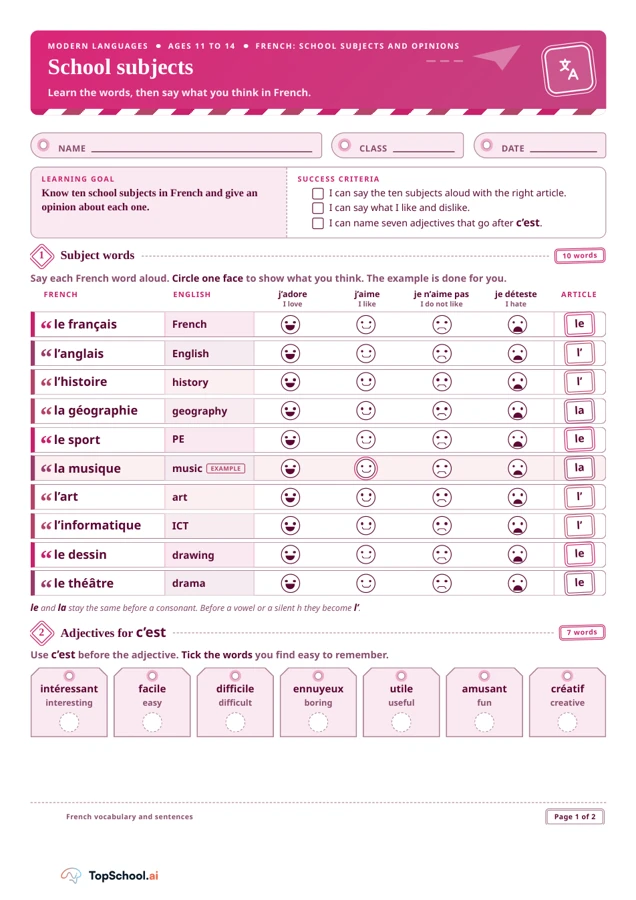
French school subjects: vocabulary and sentences
Say the French subject words aloud and choose an opinion for each one.
Explore resource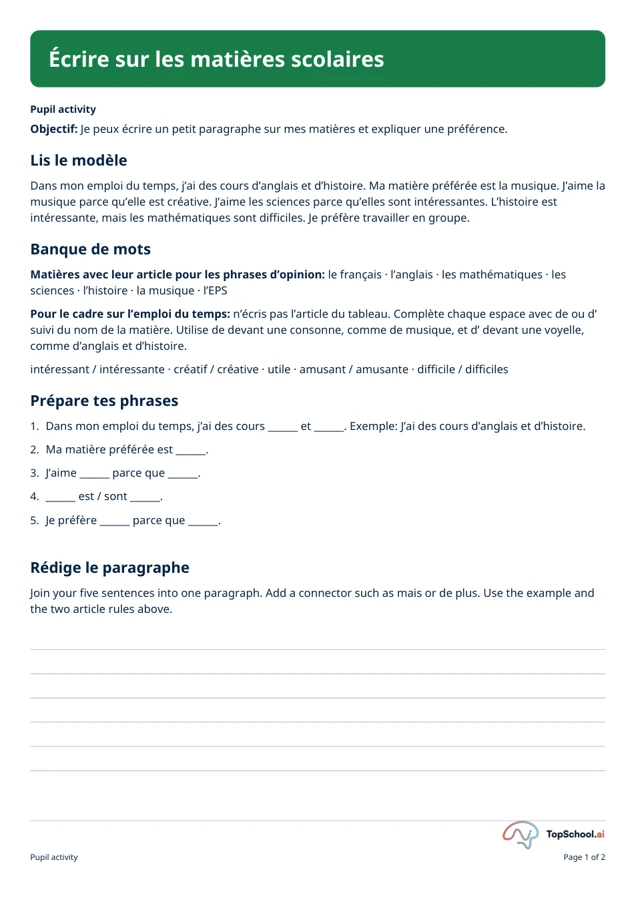
Écrire sur les matières scolaires
Read the model paragraph. Circle the school-subject words, underline the opinion phrases and box the reason introduced by parce que.
Explore resourceIdeas to try with your class
Sample teaching perspectives on what to try, what to adapt and what to watch for.
Meet The Creators
Meet a creator whose teaching interests connect with this template.
Board Eraser
These two-page French-English cards teach eight school subjects with articles, including le français, l'anglais, les mathématiques and l'EPS. Pupils recognise the words and use one in a simple French opinion sentence.
Tea at Breaktime
The articles remain attached to each subject, helping pupils learn the noun phrase rather than a bare translation. The opinion prompt gives a reason to retrieve a card in context.
Page-Turner Planner
Practise saying the French subject with its article, then use an opinion starter and a reason from the course vocabulary. Allow recognition and matching before asking for a full spoken sentence.
Book and Biscuit
The set contains eight subject terms and does not cover all subject vocabulary or opinions. Check pronunciation, article use and the taught sentence structure with the class's French course.