
Teaching and classroom support
My plan: strengths, targets and support
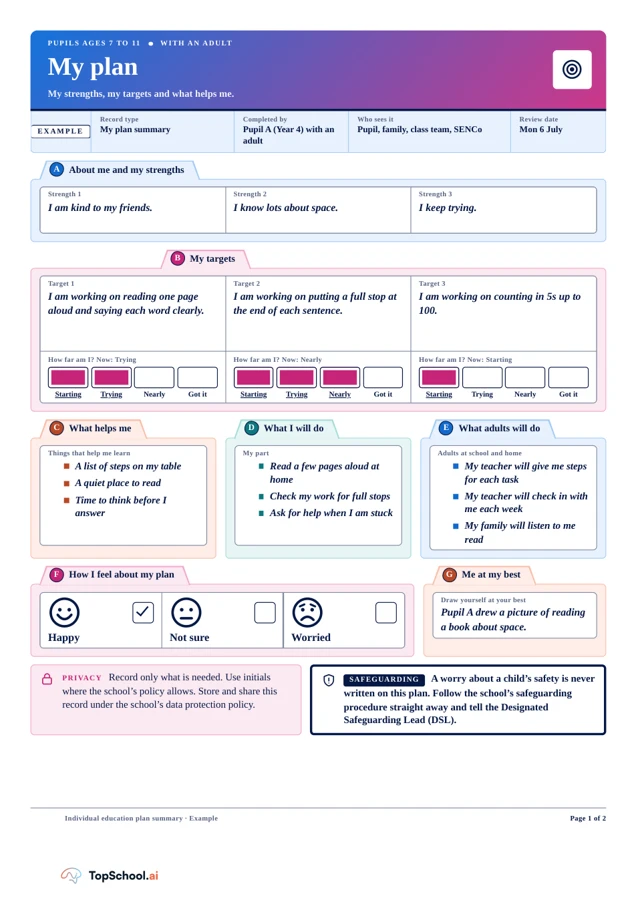
Give a pupil a clear, accessible summary of strengths, current targets and the help agreed with adults at school and home. A worked example models short targets, pupil actions, adult support and a way to show how the pupil feels about the plan.
Read the material
Give a pupil a clear, accessible summary of strengths, current targets and the help agreed with adults at school and home. A worked example models short targets, pupil actions, adult support and a way to show how the pupil feels about the plan.
Complete resource. Use the preview for diagrams and layout.
Page 1
E X A M P L E
Record type
My plan summary
Completed by
Pupil A (Year 4) with an
adult
Who sees it
Pupil, family, class team, SENCo
Review date
Mon 6 July
PRIVACY Record only what is needed. Use initials
where the school’s policy allows. Store and share this
record under the school’s data protection policy.
SAFEGUARDING
 A worry about a child’s safety is never
written on this plan. Follow the school’s safeguarding
procedure straight away and tell the Designated
Safeguarding Lead (DSL).
Individual education plan summary · Example
Page 1 of 2
PUPILS AGES 7 TO 11
WITH AN ADULT
My plan
My strengths, my targets and what helps me.
Strength 1
I am kind to my friends.
Strength 2
I know lots about space.
Strength 3
I keep trying.
Target 1
I am working on reading one page
aloud and saying each word clearly.
Target 2
I am working on putting a full stop at
the end of each sentence.
Target 3
I am working on counting in 5s up to
100.
How far am I? Now: Trying
Starting
Trying
Nearly
Got it
How far am I? Now: Nearly
Starting
Trying
Nearly
Got it
How far am I? Now: Starting
Starting
Trying
Nearly
Got it
Things that help me learn
A list of steps on my table
A quiet place to read
Time to think before I
answer
My part
Read a few pages aloud at
home
Check my work for full stops
Ask for help when I am stuck
Adults at school and home
My teacher will give me steps
for each task
My teacher will check in with
me each week
My family will listen to me
read
Happy
Not sure
Worried
Draw yourself at your best
Pupil A drew a picture of reading
a book about space.
A
About me and my strengths
B
My targets
C
What helps me
D
What I will do
E
What adults will do
F
How I feel about my plan
G
Me at my best
Page 2
Record type
My plan summary
Completed by (pupil and adult)
Who sees it
Pupil, family, class team, SENCo
Review date
PRIVACY Record only what is needed. Use initials
where the school’s policy allows. Store and share this
record under the school’s data protection policy.
SAFEGUARDING
 A worry about a child’s safety is never
written on this plan. Follow the school’s safeguarding
procedure straight away and tell the Designated
Safeguarding Lead (DSL).
Individual education plan summary · Blank template
Page 2 of 2
BLANK TEMPLATE
PUPILS AGES 7 TO 11
My plan
Strength 1
Strength 2
Strength 3
Target 1: I am working on...
Target 2: I am working on...
Target 3: I am working on...
Starting
Trying
Nearly
Got it
Starting
Trying
Nearly
Got it
Starting
Trying
Nearly
Got it
Things that help me learn
My part
Adults at school and home
Happy
Not sure
Worried
Draw yourself at your best
A
About me and my strengths
B
My targets: colour the steps
C
What helps me
D
What I will do
E
What adults will do
F
How I feel about my plan
G
Me at my best
A teaching sequence
Help a pupil identify strengths, understand a small number of targets and know what support adults will provide.
Agree strengths and small targets
Record up to three strengths in the pupil's own or agreed words, using meaningful examples. Choose a small number of clear I-am-working-on targets and explain what progress could look like.
How can the pupil show progress in their own words or chosen format?
Name pupil and adult support
Record things that help the pupil learn, then identify the pupil’s part and what adults at school or home will do. Make sure each action is realistic and agreed.
Which adult action will help with this target?
Offer a choice about reflection
Invite the pupil to show how they feel about the plan and draw themselves at their best. They may choose a response without explaining more than they wish.
Would the pupil like to show a feeling, draw or leave the space blank?
Agree access and review
Agree who will keep the summary, when it will be reviewed and how the pupil can ask for changes or help. Confirm agreement and a review date.
How can the pupil ask for a change before the review date?
Before you teach
Look for the thinking behind an answer, choose the support your class needs and leave room for an independent response.
What to look for
Check that the pupil can describe the targets and the support adults have agreed to provide. Make sure responsibilities are clear, attainable and reviewed with the pupil. A status such as Starting or Trying is a prompt for discussion, not a judgement of the child.
Give a little support
Read the language aloud, use pictures or scribing if helpful and let the pupil make choices. Avoid writing a target that the child cannot control. Include family or specialist input when appropriate, and check that the pupil understands who will see the completed summary.
Take the idea further
At review, ask the pupil which support helped and whether a target still matters. They can suggest a new step or celebrate progress in a format that is meaningful to them.
Things to keep in mind
This is a pupil-friendly summary, not a diagnosis, statutory plan or complete education record. Targets and progress scales should reflect the pupil’s needs and agreed support. Protect completed forms as sensitive information and follow school processes.
Keep the idea. Make it yours.
Bring your topic, learning goal and class context to PLAI™, then review what you create.
Ideas for using this resource
Sample teaching perspectives on what to try, what to adapt and what to watch for.
Meet The Creators
Meet a creator whose teaching interests connect with this template.

Open Book Pause
The two-page pupil plan lists strengths, three targets, progress choices and supports from home and school. The example’s goals are specific (reading a page aloud, using full stops and counting in fives) rather than broad labels.
Five More Minutes
For ages 7 to 11 with an adult, the sheet gives the pupil a role in naming what helps and what they will practise. A review date and named viewers make it possible to revisit the plan with family and school staff.
Spare Pencil
The target progress options and drawing prompt let a pupil show where they are without writing a long account. The supports (steps on a table, quiet place and thinking time) are concrete adjustments to refer back to.
Tea Break Notes
This example is labelled as a summary and does not replace any required formal education plan. Keep the pupil’s privacy and safeguarding notes in view, and agree targets and supports with the relevant adults rather than copying the sample.