
Languages and literacy
French listening: la journée de Camille
A teacher-read French script supplied with this task supports two listens for gist and detail, including likes and dislikes, followed by an evidence-based summary.
Read the material
A teacher-read French script supplied with this task supports two listens for gist and detail, including likes and dislikes, followed by an evidence-based summary.
Pupil activity and after-attempt self-check with adult guidance. Use the preview for diagrams and layout.
Page 1
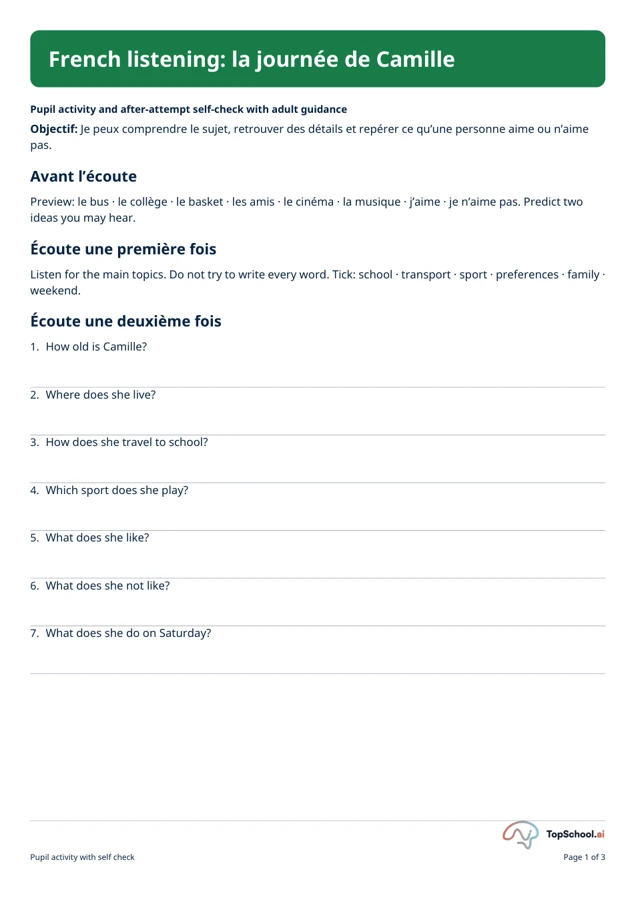
French listening: la journée de Camille
Pupil activity and after-attempt self-check with adult guidance
Objectif: Je peux comprendre le sujet, retrouver des détails et repérer ce qu’une personne aime ou n’aime
pas.
Avant l’écoute
Preview: le bus · le collège · le basket · les amis · le cinéma · la musique · j’aime · je n’aime pas. Predict two
ideas you may hear.
Écoute une première fois
Listen for the main topics. Do not try to write every word. Tick: school · transport · sport · preferences · family ·
weekend.
Écoute une deuxième fois
1. How old is Camille?
2. Where does she live?
3. How does she travel to school?
4. Which sport does she play?
5. What does she like?
6. What does she not like?
7. What does she do on Saturday?
Pupil activity with self check
Page 1 of 3
Page 2
French listening: la journée de Camille
Likes and dislikes
Likes
Dislikes
________
________
Compare avec un partenaire
Compare your detail notes and underline the French words that support each answer. If needed, the teacher
may read one sentence again.
Après l'écoute
Write four English sentences about Camille. Include at least one thing she likes and one thing she does not
like. Underline the French words that helped you.
Pour aller plus loin
Write one new French question you could ask Camille. Underline the detail you hope her answer will add.
Pupil activity with self check
Page 2 of 3
Page 3
French listening: la journée de Camille
Self-check: use after your first attempt
Script supplied
 (teacher reads aloud)
Bonjour, je m'appelle Camille et j'ai treize ans. J'habite à Lyon avec ma mère et mon frère. Le matin, je prends
le bus pour aller au collège. Le mardi, j'ai cours de français et de sciences. À midi, je déjeune avec mes amis.
Après les cours, je joue au basket. J'aime le basket et la musique. Je n'aime pas le football. Le samedi, je vais
au cinéma avec mon frère. Le dimanche, je lis ou j'écoute de la musique.
Pupil activity with self check
Page 3 of 3
Page 1
French listening: la journée de Camille
Teacher key and guidance supporting this exact edition
Script supplied
 (teacher reads aloud)
Bonjour, je m'appelle Camille et j'ai treize ans. J'habite à Lyon avec ma mère et mon frère. Le matin, je prends
le bus pour aller au collège. Le mardi, j'ai cours de français et de sciences. À midi, je déjeune avec mes amis.
Après les cours, je joue au basket. J'aime le basket et la musique. Je n'aime pas le football. Le samedi, je vais
au cinéma avec mon frère. Le dimanche, je lis ou j'écoute de la musique.
Teacher answer key
Camille is thirteen. She lives in Lyon. She takes the bus to school. She plays basketball. She likes basketball
and music. She does not like football. On Saturday, she goes to the cinema with her brother. In the script,
“J'aime” introduces what she likes and “Je n'aime pas” introduces what she does not like.
Teacher companion
Page 1 of 1
A teaching sequence
Identify the topic and retrieve key details, including a speaker’s likes and dislikes, from a short French account of a teenager’s weekday and weekend.
Hear the main topics
Read the supplied French script once at a natural, measured pace. Pupils choose the main topics they hear without writing every word.
Which words suggest the main topics without a full transcription?
Record Camille's details
Read it a second time. Pupils note Camille’s age, city, transport, sport, likes, dislikes and Saturday activity.
What stated phrase names a like and a dislike?
Compare evidence with a partner
Compare notes with a partner. Find the French words that support each answer, including the phrases that state what Camille likes and does not like.
Which French words support the detail you recorded?
Summarise what was heard
Write or say four English summary sentences using details heard. Include at least one like and one dislike.
Does your summary include at least one stated like and one dislike?
Before you teach
Look for the thinking behind an answer, choose the support your class needs and leave room for an independent response.
What to look for
Expected answers from the script supplied with this version: Camille is 13; she lives in Lyon; she takes the bus to school; she plays basketball; she likes basketball and music; she does not like football; on Saturday she goes to the cinema with her brother. Follow up: ask pupils to find “J'aime” and “Je n'aime pas” in the script and place the details in the Likes and Dislikes boxes before explaining which words support each choice.
Give a little support
Preview the key words with pronunciation, allow pupils to draw a simple morning/evening/weekend table and repeat one sentence if the class needs a third listen.
Take the idea further
Ask pupils to write one new French question they could ask Camille and explain which detail they would like to know.
Things to keep in mind
No recording is supplied. Read the script included with this version aloud for the listening rounds; pupils listen for details and the speaker’s stated likes and dislikes.
Keep the idea. Make it yours.
Bring your topic, learning goal and class context to PLAI™, then review what you create.
Ideas for using this resource
Sample teaching perspectives on what to try, what to adapt and what to watch for.
Meet The Creators
Meet a creator whose teaching interests connect with this template.

Calm Table
The answer key needs all seven details, not just the preferences: Camille is 13, lives in Lyon, takes the bus, plays basketball, likes basketball and music, dislikes football, and goes to the cinema with her brother on Saturday. That closes the questions and likes/dislikes boxes cleanly.
One Last Sticky Note
The two listens have different jobs: first tick the broad topics, then retrieve the seven facts. Since this edition includes a teacher-read script rather than a recording, the lesson plan should make the reading pace and repeat policy explicit.
Five More Minutes
The eight preview terms are well chosen for the script; a simple morning/evening/weekend table can hold notes without requiring a transcript. If needed, repeating one sentence after the second pass targets a gap without replaying the whole day.
The Curious Pencil
The supplied script is the audio source, so this cannot test response to a recording or unfamiliar speaker. A follow-up French question should ask for information Camille has not yet given, such as what she reads on Sunday, rather than restating one of the seven answers.