
Maths
Fraction wall: equivalent fractions
Shade parts of a fraction wall, compare their lengths and look for different fractions that cover the same amount. The activity pairs partitioned bars with a number line, then offers a challenge panel and two controls for comparing fractions.
The same length: 1/2, 2/4, 3/6 and 4/8. Open the wall to shade and compare other fractions.
Read the complete materialRead the material
Shade parts of a fraction wall, compare their lengths and look for different fractions that cover the same amount. The activity pairs partitioned bars with a number line, then offers a challenge panel and two controls for comparing fractions.
Fraction wall: equivalent fractions. Use the preview for diagrams and layout.
Choose a fraction row and shade consecutive parts of its bar. The activity names the shaded fraction and places its endpoint on a common number line. Compare endpoints across rows, or use the two labelled fraction selectors to compare values. The challenge panel reports the current target and progress.
A teaching sequence
Represent fractions on a shared whole, recognise equivalent amounts by comparing lengths and explain a fraction comparison.
The same length: 1/2, 2/4, 3/6 and 4/8. Open the wall to shade and compare other fractions.
Read the complete materialShade part of one whole
Select a row of the wall and shade a fraction by choosing its tiles. Say the fraction aloud and identify the whole represented by that row.
What whole does this row represent?
The same length: 1/2, 2/4, 3/6 and 4/8. Open the wall to shade and compare other fractions.
Read the complete materialFind equal endpoints
Compare the shaded endpoint with other rows and the number line. Follow up with, “How does the number line help you check?”
Which rows reach the same point on the number line?
Build a challenge match
Start a challenge and build an equivalent fraction for its target. Read the progress display as feedback about this task, then explain one match.
How do the shaded bars show your equivalent fraction?
Predict and compare
Use the comparison controls to choose two fractions. Predict which is greater or whether they are equal, then check the displayed comparison.
Are the two fractions compared using equal wholes?
Before you teach
Look for the thinking behind an answer, choose the support your class needs and leave room for an independent response.
What to look for
Ask pupils to justify a match by comparing the length covered, not by saying that the larger numbers must make the fraction larger. For example, “One half and two quarters reach the same point on the wall.” Follow up with: “How does the number line support your explanation?”
Give a little support
Begin with halves and quarters, and shade one row together before pupils work independently. Keep the same whole visible across rows. Invite pupils to point to matching endpoints or describe them with words before introducing equivalent-fraction notation.
Take the idea further
Ask pupils to find all available rows that match one target amount, then explain which representation is easiest to recognise and why. They can compare two fractions close in value and use the number line to defend their ordering.
Things to keep in mind
The wall uses a fixed set of denominators and the challenge panel provides bounded practice, not an assessment of all fraction knowledge. Check the challenge sequence and comparison feedback before using it to judge attainment. The bars are visual representations of one whole and do not provide a paper export.
Keep the idea. Make it yours.
Bring your topic, learning goal and class context to PLAI™, then review what you create.
Another starting point
Explore a different teaching task from this selection.
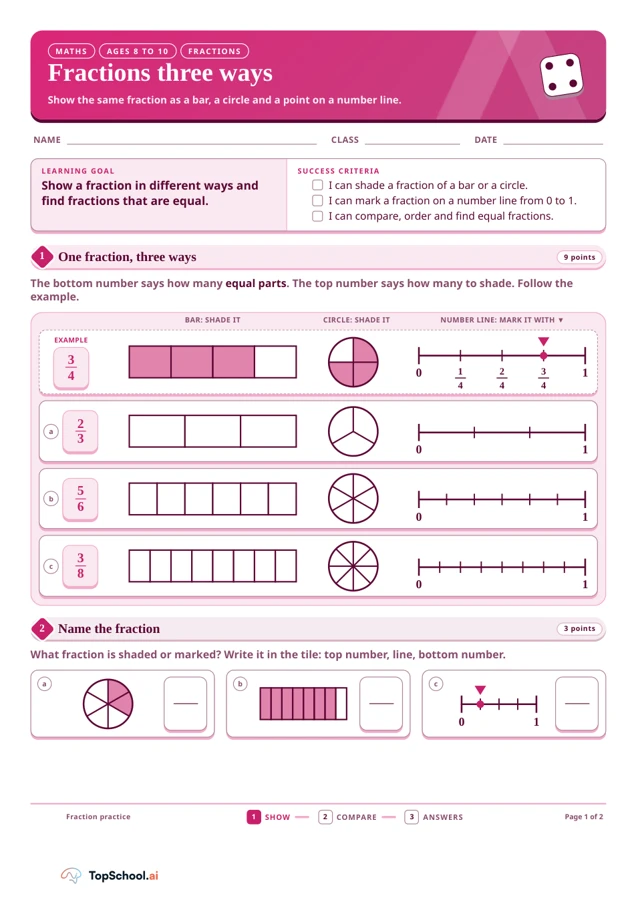
Fractions three ways
Show the same fraction three ways. Use equal wholes to compare values and explain your thinking.
Explore resourceIdeas to try with your class
Sample teaching perspectives on what to try, what to adapt and what to watch for.
Meet The Creators
Meet a creator whose teaching interests connect with this template.

Glue Stick Club
This Year 5 interactive fraction wall lets pupils shade rows, compare endpoints across partitions, use a number line and answer bounded equivalence challenges. Separate comparison controls ask whether two fractions are greater or equal.
Clear Example
The shared whole makes equivalent amounts visible: one half and two quarters reach the same point. The teacher prompt asks pupils to justify the match by length, rather than compare numerators or denominators alone.
Reread Reminder
Start with halves and quarters, shade a row and compare equal endpoints across the fraction wall and number line. Keep the same whole visible and invite a verbal explanation before introducing equivalent-fraction notation.
Paperclip Perspective
The wall has a fixed set of denominators and bounded challenges, so it does not assess all fraction knowledge. Check the challenge feedback before using it to judge attainment; the activity has no paper export.