
Wellbeing and personal development
My form-time week: reflection and targets
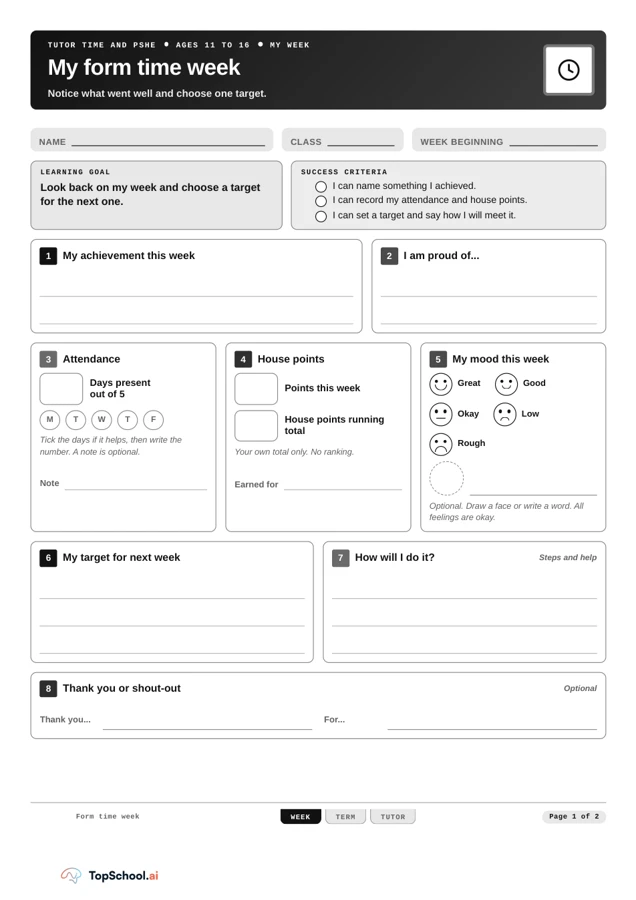
Record a weekly achievement, attendance, house points and an optional mood, then choose a target and the support that may help. A second page gathers six weeks of attendance and points and offers space to reflect on what worked and what felt difficult.
Read the material
Record a weekly achievement, attendance, house points and an optional mood, then choose a target and the support that may help. A second page gathers six weeks of attendance and points and offers space to reflect on what worked and what felt difficult.
Complete resource. Use the preview for diagrams and layout.
Page 1
NAME
CLASS
WEEK BEGINNING
LEARNING GOAL
Look back on my week and choose a target
for the next one.
SUCCESS CRITERIA
I can name something I achieved.
I can record my attendance and house points.
I can set a target and say how I will meet it.
Form time week
WEEK
TERM
TUTOR
Page 1 of 2
TUTOR TIME AND PSHE
AGES 11 TO 16
MY WEEK
My form time week
Notice what went well and choose one target.
1
My achievement this week
2
I am proud of...
3
Attendance
Days present
out of 5
M
T
W
T
F
Tick the days if it helps, then write the
number. A note is optional.
Note
4
House points
Points this week
House points running
total
Your own total only. No ranking.
Earned for
5
My mood this week
Great
Good
Okay
Low
Rough
Optional. Draw a face or write a word. All
feelings are okay.
6
My target for next week
7
How will I do it?
Steps and help
8
Thank you or shout-out
Optional
Thank you...
For...
Page 2
NAME
CLASS
Form time week
WEEK
TERM
TUTOR
Page 2 of 2
TUTOR TIME AND PSHE
AGES 11 TO 16
SIX WEEKS
My term view
1
Six weeks at a glance
Circle one in Met?
WEEK
DAYS IN
(OF 5)
POINTS
TOTAL
MY TARGET
MET?
REFLECTION
1
Met
Partly
Not yet
2
Met
Partly
Not yet
3
Met
Partly
Not yet
4
Met
Partly
Not yet
5
Met
Partly
Not yet
6
Met
Partly
Not yet
2
Targets so far
Shade a step per week
Met
1
2
3
4
5
6
Partly
1
2
3
4
5
6
Not yet
1
2
3
4
5
6
3
Term totals
Days present
House points total
4
Mood through the term
Optional
W1
W2
W3
W4
W5
W6
A word or a small face for each week, if you want to. All feelings are okay.
5
What worked
6
What was hard
7
Next term
A teaching sequence
Reflect on a week, record personal information selectively and set one achievable next target.
Record only chosen weekly details
Record an achievement, days present out of five and house points as a personal total. Mood words or drawings are optional.
Would you prefer to leave the mood prompt blank?
Set a supported target
Set one target, a step that could help and a person or resource to ask for support. Add an optional thank-you.
Which person or resource can help make the target manageable?
Review the six-week record privately
For six weeks, record attendance, points and target status, then reflect on what worked and what felt difficult. Share only with agreed people.
What worked in your own plan without treating attendance as personal worth?
Choose a next-term step
Ask, “What support could make this target manageable?” Agree a next-term step; treat records as context, not a measure of a pupil’s worth.
What support would make the next target realistic?
Before you teach
Look for the thinking behind an answer, choose the support your class needs and leave room for an independent response.
What to look for
Look for a target that is clear and achievable, plus a possible step or source of help. Use attendance and points as contextual records, not measures of a pupil’s worth. A mood entry is optional; respond supportively to anything a pupil chooses to raise and follow school wellbeing procedures where needed.
Give a little support
Allow pupils to write, draw or discuss a response and to leave any optional field blank. Use private check-ins rather than public comparison. Offer help turning a broad aim into one small action and make sure pupils know which adult they can approach.
Take the idea further
At the end of six weeks, ask pupils to compare their targets with the steps they tried. They can identify one strategy to keep, one support that helped and one change for the next term, without treating every target as either success or failure.
Things to keep in mind
This is a reflection and record-keeping tool, not a mental-health or attendance assessment. Mood entries are optional and may contain sensitive personal information. Use the school’s privacy and safeguarding procedures and do not promise confidentiality beyond those rules.
Keep the idea. Make it yours.
Bring your topic, learning goal and class context to PLAI™, then review what you create.
Ideas to try with your class
Sample teaching perspectives on what to try, what to adapt and what to watch for.
Meet The Creators
Meet the creators whose teaching interests connect with this template. Find an approach to try with your class.

Gareth Pryce
My classroom work is Year 7 Geography, so transition is not an abstract process for me: it meets pupils in the routines and subjects they encounter when they arrive.
Meet the creator
Sophie Rylance
As Head of Year, I work with tutors through the options process and look at whether a pupil’s stated interests line up with the subjects they have selected.
Meet the creator
Page-Turner Planner
The two pages cover an achievement, attendance, house points, optional mood, one next-week target and a six-week view. The sheet explicitly says house points are each pupil’s own total with no ranking and that mood is optional.
Helpful Highlighter
For ages 11 to 16, the first page supports a weekly check-in while the second helps the pupil notice patterns across a term. “What worked” and “what was hard” make the target review more reflective than a tick alone.
Pencil Case Pal
A pupil can draw a face or write a word for mood, or leave it out, and a note on attendance is optional. The target section asks for steps and help, giving a route from intention to action.
Gentle Reminder
Mood and attendance are personal information; keep completed sheets private and use the optional fields without pressure. The tracker says not to rank house points, and its mood choices do not diagnose wellbeing.