
Religious and values education
Explore a dilemma: ethical reasoning frame
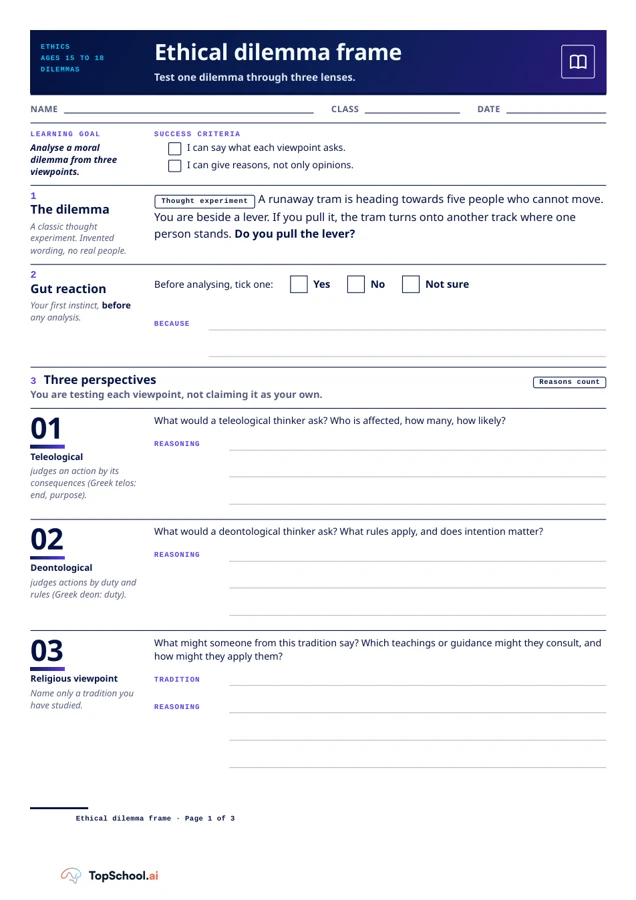
Compare how three ethical viewpoints might approach two invented versions of a runaway-tram dilemma. Pupils record an initial reaction, test each case through consequences, duties and a studied religious tradition, then weigh arguments and explain a final position.
Read the material
Compare how three ethical viewpoints might approach two invented versions of a runaway-tram dilemma. Pupils record an initial reaction, test each case through consequences, duties and a studied religious tradition, then weigh arguments and explain a final position.
Complete resource. Use the preview for diagrams and layout.
Page 1
NAME
CLASS
DATE
LEARNING GOAL
Analyse a moral
dilemma from three
viewpoints.
SUCCESS CRITERIA
I can say what each viewpoint asks.
I can give reasons, not only opinions.
1
The dilemma
A classic thought
experiment. Invented
wording, no real people.
Thought experiment A runaway tram is heading towards five people who cannot move.
You are beside a lever. If you pull it, the tram turns onto another track where one
person stands. Do you pull the lever?
2
Gut reaction
Your first instinct, before
any analysis.
Before analysing, tick one:
Yes
No
Not sure
BECAUSE
3 Three perspectives
Reasons count
You are testing each viewpoint, not claiming it as your own.
01
Teleological
judges an action by its
consequences (Greek telos:
end, purpose).
What would a teleological thinker ask? Who is affected, how many, how likely?
02
Deontological
judges actions by duty and
rules (Greek deon: duty).
What would a deontological thinker ask? What rules apply, and does intention matter?
03
Religious viewpoint
Name only a tradition you
have studied.
What might someone from this tradition say? Which teachings or guidance might they consult, and
how might they apply them?
Ethical dilemma frame · Page 1 of 3
ETHICS
AGES 15 TO 18
DILEMMAS
Ethical dilemma frame
Test one dilemma through three lenses.
REASONING
REASONING
TRADITION
REASONING
Page 2
4
A variation
Invented for this sheet.
Variation The same tram, but the only way to stop it is to push a stranger onto the
track. Do you push?
5 Compare the two
Both dilemmas
Use your page 1 notes. Be specific.
a
My view
Lever and push.
+
Strongest argument for
Your best reason to act.
−
Strongest argument
against
Your best reason not to.
?
Did my view change?
Say why, or why not.
6 Check each lens
Tick one per row
Does each viewpoint give the same answer to both dilemmas?
Teleological
Same answer
Different answer
Unsure
Deontological
Same answer
Different answer
Unsure
Religious (my tradition)
Same answer
Different answer
Unsure
DIFFERENCE
Ethical dilemma frame · Page 2 of 3
ETHICS
AGES 15 TO 18
DILEMMAS
Compare and evaluate
LEVER
PUSH
ARGUMENT
ARGUMENT
YES OR NO,
AND WHY
Page 3
7 Evaluate
8 lines
How far do the three viewpoints agree? Which reasoning persuades you most, and why?1
STARTERS
A teleological thinker would say…
However, a duty-based view…
The strongest reason is…
I changed my mind because…
One weakness is…
?
What would change my
mind?
A fact, a rule or a teaching.
vs
A partner challenges me
Listen, then reply.
8
My final position
Back to the lever.
Now I would pull the lever:
Yes
No
Not sure
ONE QUESTION
I STILL HAVE
1 Both dilemmas are invented thought experiments. Never share a personal experience on this sheet.
Ethical dilemma frame · Page 3 of 3
ETHICS
AGES 15 TO 18
DILEMMAS
Evaluate and reflect
I WOULD
CHANGE IF
CHALLENGE
MY REPLY
A teaching sequence
Compare ethical reasoning through consequences, duties and a studied religious tradition, then justify a position with reasons.
Record an initial dilemma choice
Read the lever scenario, record an initial choice as an instinct and add one reason.
What reason supports your first instinct?
Compare the three lenses
For the first case, compare consequences, duties or rules, and a religious viewpoint from a tradition pupils have studied.
What would each lens ask about the same invented case?
Reconsider the changed case
Read the altered case where stopping the tram means pushing a stranger. Compare reasons for both choices and note whether your view changes.
Which change affects your reasoning between lever and push?
Refine a supported position
Compare what changes between the two cases and where the ethical lenses agree. Consider a partner's challenge and refine the position without requiring agreement.
What fact, rule or studied teaching could change your judgement?
Before you teach
Look for the thinking behind an answer, choose the support your class needs and leave room for an independent response.
What to look for
Look for a fair account of each viewpoint, reasons linked to the scenario and a comparison of the two cases. Check that a named religious tradition is one pupils have studied and is represented through an appropriate teaching or source. A thoughtful answer may remain uncertain; agreement or a changed view is not required.
Give a little support
Pre-teach teleological and deontological in neutral language. Let pupils plan silently or write instead of speaking, and use a fictional third-person response if the scenario feels uncomfortable. Provide a short extract from a tradition studied in class rather than expecting pupils to speak for a whole faith.
Take the idea further
Ask pupils to identify an assumption that stays fixed in both scenarios and one feature that changes. They can compare whether the ethical lens gives a consistent answer, then evaluate a limitation of applying that lens to a simplified hypothetical case.
Things to keep in mind
The two scenarios simplify moral choices and do not represent an actual event. The frame introduces only three lenses, and a religious tradition is not a single uniform viewpoint. Do not use the activity to ask pupils to disclose personal experiences or to rank classmates’ beliefs.
Keep the idea. Make it yours.
Bring your topic, learning goal and class context to PLAI™, then review what you create.
Ideas to try with your class
Sample teaching perspectives on what to try, what to adapt and what to watch for.
Meet The Creators
Meet a creator whose teaching interests connect with this template.

One Last Sticky Note
The three-page frame separates a first reaction from teleological consequences, deontological duties and a studied religious tradition. It then changes the tram case from pulling a lever to pushing a stranger, asking pupils to compare the dilemmas.
Book and Biscuit
The question asks for reasons and a final position instead of a bare opinion. Its instruction to name only a tradition already studied avoids inventing religious teaching for the exercise.
Helpful Highlighter
Complete one lens at a time and record who is affected, which rule might apply or which source a tradition would consult. The repeated reasoning boxes support comparison without requiring a pupil to state that any one view is their personal belief.
Storytime Sidekick
The dilemmas are invented and the religious response must come from an accurate studied source. Do not generalise about a whole tradition or present either scenario as a real event.