
Design and technology
Design specification: a desk tidy
Turn a client’s desk problem into a design brief and testable ACCESS FM specification. This two-page A4 design and technology project provides a made-up Year 7 client, measured storage needs, interview prompts, sketch space and a materials shortlist.
Read the material
Turn a client’s desk problem into a design brief and testable ACCESS FM specification. This two-page A4 design and technology project provides a made-up Year 7 client, measured storage needs, interview prompts, sketch space and a materials shortlist.
Complete resource. Use the preview for diagrams and layout.
Page 1
NAME
CLASS
DATE
LEARNING GOAL
Turn a client's problem into a clear design
brief and a specification you can test.
SUCCESS CRITERIA
I can write a brief naming the user and the problem.
I can find user needs with open questions.
I can write measurable ACCESS FM criteria.
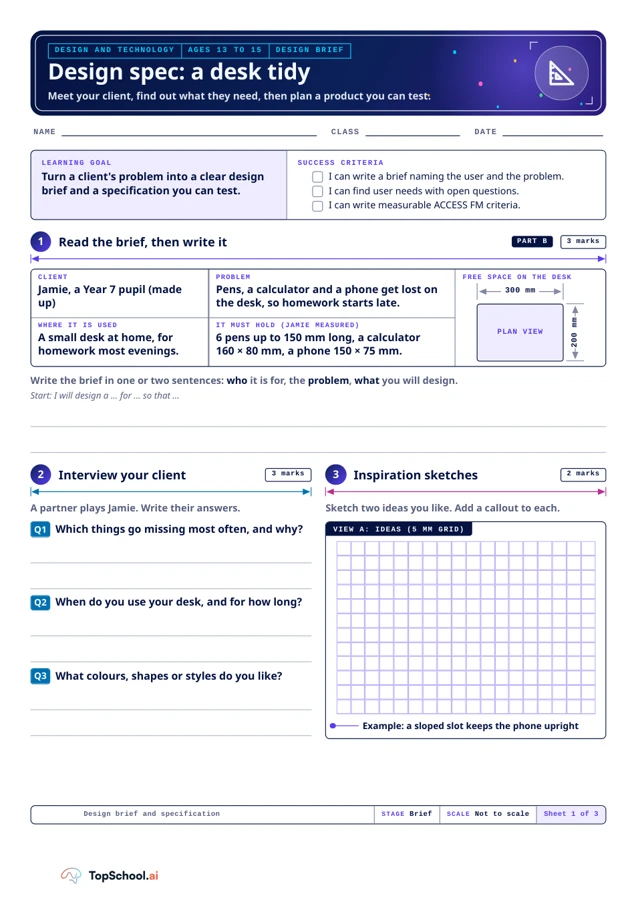
CLIENT
Jamie, a Year 7 pupil (made
up)
PROBLEM
Pens, a calculator and a phone get lost on
the desk, so homework starts late.
FREE SPACE ON THE DESK
PLAN VIEW
WHERE IT IS USED
A small desk at home, for
homework most evenings.
IT MUST HOLD (JAMIE MEASURED)
6 pens up to 150 mm long, a calculator
160 × 80 mm, a phone 150 × 75 mm.
Write the brief in one or two sentences: who it is for, the problem, what you will design.
Start: I will design a ... for ... so that ...
A partner plays Jamie. Write their answers.
Q1
Which things go missing most often, and why?
Q2
When do you use your desk, and for how long?
Q3
What colours, shapes or styles do you like?
Sketch two ideas you like. Add a callout to each.
Design brief and specification
STAGE Brief
SCALE Not to scale
Sheet 1 of 3
DESIGN AND TECHNOLOGY
AGES 13 TO 15
DESIGN BRIEF
Design spec: a desk tidy
Meet your client, find out what they need, then plan a product you can test.
1
Read the brief, then write it
PART B
3 marks
300 mm
200 mm
2
Interview your client
3 marks
3
Inspiration sketches
2 marks
VIEW A: IDEAS (5 MM GRID)
Example: a sloped slot keeps the phone upright
Page 2
Write one criterion you can measure for each area, and how you will test it. Read the Size model first.
AREA
CRITERION: IT MUST ...
HOW I WILL TEST IT
A
AESTHETICS
look, colour, shape,
finish
C
COST
budget for materials
C
CUSTOMER
what Jamie needs and
likes
E
ENVIRONMENT
waste, reuse, recycling
S
SAFETY
edges, corners, stability
S
SIZE
MODEL
It must fit the free space: no more than 300 mm
wide and 200 mm deep.
Measure the finished product with a
steel rule and check it fits the space.
F
FUNCTION
what it must hold or do
M
MATERIALS
what it is made from,
and why
Name three materials you could use. Give one reason each links to your specification.
MATERIAL 1 AND WHY
MATERIAL 2 AND WHY
MATERIAL 3 AND WHY
Design brief and specification
DRAWN BY
REV
Sheet 2 of 3
DESIGN AND TECHNOLOGY
AGES 13 TO 15
SPECIFICATION
Write a specification you can test
4
Specification: ACCESS FM
PART S
14 marks
5
Materials shortlist
3 marks
A
A teaching sequence
Write a design brief and measurable ACCESS FM specification that respond to a user’s stated needs and can be tested.
Write the user and problem brief
Write a one- or two-sentence brief naming the fictional user, the problem and what will be designed.
Who is the fictional desk tidy for, and what must it solve?
Interview for user needs
Use the interview prompts to find out what is used, when the desk is used and what style the user likes.
Which answer tells you how and when the desk is used?
Sketch two ideas
Sketch two initial ideas and label one feature on each.
What labelled feature responds to a stated user need?
Specify a measurable test
Write one measurable, testable criterion for each ACCESS FM area and shortlist materials with a reason linked to the specification. Describe how you would test whether the tidy holds the intended items and fits the available space.
How will you know the tidy holds the items and fits the space?
Before you teach
Look for the thinking behind an answer, choose the support your class needs and leave room for an independent response.
What to look for
Check that a brief names the user and problem and that each criterion can be measured or tested. Ask: “How will you know whether the product holds the items and fits the space?” The client and dimensions are fictional and should not be treated as actual research.
Give a little support
Model one open client question and one measurable test. Provide a small set of material samples or measurement tools, and let pupils sketch ideas before writing all eight criteria.
Take the idea further
Build a small mock-up from scrap material and test one criterion with a ruler or sample objects. Pupils can revise the specification if the test reveals that a measurement or user need was unclear.
Things to keep in mind
The business brief uses made-up dimensions and a fictional name. Pupils need to gather genuine user needs and verify actual measurements for a real product.
Keep the idea. Make it yours.
Bring your topic, learning goal and class context to PLAI™, then review what you create.
Ideas to try with your class
Sample teaching perspectives on what to try, what to adapt and what to watch for.
Meet The Creators
Meet the creators whose teaching interests connect with this template. Find an approach to try with your class.

Daniel Lee
I teach debugging through working artefacts: pupils compare what they expected with what happened, change one part at a time and explain what they tested and improved.
Meet the creator
Nathan Boateng
When something does not stand up or function as intended, we can ask why, identify a constraint and try another solution.
Meet the creator
Josh Renshaw
The wording has to fit the work underway, whether a student is setting up equipment or following a sequence in a computing task.
Meet the creatorPatrick Nkemelu
I use clear scoring rubrics for design-and-build challenges, making criteria visible in advance so student judges can compare entries fairly while allowing different ideas and solutions.
Meet the creator
Coffee Before Copies
The fictional Year 7 client needs a desk tidy for six pens up to 150 mm, a 160 × 80 mm calculator and a 150 × 75 mm phone. The task moves from the brief to an interview, sketches and measurable ACCESS FM criteria.
Spare Pencil
The specification is intended to be testable against stated user needs: a small home desk, used most evenings, with named objects and dimensions. Asking a partner to play Jamie gives the interview questions a concrete role in developing the brief.
Little Lightbulbs
The sentence frame “I will design a … for … so that …” helps pupils state user and problem before sketching. Callouts on two ideas can make a design feature visible before it is converted into a measurable requirement.
Reread Reminder
Jamie is a fictional client and the plan view says it is not to scale. Treat the measurements as this case’s constraints, then test a prototype against them; do not present the invented preferences as real user research.