
Languages and literacy
Lady Macbeth: character and theme analysis
Trace Lady Macbeth’s changing role through selected quotations, a relationship map and a scene-by-scene arc. Use evidence from the play to plan an analytical paragraph; quotations and line references vary between editions.
Read the material
Trace Lady Macbeth’s changing role through selected quotations, a relationship map and a scene-by-scene arc. Use evidence from the play to plan an analytical paragraph; quotations and line references vary between editions.
Activity. Use the preview for diagrams and layout.
Page 1
NAME
CLASS
DATE
LEARNING GOAL
Analyse how Shakespeare presents Lady
Macbeth, and how she changes.
SUCCESS CRITERIA
I can link a trait to a quotation and explain key words.
I can explain what her relationships show about her.
I can track her change and link it to the play's themes.
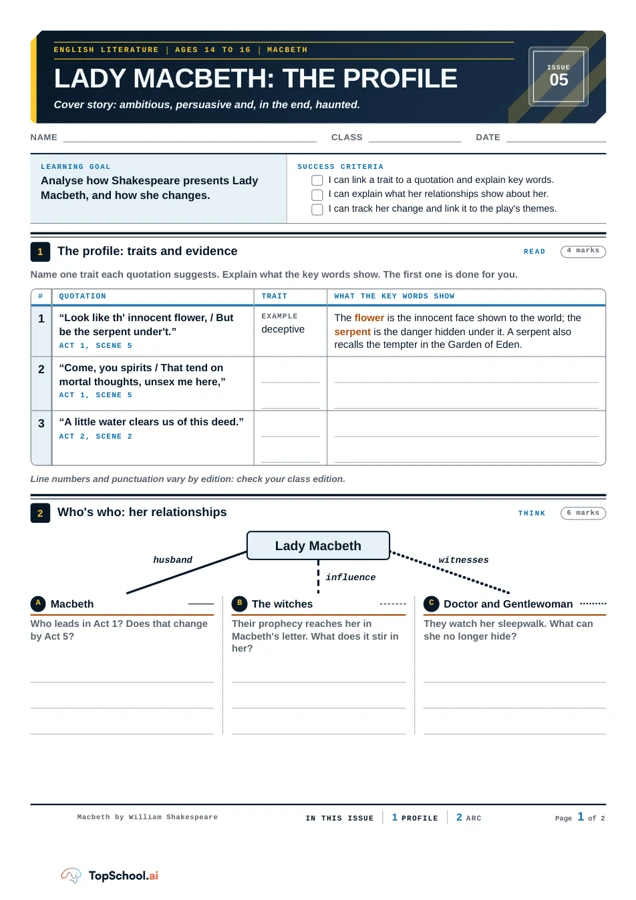
Name one trait each quotation suggests. Explain what the key words show. The first one is done for you.
#
QUOTATION
TRAIT
WHAT THE KEY WORDS SHOW
1
“Look like th' innocent flower, / But
be the serpent under't.”
ACT 1, SCENE 5
EXAMPLE
deceptive
The flower is the innocent face shown to the world; the
serpent is the danger hidden under it. A serpent also
recalls the tempter in the Garden of Eden.
2
“Come, you spirits / That tend on
mortal thoughts, unsex me here,”
ACT 1, SCENE 5
3
“A little water clears us of this deed.”
ACT 2, SCENE 2
Line numbers and punctuation vary by edition: check your class edition.
Lady Macbeth
husband
influence
witnesses
A
Macbeth
Who leads in Act 1? Does that change
by Act 5?
B
The witches
Their prophecy reaches her in
Macbeth's letter. What does it stir in
her?
C
Doctor and Gentlewoman
They watch her sleepwalk. What can
she no longer hide?
Macbeth by William Shakespeare
IN THIS ISSUE
1 PROFILE
2 ARC
E N G L I S H L I T E R A T U R E
A G E S 1 4 T O 1 6
M A C B E T H
LADY MACBETH: THE PROFILE
Cover story: ambitious, persuasive and, in the end, haunted.
ISSUE
05
1
The profile: traits and evidence
R E A D
4 marks
2
Who's who: her relationships
T H I N K
6 marks
Page 1 of 2
Page 2
NAME
CLASS
DATE
Read each stop. Circle her control (1 = none, 5 = total). Write one reason.
Ambition
NO.
Guilt
NO.
Appearance and reality
NO.
Gender
NO.
QUESTION How does Shakespeare present the change in Lady Macbeth from Act 1 to Act 5?
STARTERS
At the start, Shakespeare
presents her as ...
This is clear when she
says ...
The word "..." suggests ...
However, by Act 5 ...
This links to the theme
of ...
Character and theme analysis · Feature desk
I S S U E 0 5
M A C B E T H
F E A T U R E D E S K
FROM POWER TO GUILT
3
Her development arc
P L A N
She reads Macbeth's letter about the
witches' prophecy. She persuades him to
kill King Duncan, and plans the murder.
See quotations 1 and 2
ACT 1
1
2
3
4
5
After the murder, she returns the
daggers.
See quotation 3
ACT 2
1
2
3
4
5
Watched by a Doctor and a Gentlewoman, she
sleepwalks, trying to wash imagined blood from
her hands. Later, her death is reported.
“Out, damned spot! out, I say!” (5.1)
ACT 5
1
2
3
4
5
4
Theme links: best quotation, one idea
T H I N K
5
Write an exam-style paragraph
W R I T E
10 marks
What's done cannot be
undone.
ACT 5, SCENE 1
“
Page 2 of 2
A teaching sequence
Explain how Shakespeare presents Lady Macbeth and how evidence from different parts of the play shows her changing relationship with ambition, power and guilt.
Link a trait to a word
Analyse a quotation by naming a trait and explaining how a key word supports it; compare the completed flower/serpent example with the two blank rows.
Which word in the quotation supports the trait you named?
Map the relationships
Use the relationship map to consider Macbeth, the witches, the doctor and the gentlewoman, drawing on scenes rather than assumptions.
Which scene supports your idea about influence or witnessing?
Trace control across the play
Rate Lady Macbeth’s control at the listed points in her development and justify each rating with evidence.
What evidence justifies your rating at this point in her development?
Explain change and theme
Plan an exam-style paragraph answering how she changes from Act 1 to Act 5, using a quotation and linking the analysis to a theme. Confirm the quotation in the class edition.
How does the impression change between Act 1 and Act 5 in your class edition?
Before you teach
Look for the thinking behind an answer, choose the support your class needs and leave room for an independent response.
What to look for
Look for an interpretation tied to the wording of a quotation and supported by the relevant scene, not a trait label alone. Ask: “How does this word change the impression between Act 1 and Act 5?” Confirm all quotations in the class edition because the sheet warns that punctuation and line references vary.
Give a little support
Select one quotation at a time, provide the relevant scene and offer a frame such as “The word ___ suggests ___ because…”. Pupils can annotate key words before writing a paragraph; keep edition-specific line references on the teacher’s copy.
Take the idea further
Ask pupils to compare an early quotation with the later sleepwalking language and explain how the change affects the audience’s view of ambition or guilt. They can add a second interpretation and defend it with details from the play.
Things to keep in mind
The short quotations support close reading but do not replace the full play. Check wording and line references against the class edition, and use textual evidence for interpretations of gender, ambition and guilt.
Keep the idea. Make it yours.
Bring your topic, learning goal and class context to PLAI™, then review what you create.
Ideas to try with your class
Sample teaching perspectives on what to try, what to adapt and what to watch for.
Meet The Creators
Meet the creators whose teaching interests connect with this template. Find an approach to try with your class.

Claire Dunmore
Drafting gives pupils a chance to shape an idea, test what they mean and make a revision with a purpose.
Meet the creator
Nadia Okoro
Notes should be specific enough that a new teacher can use them in the next lesson, not simply describe what went well or badly.
Meet the creator
Hayley Crompton
Our reading challenge is run with the library, and it has to reach pupils who are not already choosing books for pleasure.
Meet the creator
Kindly Red Pen
The two-page Lady Macbeth profile asks pupils to connect three quotations to traits, then consider her relationships and movement from Act 1 to Act 5. Its note says line numbers and punctuation vary, so the class edition must be checked.
Thoughtful Pause
The organiser links ambition, guilt, appearance and reality to specific moments in the play. The control scale and question about change across the acts give a route from close quotation analysis to a broader character argument.
Spare Pencil
The worked “innocent flower” example models how to explain key words and an allusion rather than label a trait only. Pupils can use that structure for “A little water clears us” before comparing how their view changes later.
Book and Biscuit
The supplied quotations are a small selection and cannot stand for every scene or interpretation. Check wording against the class edition and treat control ratings as a pupil’s reading, not a fixed measurement of Lady Macbeth’s power.