
Business and economics
Case-study analysis: Harbour Street Cycles
Analyse the fictional Harbour Street Cycles case using sales and repair figures, customer needs and three business options. Compare costs, risks and missing information before recommending an option; the case figures are invented for analysis.
Read the material
Analyse the fictional Harbour Street Cycles case using sales and repair figures, customer needs and three business options. Compare costs, risks and missing information before recommending an option; the case figures are invented for analysis.
Complete resource. Use the preview for diagrams and layout.
Page 1
NAME
CLASS
DATE
LEARNING GOAL
Read a case closely and
sort facts from problems.
SUCCESS CRITERIA
I can mark facts, problems, decisions and questions.
I can list key facts with their numbers and units.
I can say what the case does not tell me.
1
Read the case
Read it twice. Mark it with the
symbols, then add notes here.
SYMBOL KEY
abc
underline a fact
star a problem
ab
ring a decision
?
write a question
Fictional case
 Invented for this sheet.
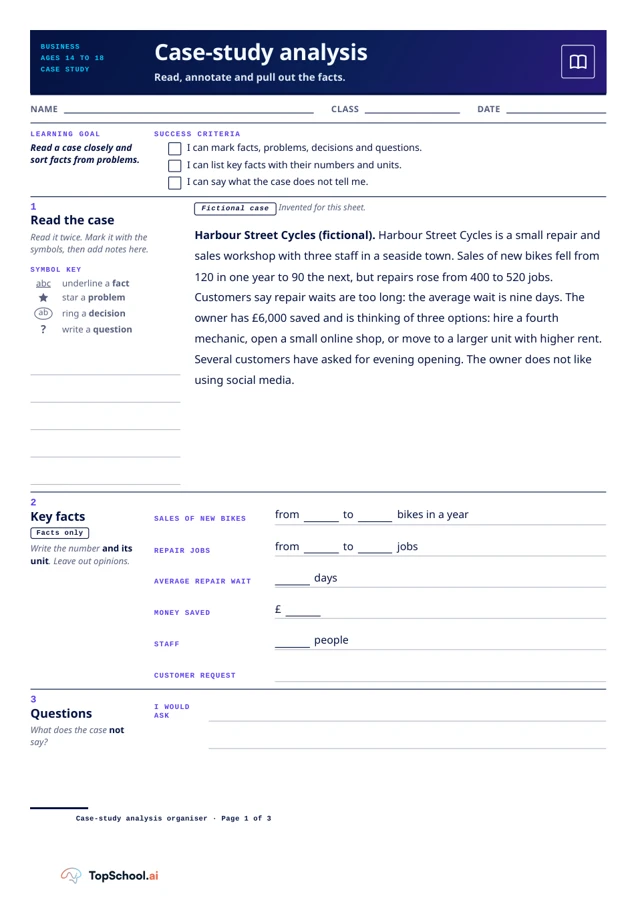
Harbour Street Cycles (fictional). Harbour Street Cycles is a small repair and
sales workshop with three staff in a seaside town. Sales of new bikes fell from
120 in one year to 90 the next, but repairs rose from 400 to 520 jobs.
Customers say repair waits are too long: the average wait is nine days. The
owner has £6,000 saved and is thinking of three options: hire a fourth
mechanic, open a small online shop, or move to a larger unit with higher rent.
Several customers have asked for evening opening. The owner does not like
using social media.
2
Key facts
Facts only
Write the number and its
unit. Leave out opinions.
SALES OF NEW BIKES
from
to
bikes in a year
REPAIR JOBS
from
to
jobs
AVERAGE REPAIR WAIT
days
MONEY SAVED
£
STAFF
people
CUSTOMER REQUEST
3
Questions
What does the case not
say?
I WOULD
ASK
Case-study analysis organiser · Page 1 of 3
BUSINESS
AGES 14 TO 18
CASE STUDY
Case-study analysis
Read, annotate and pull out the facts.
Page 2
4 Name the problems
Three problems
Use your starred notes. Each problem needs evidence from the case, not just an opinion.
01
Your most urgent problem.
PROBLEM
EVIDENCE
WHO IS
AFFECTED
02
A problem for customers or
staff.
PROBLEM
EVIDENCE
WHO IS
AFFECTED
03
A problem the owner may
not have noticed.
PROBLEM
EVIDENCE
WHO IS
AFFECTED
5
Calculate
Show working
Change = new − old.
Percentage change =
change ÷ old × 100.
New bike sales
Old figure 120   New figure 90
WORKING
Percentage change
%
Circle one: fall / rise
Repair jobs
Old figure 400   New figure 520
WORKING
Percentage change
%
Circle one: fall / rise
6
Rank them
Which problem comes first?
MOST URGENT
problem
BECAUSE
Case-study analysis organiser · Page 2 of 3
BUSINESS
AGES 14 TO 18
CASE STUDY
Problems and numbers
Page 3
7 Compare the options
Three options
Use evidence from the case1. If it gives no cost, write what you would need to find out.
A
Hire a fourth mechanic
Think about the nine-day
wait.
ADVANTAGE
RISK
COST
B
Open a small online
shop
Think about new bike sales.
ADVANTAGE
RISK
COST
C
Move to a larger unit
with higher rent
Think about the £6,000.
ADVANTAGE
RISK
COST
8
My decision
Any option can be argued if
you use evidence.
I RECOMMEND
option
BECAUSE
I WOULD
CHANGE MY
MIND IF
1 Harbour Street Cycles is fictional and invented for this sheet. It is not a real business.
Case-study analysis organiser · Page 3 of 3
BUSINESS
AGES 14 TO 18
CASE STUDY
Options and decision
A teaching sequence
Extract case facts, calculate percentage change, compare options and make a recommendation that acknowledges missing information.
Separate facts and gaps
Pull out the stated numbers, units and customer requests, then list questions the case does not answer.
Is each number attached to its unit and time period?
Name the problems
Identify three problems and link each to case evidence and people affected.
Who is affected, and which case detail shows the problem?
Calculate the changes
Calculate the change in bike sales and repair jobs from their original figures, then rank the problems by urgency.
Have you divided each change by its original figure?
Weigh the three options
Compare the three options using the case evidence, identifying advantages, risks and any missing costs or customer information. Explain what further information could change the recommendation and where you would verify it.
What new cost or customer fact would change your recommendation?
Before you teach
Look for the thinking behind an answer, choose the support your class needs and leave room for an independent response.
What to look for
Check that sales changed from 120 to 90 (a 25% fall) and repairs from 400 to 520 (a 30% rise), with calculations shown. Then look for each recommendation to refer to evidence and name missing costs or information. Ask: “What new fact would change your decision?”
Give a little support
Read the case in sections and provide a number line or calculator if the intended focus is decision-making rather than mental percentage calculation. Model the fact/problem distinction and let pupils highlight evidence before writing a recommendation.
Take the idea further
Ask pupils to rank the options under a different stated condition, such as a smaller budget or a shorter repair wait. They should name the new evidence needed and explain why their recommendation changed.
Things to keep in mind
Harbour Street Cycles is expressly fictional; its people, sales and repair figures are not real evidence. Option costs are intentionally incomplete, so pupils should identify what they need to know. The organiser structures analysis but does not supply a decision key.
Keep the idea. Make it yours.
Bring your topic, learning goal and class context to PLAI™, then review what you create.
Ideas to try with your class
Sample teaching perspectives on what to try, what to adapt and what to watch for.
Meet The Creators
Meet the creators whose teaching interests connect with this template. Find an approach to try with your class.

Ho Thi Chi
Business concepts become more useful when pupils can apply them to a decision or explain how one factor affects another.
Meet the creator
Adaeze Okonkwo
I ask pupils to draw the economic diagram before arguing a position, then connect its relationships and assumptions with a nearby example and a reasoned claim.
Meet the creatorFarhan Malik
I use recognisable local work and community cases in Business and Applied Learning, giving students concrete material to analyse while preserving each subject’s questions and different possible pathways.
Meet the creator
Little Lightbulbs
The Harbour Street Cycles case separates facts, problems, calculations, options and questions across three pages. Sales fall from 120 to 90 bikes while repairs rise from 400 to 520; the organiser asks pupils to keep those units distinct.
Glue Stick Club
The fictional owner has £6,000, three staff and several possible responses, including hiring, an online shop or moving premises. Pupils must compare choices while acknowledging the average nine-day repair wait and customer requests for evening opening.
Notes Between Bells
The symbol key for fact, problem, decision and question gives pupils a way to annotate before writing. The fact table asks for numbers with units, which can prevent a percentage calculation from being detached from whether it concerns bike sales or repair jobs.
Coffee Before Copies
The case withholds important information such as project costs and fuller demand evidence. Treat any recommendation as provisional, then use the organiser’s question section to identify what the fictional owner would need before committing the savings.