
Wellbeing and personal development
A private check-in: notice, choose, plan
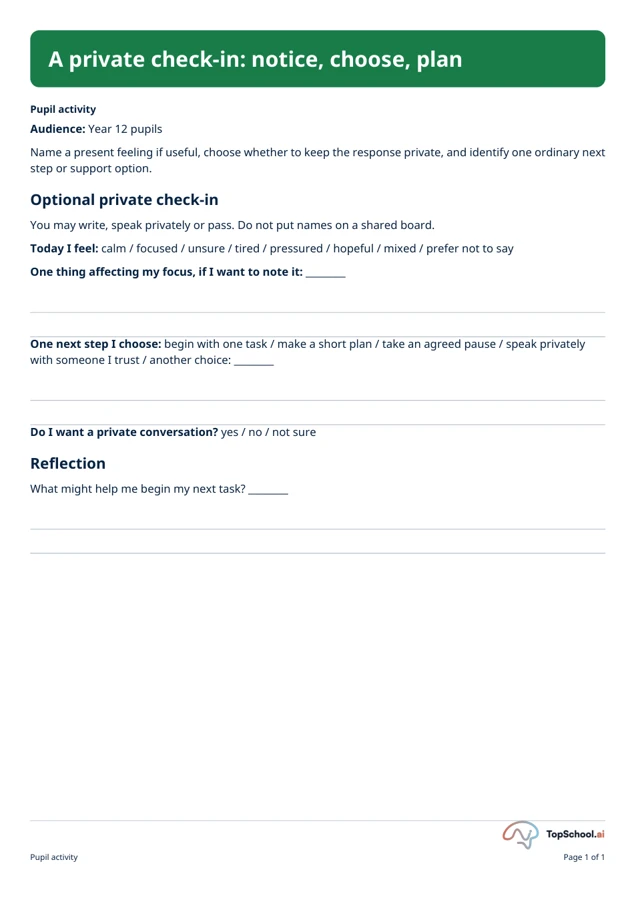
For Year 12 pupils, name a present feeling if useful, choose whether to keep the response private, and identify one ordinary next step or support option.
Read the material
For Year 12 pupils, name a present feeling if useful, choose whether to keep the response private, and identify one ordinary next step or support option.
Pupil worksheet. Use the preview for diagrams and layout.
Page 1
A private check-in: notice, choose, plan
Pupil activity
Audience: Year 12 pupils
Name a present feeling if useful, choose whether to keep the response private, and identify one ordinary next
step or support option.
Optional private check-in
You may write, speak privately or pass. Do not put names on a shared board.
Today I feel: calm / focused / unsure / tired / pressured / hopeful / mixed / prefer not to say
One thing affecting my focus, if I want to note it: ________
One next step I choose: begin with one task / make a short plan / take an agreed pause / speak privately
with someone I trust / another choice: ________
Do I want a private conversation? yes / no / not sure
Reflection
What might help me begin my next task? ________
Pupil activity
Page 1 of 1
A teaching sequence
Name a present feeling if useful, choose whether to keep the response private, and identify one ordinary next step or support option.
Choose what to name
Choose a word, two words or “prefer not to say”.
Would you prefer a word, a private response or to pass?
Choose an ordinary next step
Note one thing affecting focus, or leave that field blank. Choose a neutral next step such as making a plan or speaking with a trusted person.
What might help you begin the next task, if you want to note it?
Decide whether to share
Decide whether to keep the response private or request a conversation.
Would you like a private conversation, or to keep this to yourself?
Before you teach
Look for the thinking behind an answer, choose the support your class needs and leave room for an independent response.
What to look for
A useful response may be “tired; I will plan my first task” or a blank page. Do not infer a diagnosis. Ask privately whether the pupil wants a conversation.
Give a little support
Offer a blank option, private writing or a verbal check-in; do not project or collect answers as a class display.
Take the idea further
Invite pupils to identify which routine helps them return to a task and reflect on whether it worked.
Things to keep in mind
This is not a diagnostic or counselling tool. Keep responses private and follow the school's established process if a concern is raised.
Keep the idea. Make it yours.
Bring your topic, learning goal and class context to PLAI™, then review what you create.
Ideas to try with your class
Sample teaching perspectives on what to try, what to adapt and what to watch for.
Meet The Creators
Meet a creator whose teaching interests connect with this template.
Steady Marker
The Year 12 prompt allows a pupil to write, speak privately or pass, and asks for one chosen next step such as starting a task, planning or taking an agreed pause. It explicitly rules out names on a shared board.
Storytime Sidekick
This one-page check-in is about present focus and a practical next move, not a full wellbeing assessment. The yes/no/not-sure conversation choice leaves room for a pupil who wants privacy or is not ready to decide.
Notes Between Bells
“Prefer not to say” and the pass option protect a pupil’s choice about the feeling prompt. The alternative next steps make it possible to continue towards the lesson without requiring a personal explanation.
Kind Check-In
The response should not be collected or displayed without a clear local handling plan. A request for a private conversation needs the school’s confirmed response process; the sheet does not specify who will receive or store it.