Teaching elapsed time with a clock and a timeline
Use one worked example to connect clock times with a duration, then change the finish time to check pupils’ reasoning.
On this page4 sections
Reading 10:45 and 12:15 correctly is only part of working out how long an activity lasts. The two times tell pupils when it starts and finishes. They still need to account for everything in between, including the minutes before and after each whole hour.
A clock with movable hands and a timeline give you two ways to explore that interval. Move the hands as time passes, then record the same movement as jumps along a line. Here, 15 minutes to 11:00, a full hour to noon and 15 more minutes give 90 minutes, or 1 hour 30 minutes.
This example is intended for Year 3 mathematics in England, once pupils can read quarter-hour times and know that an hour contains 60 minutes. The Year 3 measurement programme includes reading time to the nearest minute and comparing durations. Choose the support according to your pupils’ prior learning and your school’s curriculum sequence.
Set the clock before counting on
Use this original, fictional teaching example:
A class begins a museum sketching task at 10:45 am. It finishes at 12:15 pm on the same day. How long does the task last?
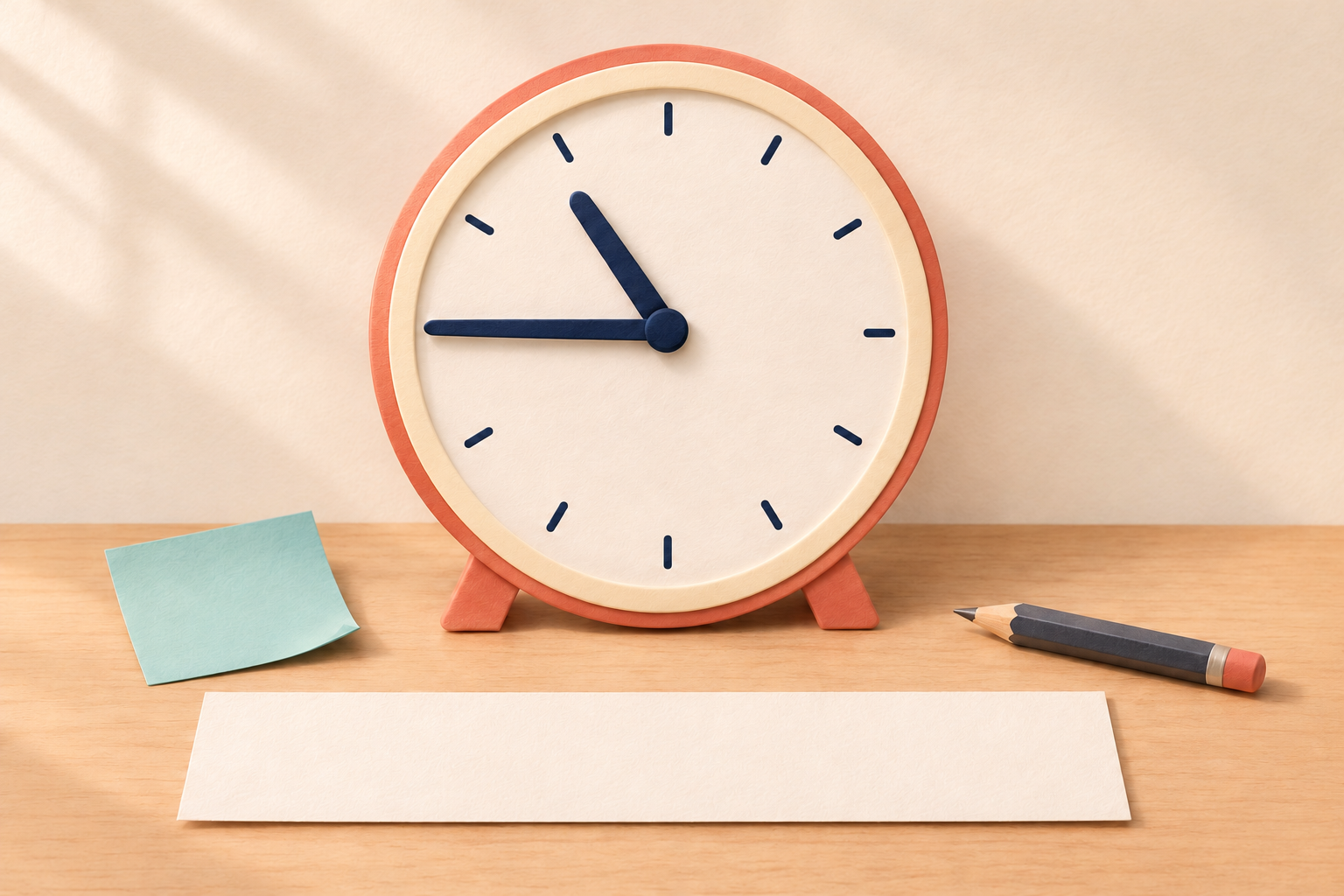
Set the clock to 10:45. The minute hand points to 9; the hour hand sits between 10 and 11, closer to 11. Ask pupils to read the time before moving anything.
Keep both hands moving as you count forwards. From 10:45 to 11:00, the minute hand travels clockwise from 9 to 12 while the hour hand reaches 11. That first part takes 15 minutes. Pause and ask pupils to show where those minutes went.
Continue to 12:00, then to 12:15. At the finish, the minute hand points to 3 and the hour hand sits just past 12. Leave a written label for the start time beside the clock so pupils can return to it.
Draw the same interval on a timeline
Draw a horizontal line from 10:45 am to 12:15 pm. Mark six equal spaces, each representing 15 minutes. The labels, from left to right, are 10:45, 11:00, 11:15, 11:30, 11:45, 12:00 and 12:15.
Above the line, group the spaces into three forward jumps:
| From | To | Time passed |
|---|---|---|
| 10:45 am | 11:00 am | 15 minutes |
| 11:00 am | 12:00 noon | 60 minutes |
| 12:00 noon | 12:15 pm | 15 minutes |
The middle jump spans four spaces. It should be four times as long as either 15-minute jump. Point to each jump and show the corresponding movement on the clock, including the minute hand’s full turn from 11:00 to 12:00.
Now add the durations: 15 + 60 + 15 = 90 minutes. Regroup the 90 minutes as 60 minutes and 30 minutes to give 1 hour 30 minutes.
Ask pupils to complete two sentences: “The task finished at ___” and “The task lasted ___”. The answers, 12:15 pm and 1 hour 30 minutes, distinguish a time of day from a duration.
Use a wrong answer to find the missing part
If a pupil says the first jump takes 45 minutes, ask them to count clockwise from 9 to 12 in fives. They are finding the minutes still to come before 11:00. The 45 in 10:45 describes the minutes already passed since 10:00.
An answer of two hours needs a different check. Ask the pupil to locate a second complete hour on the timeline. There is one full hour between 11:00 and 12:00, with a quarter of an hour on either side.
Let pupils point, move the hands or explain aloud before writing. Keep the question focused on which interval they have counted.
Change the finish time and listen again
When pupils can read five-minute times, keep 10:45 am as the start but change the finish to 11:55 am. Ask pupils to sketch a fresh timeline and label their jumps. They might use 15 minutes to 11:00, then 55 minutes to 11:55: 70 minutes, or 1 hour 10 minutes.
Ask why this task is 20 minutes shorter than the first. On the clock, 11:55 is five minutes before noon, while 12:15 is 15 minutes after it. Those two parts account for the difference.
If the hour crossing is still uncertain, shorten the task to 10:45 am to 11:00 am and connect that single jump to the clock. If pupils can explain both examples, reverse the original question: a task starts at 10:45 am and lasts 90 minutes. When does it finish? Ask them to show how they reach 12:15 pm.
For a short teaching sequence, start with the original interval and one changed finish time. Choose the follow-up from what pupils can explain. Listen for an account of every jump, with the units attached, before introducing a less familiar pair of times.