From one resource to a short teaching sequence
With one maths reasoning card, you can move from a pupil’s first prediction to a discussion that helps you choose what to ask next.

On this page3 sections
When a pupil says that 9 − 4 is five, there’s still a conversation to have. Their answer tells you the result; their explanation gives you a way into how they’re thinking.
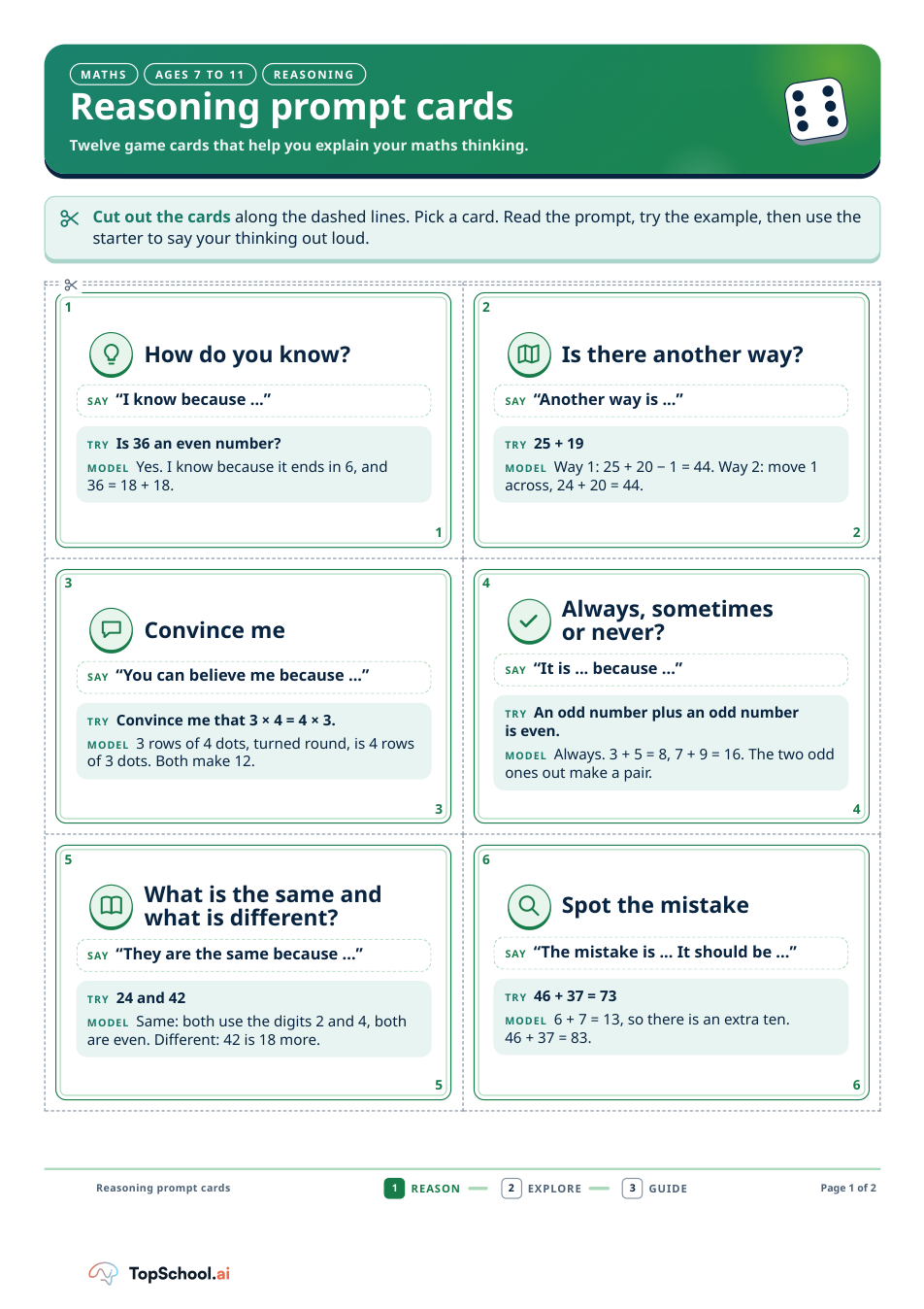
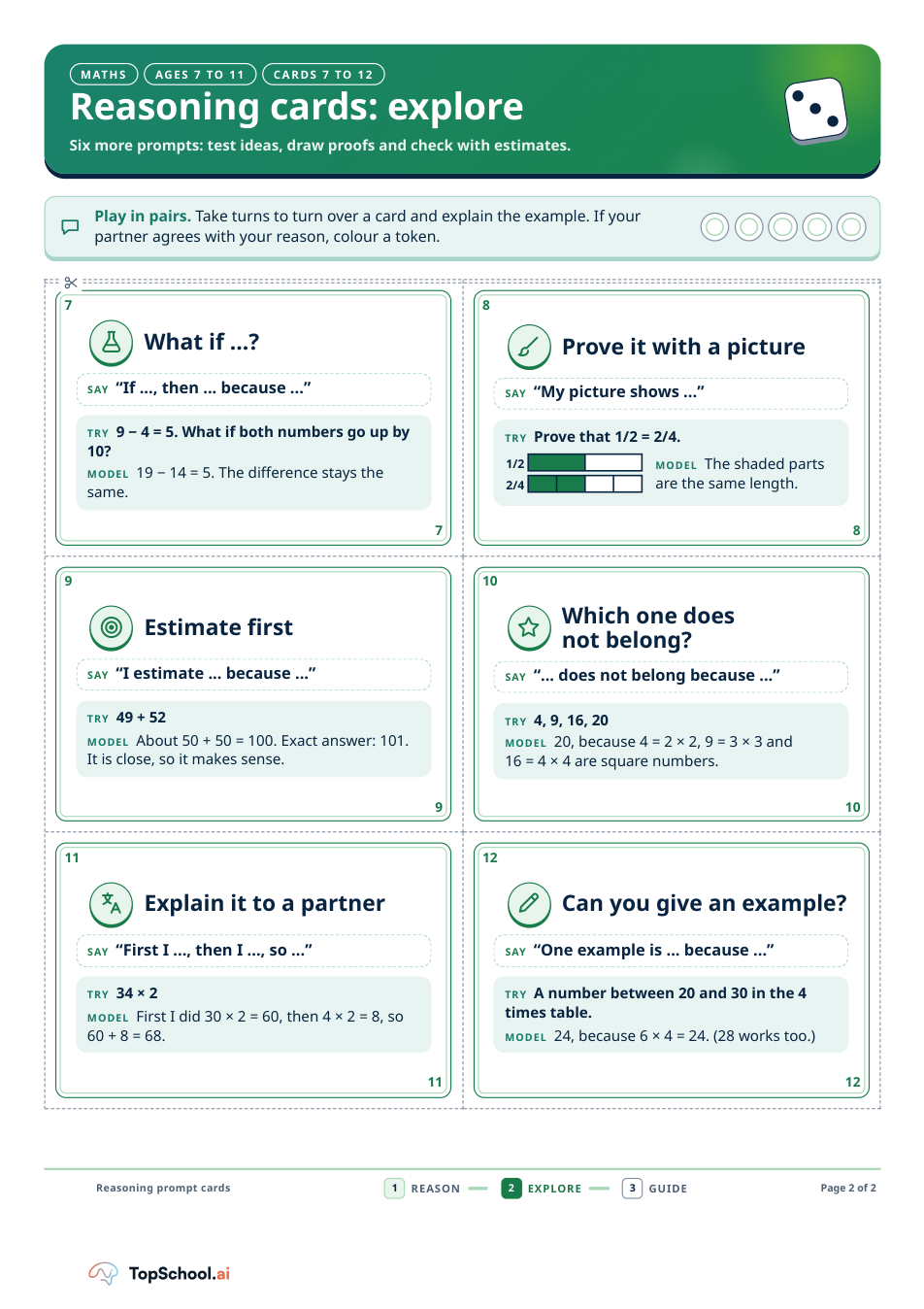
Card 7 in Reasoning prompt cards starts with that calculation, then asks what happens if both numbers go up by ten. Here’s one way to turn it into a short discussion, with the next question shaped by what pupils can explain.
Before pupils see the answer
The worked model is already printed on the card, so you could begin by reading the prompt aloud while keeping the model covered. Give pupils a moment to say what they expect and why. Those first ideas give you something to return to when you reveal the answer.
Keep the calculations within pupils’ reach, so there’s room to think about the relationship. They might talk it through, point to a number line or sketch the change.
The gap stays the same
Once you reveal the model, you have two calculations to put side by side:
9 − 4 = 5
19 − 14 = 5
Both answers are five. To explore why, mark 4 and 9 on a number line, then 14 and 19 on the same line. Each end of the gap has moved ten units to the right, while the distance between them is still five.
You can then return to that first prediction and ask pupils to explain the two answers using those marks. Listen for the connection between moving both ends by the same amount and keeping the gap unchanged.
View the worksheet 2 pupil pages
Reasoning prompt cards
Card 7 is at the top left of page 2.
What to ask next
What you hear gives you a reason to stay with the drawing or try another question. A pupil might have both answers right but still be unsure why they match. In that case, ask them to show what moved and what stayed the same, then give them another chance to explain it.
If that connection is clear, there’s room for a fresh pair: 12 − 5 and 22 − 15. Both give seven. Without a worked answer in view, how could the first calculation help them work out the second?
Once a pupil can explain that pair, you could change just one number. Put 12 − 5 beside 22 − 5. The differences are now seven and seventeen. What has moving only one end done to the gap?
The EEF’s maths guidance recommends using assessment to inform subsequent teaching. The card gives you a place to start; pupils’ explanations help you decide where the conversation goes next.
For another example of choosing a follow-up from what pupils can explain, see teaching elapsed time with a clock and a timeline.