
Find another way in
Suggest a different opening question that connects this learning goal to something learners already know.
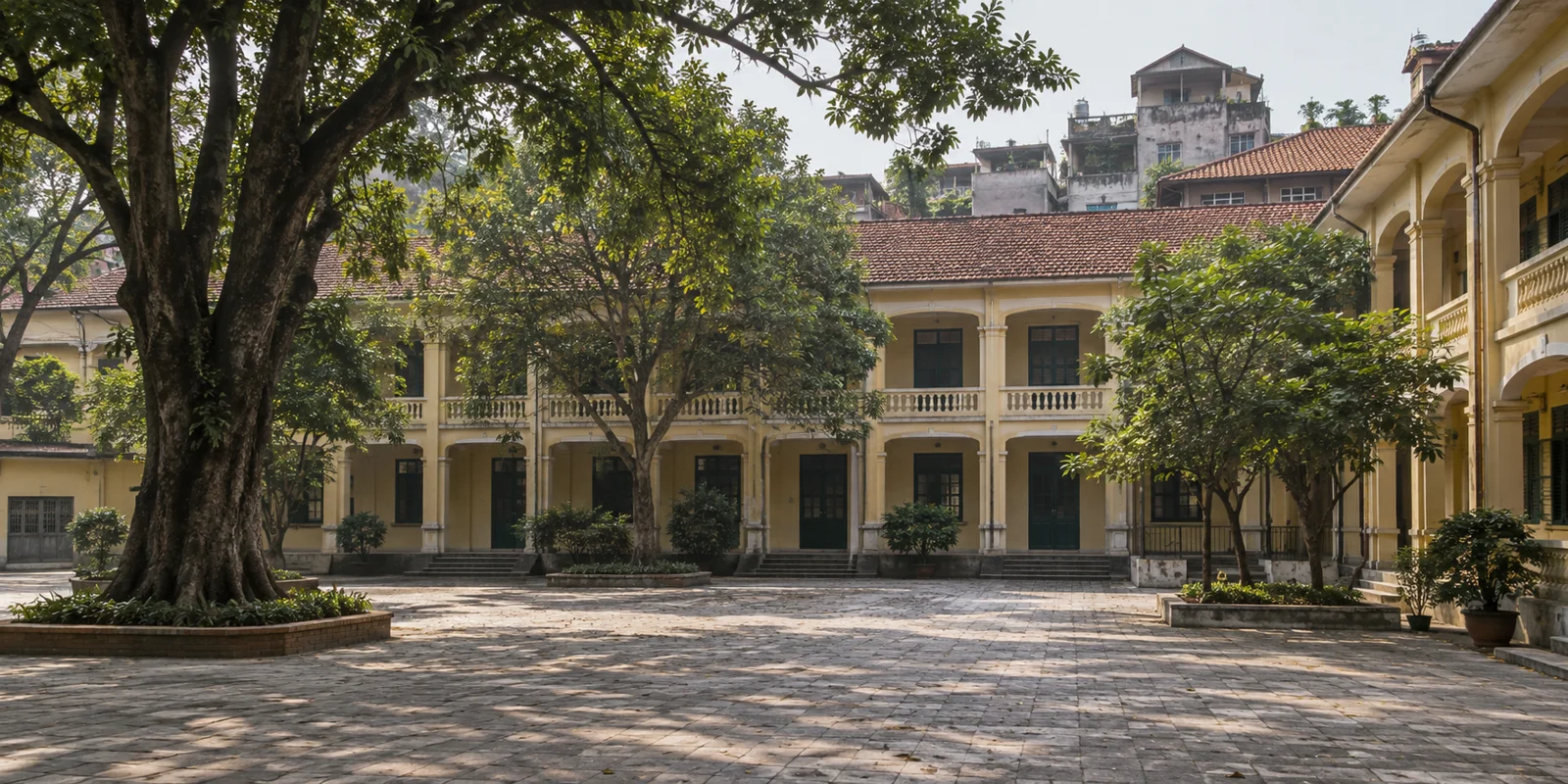
British Vietnamese International School HanoiHanoi, Vietnam
Where does the water go when a puddle dries? Use a Primary water-cycle task to help learners connect scientific vocabulary with an explanation. Bring your year group and language choices to PLAI™, then shape and review the draft for your class.
AI-generated campus illustration. Not a photograph of this school.
BVIS Hanoi brings the National Curriculum for England into Primary learning in English and Vietnamese, with language-rich lessons that connect subjects. Use that bilingual context to explore evaporation and condensation: ask learners to explain what changes, then choose the vocabulary support that helps them express their understanding.
What can you tell me about British Vietnamese International School Hanoi and its bilingual Primary curriculum? Use public sources, distinguish Hanoi from BVIS HCMC, and flag anything you cannot confirm. Ask which year group and language of instruction I use before suggesting a task.
School context
Start with a picture of a drying puddle. Ask learners where the water has gone and why. Connect their ideas to evaporation and condensation on a shared diagram, then use a fresh situation to check what they can explain independently.
Help me plan a Primary lesson on evaporation and condensation in the water cycle. Ask for my year group, learning objective, programme, language of instruction and approved diagram. Start with a picture of a drying puddle and the question “Where has the water gone?” Build a shared explanation of the changes, then an independent check in a new situation. Offer a vocabulary bank in the language I choose. Use pictures and discussion; include teacher-check notes without inventing school assessment criteria.
Inspect the water-cycle and frog-cycle flowcharts, then use the space for a process of your own. For this page’s task, prepare the material around explaining evaporation and condensation in the water cycle.
Help me prepare an original task about explaining evaporation and condensation in the water cycle for my confirmed class. I will supply the source content. Use Process flowchart organiser as a model for the teaching structure. Ask for my year group, goal and prior learning. Check the new subject content and age suitability, offer optional support and leave an independent explanation. Keep source facts distinct from this new task and do not infer school criteria.
Review the new explaining evaporation and condensation in the water cycle task for my confirmed class. Check the subject content, reading load and response space. Add optional support while keeping an independent explanation. Use checked steps from the current class topic. Show a return arrow only for a real cycle; keep a non-cyclic process as a sequence.
Use the source as a teaching model, then review the new task for your confirmed class.
For explaining evaporation and condensation in the water cycle, decide what pupils must explain independently. Use checked steps from the current class topic. Show a return arrow only for a real cycle; keep a non-cyclic process as a sequence.
Keep the conversation going
Tell PLAI™ what you want to change. Try one of these follow-ups with your draft, then check the result for your class.
Suggest a different opening question that connects this learning goal to something learners already know.
Add an optional vocabulary box and a sentence starter. Keep the main reasoning task and final independent question.
Add a follow-up question that asks learners to explain their reasoning in a new situation.
Start with the water cycle or another Primary topic. Tell PLAI™ what learners should understand and how they will express it, then review the draft before using it.
Start with PLAI™