
Science
Process flowchart organiser
Use a flowchart to put process steps in order and show how a cycle returns to its start. One page covers the water cycle, while the other provides a frog life-cycle sequence and space for a process pupils choose.
Follow the arrows around the water cycle. The spaces are for pupils to add their own words.
Read the complete materialRead the material
Use a flowchart to put process steps in order and show how a cycle returns to its start. One page covers the water cycle, while the other provides a frog life-cycle sequence and space for a process pupils choose.
Complete resource. Use the preview for diagrams and layout.
Page 1
SCIENCE
AGES 9 TO 12
PROCESSES
Process flowchart
Follow the water cycle round and round.
NAME
CLASS
DATE
LEARNING GOAL
Show the steps of a process in order, in
my own words.
SUCCESS CRITERIA
I can put steps in order with arrows.
I can explain each step.
I can show that a cycle goes round again.
E N T R Y
1
The water cycle
Write 2 lines in each box
1
The sun heats
2
Evaporation
3
Condensation
4
Precipitation
5
Collection
then
then
then
then
Back to step 1:
the cycle starts again
E N T R Y
2
Word bank
evaporation
condensation
precipitation
collection
water vapour
liquid
gas
clouds
E N T R Y
3
Circle these words in your boxes
E N T R Y
4
My picture
RISES
COOLS
FALLS
DRAW ONE PICTURE FOR STEP 3
Process flowchart organiser
Page 1 of 2
Page 2
SCIENCE
AGES 9 TO 12
LIFE CYCLES
A frog’s life cycle
E N T R Y
1
Draw and write
Draw it. Write 2 lines.
1
Frogspawn
2
Tadpole
3
Tadpole with legs
back legs, then front legs
4
Young frog
(froglet)
5
Adult frog
then
then
then
then
the adult
lays eggs
E N T R Y
2
My own process
Ideas: shoelace, bean, toast
I pick:
1
2
3
4
5
Process flowchart organiser
Page 2 of 2
A teaching sequence
Represent a process in order, explain each step in their own words and show where a cycle returns or repeats.
Follow the arrows around the water cycle. The spaces are for pupils to add their own words.
Read the complete materialExplain the water-cycle boxes
Complete the water-cycle flowchart using the printed headings and connect the steps with words and arrows.
What changes at each named stage before the arrow moves on?
Follow the arrows around the water cycle. The spaces are for pupils to add their own words.
Read the complete materialUse and identify process words
Use the word bank to include evaporation, condensation, precipitation and collection, then circle the related process words.
Where do evaporation, condensation, precipitation and collection appear in your explanation?
Show the frog's life cycle
On page 2, draw and write the stages of a frog life cycle, from frogspawn through tadpole stages to adult frog.
How do the arrows show both the printed stages and the return to eggs?
Order a chosen new process
Choose another process, such as a bean growing or toast being made, and use the five boxes to put its steps in order. Check that each arrow points to the next stage.
Does each arrow lead to the next action in your own five-box sequence?
Before you teach
Look for the thinking behind an answer, choose the support your class needs and leave room for an independent response.
What to look for
Look for arrows that connect steps in a sensible order and an explanation of what changes at each step. Ask, “Where does this process go next, and does it begin again?” For the water cycle, ask pupils to explain the link between the named processes rather than treating each word as an isolated label.
Give a little support
Provide a partly completed sequence or offer three printed words to place first. Let pupils rehearse each step aloud before writing, then add arrows to make order visible using picture cues.
Take the idea further
Ask pupils to compare a repeating cycle with a process that has a beginning and end. They can add a missing stage or explain which steps would need more detail in a scientific account.
Things to keep in mind
Both diagrams are simplified representations. The water-cycle sequence leaves out processes such as transpiration and groundwater movement, while a frog's development can vary by species and conditions. Review the level of detail against the class's science content.
Keep the idea. Make it yours.
Bring your topic, learning goal and class context to PLAI™, then review what you create.
Another starting point
Explore a different teaching task from this selection.
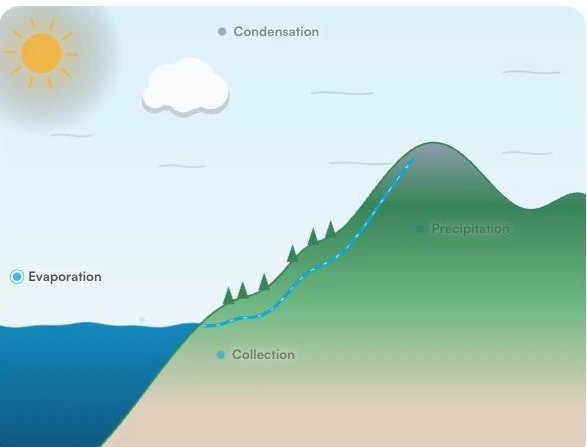
Water cycle: an interactive model
Watch the warm, breezy starting model. Keep wind fixed while exploring sun heat, then select Reset before comparing wind settings so the two investigations remain separate.
Explore resource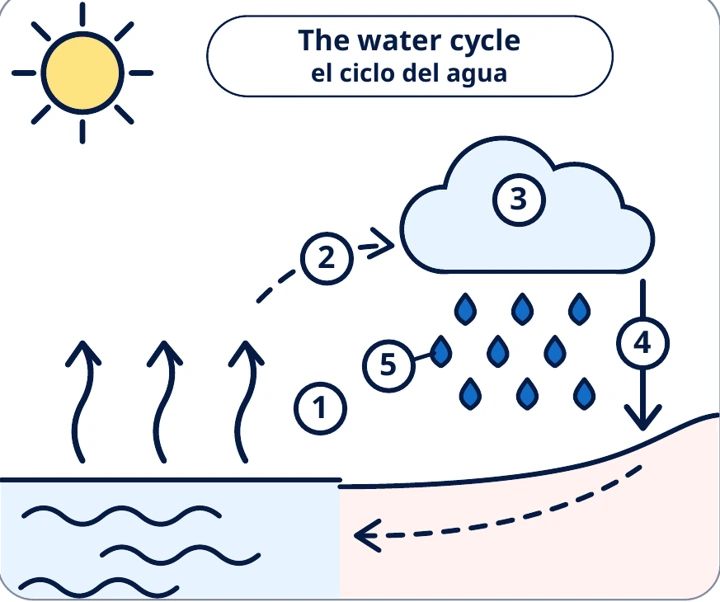
The water cycle in English, Spanish and your language
Point to each numbered part of the water-cycle picture and read its English and Spanish label.
Explore resourceIdeas to try with your class
Sample teaching perspectives on what to try, what to adapt and what to watch for.
Meet The Creators
Meet a creator whose teaching interests connect with this template.

Gentle Reminder
This two-page science organiser asks pupils to write the water cycle in order, put arrows between stages and show how the cycle returns to its start. The success criteria include explaining each step in their own words, not just copying labels.
Pocketful of Stories
The water-cycle entry gives a familiar process for practising flowchart conventions before pupils use the blank organiser. Arrows and a returning cycle make sequence and repetition visible.
After the Bell
Model one box and one connecting arrow, then ask pupils to explain why the next stage follows. Use the supplied labels as prompts where needed while keeping the explanation in the pupil's own words.
Board Eraser
A flowchart simplifies a process and this example covers the stages shown on the page. Check the sequence against the lesson's science source and do not treat the diagram as a complete account of every water-cycle condition.