
Languages and literacy
Writing editing checklist
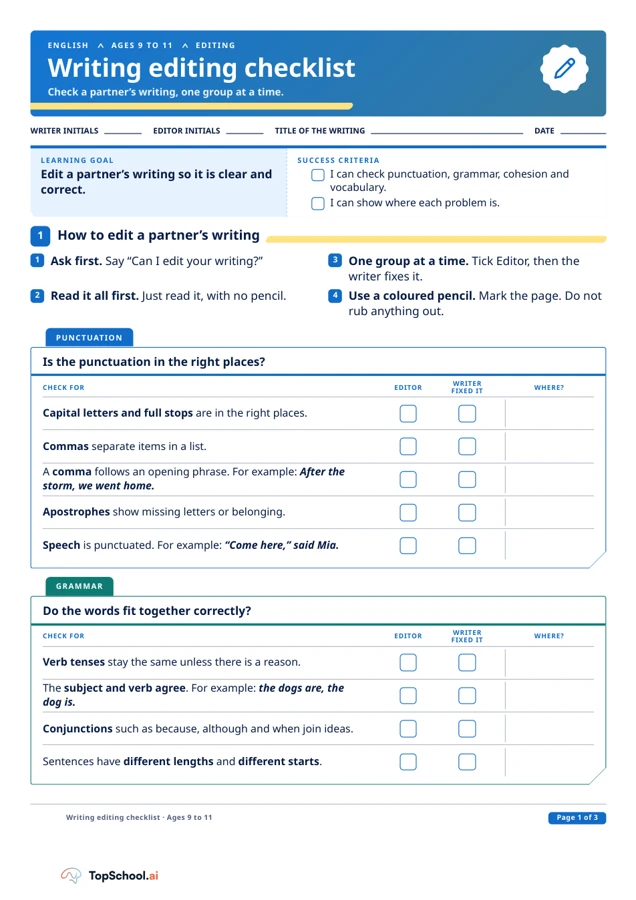
Help pupils edit a partner’s writing one group of features at a time, then give kind, specific feedback. A final invented passage lets them practise the editing marks before working on a partner’s piece. Discuss the writer’s choices.
Read the material
Help pupils edit a partner’s writing one group of features at a time, then give kind, specific feedback. A final invented passage lets them practise the editing marks before working on a partner’s piece. Discuss the writer’s choices.
Complete resource. Use the preview for diagrams and layout.
Page 1
WRITER INITIALS
EDITOR INITIALS
TITLE OF THE WRITING
DATE
LEARNING GOAL
Edit a partner’s writing so it is clear and
correct.
SUCCESS CRITERIA
I can check punctuation, grammar, cohesion and
vocabulary.
I can show where each problem is.
1
How to edit a partner’s writing
Writing editing checklist · Ages 9 to 11
Page 1 of 3
ENGLISH
AGES 9 TO 11
EDITING
Writing editing checklist
Check a partner’s writing, one group at a time.
Ask first. Say “Can I edit your writing?”
1
Read it all first. Just read it, with no pencil.
2
One group at a time. Tick Editor, then the
writer fixes it.
3
Use a coloured pencil. Mark the page. Do not
rub anything out.
4
Is the punctuation in the right places?
CHECK FOR
EDITOR
WRITER
FIXED IT
WHERE?
Capital letters and full stops are in the right places.
Commas separate items in a list.
A comma follows an opening phrase. For example: After the
storm, we went home.
Apostrophes show missing letters or belonging.
Speech is punctuated. For example: “Come here,” said Mia.
PUNCTUATION
Do the words fit together correctly?
CHECK FOR
EDITOR
WRITER
FIXED IT
WHERE?
Verb tenses stay the same unless there is a reason.
The subject and verb agree. For example: the dogs are, the
dog is.
Conjunctions such as because, although and when join ideas.
Sentences have different lengths and different starts.
GRAMMAR
Page 2
Writing editing checklist · Ages 9 to 11
Page 2 of 3
ENGLISH
AGES 9 TO 11
EDITING
Cohesion, vocabulary and feedback
Finish the checklist, then say what you found.
Does the writing hang together?
CHECK FOR
EDITOR
WRITER
FIXED IT
WHERE?
A new paragraph for a new idea, time, place or speaker.
Linking words connect paragraphs. For example: Later,
Meanwhile, The next morning.
Pronouns are clear: it is plain who he or she is.
COHESION
Are the words well chosen?
CHECK FOR
EDITOR
WRITER
FIXED IT
WHERE?
Exact verbs replace plain ones. For example: sprinted for ran,
whispered for said.
Adjectives and adverbs are chosen with care and not piled up.
No word is repeated too often.
Topic words are used correctly.
VOCABULARY
Feedback for your partner: two things you did well
Write about the writing, not the writer. Try: I liked ... because ... or I could picture ... when ...
DID WELL
One thing to fix
Try: One way to make it stronger is ...
FIX
Highlight the best sentence in
the writing, then copy it here.
BEST
One:
Two:
Fix:
Page 3
2
Edit this passage
Find every mistake
This passage is invented. Read it, then mark each mistake with the key. To change a word, put a line
through it and write the right word above.
1
last saturday we went to the beach.
2
it was sunny so we builded a huge sandcastle.
3
my brother said, “look at that wave.”
4
we runs to the water and splashed.
5
Then it was time to go home we was tired.
Now write the passage out correctly.
I found
mistakes.
Go further: swap one plain verb for
an exact one (see Vocabulary, page 2).
Writing editing checklist · Ages 9 to 11
Page 3 of 3
ENGLISH
AGES 9 TO 11
EDITING
Edit this passage
Practise the marks before you edit a partner.
Insert
a caret, then the
missing word
Delete
draw a line through it
Capital letter
three lines under the
letter
New paragraph
a pilcrow where it
starts
MARKS KEY
A teaching sequence
Use a staged checklist and agreed editing marks to identify possible changes in punctuation, grammar, cohesion and vocabulary, then give feedback about the writing rather than the writer.
Read, then check one group
Read the full text without a pencil to understand its meaning and purpose. Check punctuation, then grammar, cohesion and vocabulary one group at a time.
Has the writer agreed to an edit, and what is the text trying to do?
Mark changes clearly
Mark possible changes with the insert, delete, capital-letter or new-paragraph symbols; do not erase the writer’s work.
Can the writer distinguish your suggestion from their original words?
Give specific feedback
Name two effective choices and one possible next step, with an example from the writing. Practise on the invented passage and review possible corrections with the teacher.
Which exact sentence supports one strength and one next step?
Let the writer revise
Invite the writer to review suggestions and choose revisions.
Which suggestion does the writer choose, and how does it help the intended meaning?
Before you teach
Look for the thinking behind an answer, choose the support your class needs and leave room for an independent response.
What to look for
Look for specific evidence of a possible edit, a clear explanation and feedback that respects the writer. Check whether pupils use the marks key consistently and whether the writer retains control over the final revisions. Ask how an edit may help the reader.
Give a little support
Model one edit at a time using a short shared passage. Offer a reduced checklist, a coloured key or oral feedback frames, and let pupils make suggestions verbally or with assistive technology.
Take the idea further
Ask pupils to justify an edit by explaining how it changes clarity, rhythm or meaning. Invite them to accept, adapt or decline a suggestion and explain the choice to the writer.
Things to keep in mind
Editing conventions can depend on purpose, dialect and genre, so review suggestions in context. The invented passage has no supplied answer key; check its corrections before asking pupils to mark it independently or compare their answers.
Keep the idea. Make it yours.
Bring your topic, learning goal and class context to PLAI™, then review what you create.
Ideas to try with your class
Sample teaching perspectives on what to try, what to adapt and what to watch for.
Meet The Creators
Meet the creators whose teaching interests connect with this template. Find an approach to try with your class.
Cerys Evans
Staying connected to classroom learning helps me understand what pupils know through the work itself, alongside the information a report or assessment may provide.
Meet the creator
Rachel Duffield
I plan a two-year rolling curriculum with clear subject maps and adaptable sequences, while asking what support helps an anxious pupil feel ready to take part in class.
Meet the creator
Nicholas Blaker
I use a clear curriculum map to connect what pupils have learned with what comes next, keeping Year 6 preparation proportionate across different secondary-school pathways.
Meet the creator
Planning List
The three-page checklist for ages 9 to 11 asks a pupil to ask permission before editing a partner’s writing, read it all once without a pencil, check one group at a time, mark in colour and let the writer fix the text.
Quietly Curious
The staged process supports punctuation, grammar, cohesion and vocabulary while protecting the writer's ownership. “Do not rub anything out” keeps the original visible for revision.
Good Question
Model the permission question and one editing mark, then focus on a single category before moving on. The writer can accept or discuss a suggested change rather than having the editor rewrite the piece.
The Curious Pencil
Peer editing should remain about the writing, not the writer. Check the age group's understanding of the marks and ensure the teacher supports disagreements or sensitive content.