
Languages and literacy
Verbos en -ar: estudiar y hablar
Use the present-tense pattern for two regular -ar verbs, then complete and correct short sentences about school and learning.
Read the material
Use the present-tense pattern for two regular -ar verbs, then complete and correct short sentences about school and learning.
Pupil worksheet. Use the preview for diagrams and layout.
Page 1
Verbos en -ar: estudiar y hablar
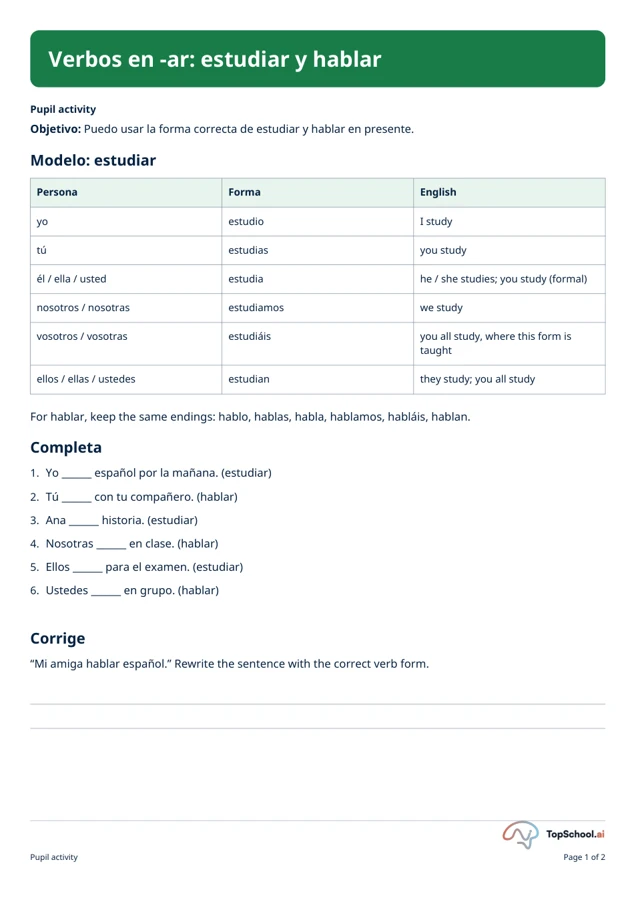
Pupil activity
Objetivo: Puedo usar la forma correcta de estudiar y hablar en presente.
Modelo: estudiar
Persona
Forma
English
yo
estudio
I study
tú
estudias
you study
él / ella / usted
estudia
he / she studies; you study (formal)
nosotros / nosotras
estudiamos
we study
vosotros / vosotras
estudiáis
you all study, where this form is
taught
ellos / ellas / ustedes
estudian
they study; you all study
For hablar, keep the same endings: hablo, hablas, habla, hablamos, habláis, hablan.
Completa
1. Yo ______ español por la mañana. (estudiar)
2. Tú ______ con tu compañero. (hablar)
3. Ana ______ historia. (estudiar)
4. Nosotras ______ en clase. (hablar)
5. Ellos ______ para el examen. (estudiar)
6. Ustedes ______ en grupo. (hablar)
Corrige
“Mi amiga hablar español.” Rewrite the sentence with the correct verb form.
Pupil activity
Page 1 of 2
Page 2
Verbos en -ar: estudiar y hablar
Traduce
Translate: “We study Spanish and speak with a partner.”
Pupil activity
Page 2 of 2
Page 1
Verbos en -ar: estudiar y hablar
Teacher key and guidance supporting this exact edition
Teacher check
1 estudio; 2 hablas; 3 estudia; 4 hablamos; 5 estudian; 6 hablan. Correction: “Mi amiga habla español.”
Translation: “Estudiamos español y hablamos con un compañero/una compañera.” Follow the class’s taught
regional form for the second person plural.
Teacher companion
Page 1 of 1
A teaching sequence
Conjugate estudiar and hablar in the present tense and use the matching ending in a short sentence.
Read the two regular verb models
Read the model endings aloud and notice the repeated pattern.
Which ending changes with the subject in estudiar and hablar?
Complete the present-tense sentences
Complete each sentence with estudiar or hablar in the present tense.
Does the verb form agree with the printed subject and taught variety?
Correct the mismatched verb ending
Correct one sentence with the wrong verb ending.
What form is needed with Mi amiga?
Translate the supplied combined sentence
Translate the supplied sentence about studying Spanish and speaking with a partner. Check both verb forms and the complete meaning against the printed models and taught variety.
Does your sentence preserve both studying Spanish and speaking with a partner?
Before you teach
Look for the thinking behind an answer, choose the support your class needs and leave room for an independent response.
What to look for
Expected answers: estudio, hablas, estudia, hablamos, estudian, hablan; the correction is “Mi amiga habla español”; the translation is “Estudiamos español y hablamos con un compañero/una compañera.” Follow up: write “Tú estudias español”, underline the stem estudi- and circle the ending -as, then compare it with the class-taught vosotros/as or ustedes form.
Give a little support
Keep the subject pronoun and ending table together. Mark the stem in one colour and the ending in another. Let pupils complete one row at a time.
Take the idea further
Write four connected sentences about a school day using both verbs and at least three different subjects. Add a time phrase such as por la mañana.
Things to keep in mind
This set practises two regular -ar verbs, estudiar and hablar. Use the second-person plural form taught in your course: vosotros/as estudiáis or ustedes estudian.
Keep the idea. Make it yours.
Bring your topic, learning goal and class context to PLAI™, then review what you create.
Ideas to try with your class
Sample teaching perspectives on what to try, what to adapt and what to watch for.
Meet The Creators
Meet a creator whose teaching interests connect with this template.

Extra Page
This two-page Spanish activity practises estudiar and hablar in the present, showing forms from yo through ustedes and noting vosotros where that form is taught. Pupils use the matching ending in a short sentence.
Storytime Sidekick
The model makes the shared -ar endings visible across two familiar verbs, while the English glosses clarify the subject meaning. The conditional note on vosotros avoids assuming the form is taught in every setting.
Tea at Breaktime
Have pupils identify the subject pronoun, choose the ending and then apply it to estudiar or hablar. Keep the note about regional or course variation visible when discussing vosotros and ustedes.
Calm Table
The activity covers two regular verbs and selected present forms only. Follow the class's Spanish variety and course sequence, and check spelling and accents in pupil sentences.