
Languages and literacy
French verbs in the present
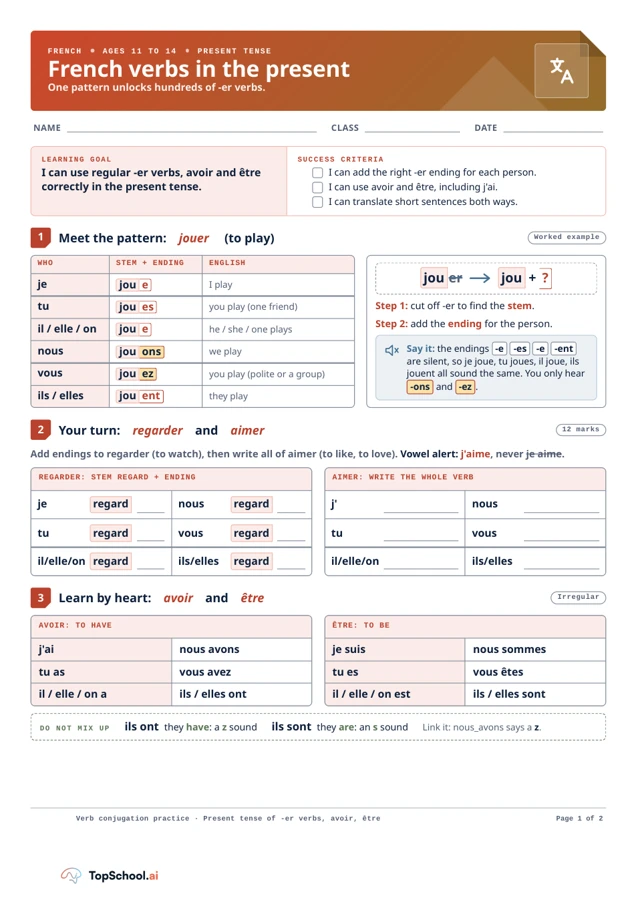
Practise the present tense of regular -er verbs alongside avoir and être. Pupils study a worked pattern, complete short sentences, correct common errors and translate simple phrases between French and English. Review their forms aloud together.
Read the material
Practise the present tense of regular -er verbs alongside avoir and être. Pupils study a worked pattern, complete short sentences, correct common errors and translate simple phrases between French and English. Review their forms aloud together.
Activity. Use the preview for diagrams and layout.
Page 1
NAME
CLASS
DATE
LEARNING GOAL
I can use regular -er verbs, avoir and être
correctly in the present tense.
SUCCESS CRITERIA
I can add the right -er ending for each person.
I can use avoir and être, including j'ai.
I can translate short sentences both ways.
Meet the pattern:
jouer
 (to play)
Worked example
WHO
STEM + ENDING
ENGLISH
je
jou e
I play
tu
jou es
you play (one friend)
il / elle / on
jou e
he / she / one plays
nous
jou ons
we play
vous
jou ez
you play (polite or a group)
ils / elles
jou ent
they play
jou er
jou + ?
Step 1: cut off -er to find the stem.
Step 2: add the ending for the person.
Say it: the endings -e -es -e -ent
are silent, so je joue, tu joues, il joue, ils
jouent all sound the same. You only hear
-ons and -ez .
Your turn:
regarder
and
aimer
12 marks
Add endings to regarder (to watch), then write all of aimer (to like, to love). Vowel alert: j'aime, never je aime.
REGARDER: STEM REGARD + ENDING
je
regard
nous
regard
tu
regard
vous
regard
il/elle/on regard
ils/elles
regard
AIMER: WRITE THE WHOLE VERB
j'
nous
tu
vous
il/elle/on
ils/elles
Learn by heart:
avoir
and
être
Irregular
AVOIR: TO HAVE
j'ai
nous avons
tu as
vous avez
il / elle / on a
ils / elles ont
ÊTRE: TO BE
je suis
nous sommes
tu es
vous êtes
il / elle / on est
ils / elles sont
DO NOT MIX UP
ils ont they have: a z sound
ils sont they are: an s sound
Link it: nous_avons says a z.
Verb conjugation practice · Present tense of -er verbs, avoir, être
FRENCH
AGES 11 TO 14
PRESENT TENSE
French verbs in the present
One pattern unlocks hundreds of -er verbs.
1
2
3
Page 1 of 2
Page 2
Fill the gaps
9 marks
Who is it? ma sœur = elle · mes parents = ils · Léa et moi = nous · on = il ending
1
Le samedi, je
joue
 (jouer) au foot.
2
Tu
 (regarder) la télé le dimanche ?
3
Ma sœur
 (aimer) la musique pop.
4
Nous
 (jouer) aux jeux vidéo le soir.
5
Vous
 (avoir) un chien ?
6
Mes parents
 (être) très sportifs.
7
Le week-end, on
 (regarder) des films.
8
Léa et moi, nous
 (être) au parc.
9
Elles
 (aimer) beaucoup le cinéma.
10
Le soir, tu
 (avoir) des devoirs ?
Find the mistake
8 marks
Each sentence has one mistake. Circle it, then write the sentence correctly. One mark for spotting, one for fixing.
A
Je aime le tennis.
B
Nous regardez un match à la télé.
C
Mes cousins sont un chat noir.
D
Tu joue de la guitare le samedi.
Translate
9 marks
FRENCH TO ENGLISH · 1 MARK EACH
a
J'aime le foot.
b
Nous regardons un film le samedi.
c
Mes amis sont très drôles.
ENGLISH TO FRENCH · 2 MARKS EACH
d
I play tennis. (jouer au + sport)
e
We have a dog.
f
They (girls) watch TV.
GO FURTHER
le samedi matin
puis
le soir
avec ma famille
Translate into French: On Saturday mornings, I play tennis, then in the evening I watch a film with
my family.
Verb conjugation practice · Total 38 marks with page 1
Not yet
Getting there
Got it
PRESENT TENSE
PRACTICE
Use your verbs: le week-end
Write each verb in brackets with the right ending. Number 1 is done for you.
4
5
6
Page 2 of 2
A teaching sequence
Choose and write the correct present-tense form of a regular -er verb, avoir or être, then translate short sentences using the intended subject and meaning.
Find the regular stem and ending
Use the worked jouer pattern to identify the stem and match an ending to each subject pronoun.
Which ending matches the subject pronoun in jouer?
Practise regular and irregular forms
Complete the regarder endings and write the forms of aimer, applying the vowel change in j’aime. Recall avoir and être, then say the forms aloud and notice the sound contrast highlighted on the sheet.
How does j'aime differ from a form beginning je before a consonant?
Use verbs in whole sentences
Complete the sentence gaps, correct one error in each example and translate the French and English sentences.
Which subject decides the form in this gap or correction?
Review the Saturday routine
Attempt the longer Saturday routine using the verbs and phrases on the page, then review the forms that need further practice.
Which verb form needs another checked model before you use it?
Before you teach
Look for the thinking behind an answer, choose the support your class needs and leave room for an independent response.
What to look for
Check subject and verb agreement, spelling of endings, correct use of j’ before a vowel, and the meaning of each translated sentence. Use an answer guide prepared from a trusted French reference, and ask pupils to explain one choice rather than relying only on a total score.
Give a little support
Keep a subject-pronoun and ending card visible, rehearse each form aloud and complete one example together. Let pupils build sentences from word cards before writing and give extra practice with j’ai and the silent -ent ending.
Take the idea further
Ask pupils to write a short paragraph about a weekend using all three verbs, then underline each subject and circle its verb ending. Invite them to explain where spoken French does not reveal the written ending.
Things to keep in mind
This sheet practises a narrow set of present-tense forms and does not assess broader French communication. Check translations and pronunciation against your course reference, and introduce other verb patterns separately rather than extending the regular -er rule to every verb.
Keep the idea. Make it yours.
Bring your topic, learning goal and class context to PLAI™, then review what you create.
Ideas to try with your class
Sample teaching perspectives on what to try, what to adapt and what to watch for.
Meet The Creators
Meet a creator whose teaching interests connect with this template.

Bright Margins
This two-page French practice sheet covers present-tense regular -er verbs, avoir and être, including the worked model for jouer. Pupils complete conjugations and translate short sentences in both directions.
Board Eraser
The model shows the stem and ending by subject, with forms for je, tu, il/elle/on, nous, vous and ils/elles. It makes the relationship between person and verb ending visible before sentence translation.
One More Question
Underline the subject, separate the verb stem from its ending and check one form at a time against the model. Pay attention to j'ai and the forms of être as distinct patterns.
Little Lightbulbs
The sheet practises selected present-tense forms and does not cover all French verbs or tenses. Check accents and subject agreement against the taught course sequence.