
Languages and literacy
Two little weather poems: compare and notice
For Early Years children aged 3 to 5 with adult support, notice one same and one different detail in two short poems and point to a word or sound that helped.
Read the material
For Early Years children aged 3 to 5 with adult support, notice one same and one different detail in two short poems and point to a word or sound that helped.
Pupil activity with adult guidance. Use the preview for diagrams and layout.
Page 1
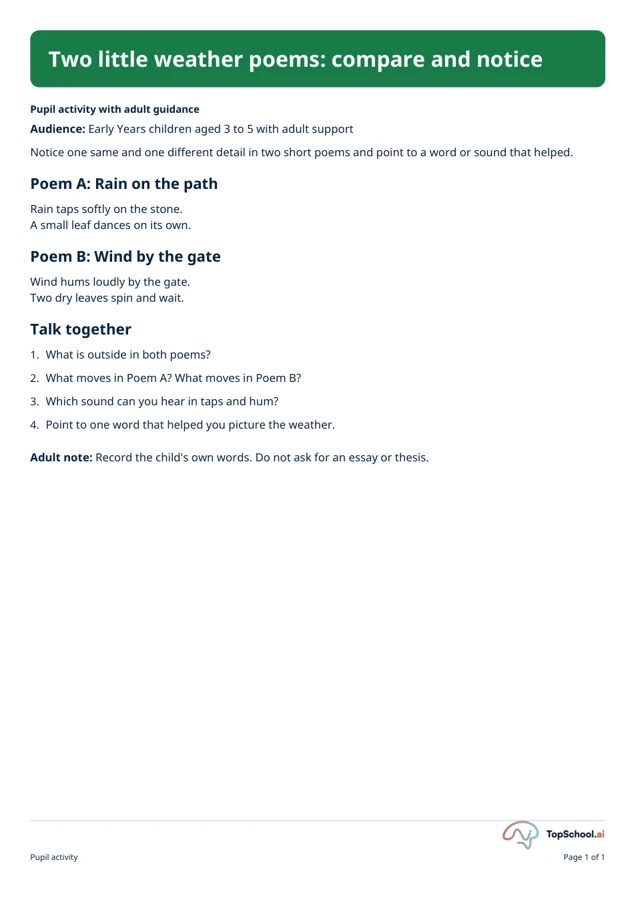
Two little weather poems: compare and notice
Pupil activity with adult guidance
Audience: Early Years children aged 3 to 5 with adult support
Notice one same and one different detail in two short poems and point to a word or sound that helped.
Poem A: Rain on the path
Rain taps softly on the stone.
A small leaf dances on its own.
Poem B: Wind by the gate
Wind hums loudly by the gate.
Two dry leaves spin and wait.
Talk together
1. What is outside in both poems?
2. What moves in Poem A? What moves in Poem B?
3. Which sound can you hear in taps and hum?
4. Point to one word that helped you picture the weather.
Adult note: Record the child's own words. Do not ask for an essay or thesis.
Pupil activity
Page 1 of 1
A teaching sequence
Notice one same and one different detail in two short poems and point to a word or sound that helped.
Listen to the rain poem
Read Poem A and invite children to point to rain or tap its sound.
Which word or optional tap represents the rain sound?
Listen to the wind poem
Read Poem B and show what the wind moves.
What does the wind move in this poem?
Notice one same and one different detail
Place both texts together; gather one same and one different detail.
What can you point to in both poems to support the comparison?
Choose a word that makes a picture
Ask children to choose a word and say what it helps them imagine.
What does this word help you imagine about the weather?
Before you teach
Look for the thinking behind an answer, choose the support your class needs and leave room for an independent response.
What to look for
A useful response links a comparison to a detail, such as both poems being outdoors or only the second having wind. Ask, “Which word helped you notice that?”
Give a little support
Offer picture cards for rain, leaf and cloud; accept pointing or a phrase before a full sentence.
Take the idea further
Invite children to make a two-line weather poem and choose a sound word to repeat.
Things to keep in mind
The poems are original classroom examples. This oral starter is not a reading assessment or a replacement for the class text.
Keep the idea. Make it yours.
Bring your topic, learning goal and class context to PLAI™, then review what you create.
Ideas to try with your class
Sample teaching perspectives on what to try, what to adapt and what to watch for.
Meet The Creators
Meet a creator whose teaching interests connect with this template.

Gentle Reminder
Two short poems share moving leaves but differ in rain tapping on stone and wind humming by a gate. The adult-guided questions ask what is outside in both, what moves in each, and which words carry the sounds.
Steady Marker
For ages 3 to 5, the task stays with noticing and oral comparison rather than an essay thesis. The adult note asks to record the child’s own words, preserving the activity as a conversation about two short texts.
Book and Biscuit
A child can point to “taps” or “hums” while an adult rereads the line. Asking one question at a time makes the distinction between the two leaves and the weather sounds easier to hold in discussion.
Chalk & Chai
The poems are short prompts, not a complete unit on weather or poetry. Do not require a written comparison or thesis; the material expressly says to record the child’s words instead.