
Languages and literacy
Phra Aphai Mani: characters, story and style
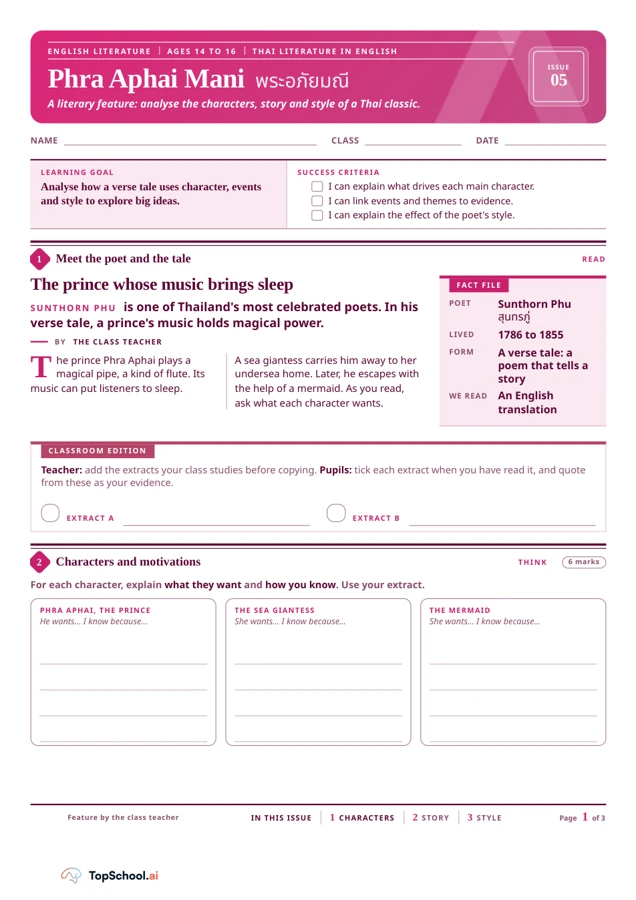
Explore how the verse tale Phra Aphai Mani presents character, freedom and the power of music. Pupils gather evidence from class-selected extracts, trace important moments and shape a response about Sunthorn Phu’s storytelling. Review the chosen translation first.
Read the material
Explore how the verse tale Phra Aphai Mani presents character, freedom and the power of music. Pupils gather evidence from class-selected extracts, trace important moments and shape a response about Sunthorn Phu’s storytelling. Review the chosen translation first.
Activity. Use the preview for diagrams and layout.
Page 1
NAME
CLASS
DATE
LEARNING GOAL
Analyse how a verse tale uses character, events
and style to explore big ideas.
SUCCESS CRITERIA
I can explain what drives each main character.
I can link events and themes to evidence.
I can explain the effect of the poet's style.
The prince whose music brings sleep
SUNTHORN PHU is one of Thailand's most celebrated poets. In his
verse tale, a prince's music holds magical power.
BY
THE CLASS TEACHER
T
he prince Phra Aphai plays a
magical pipe, a kind of flute. Its
music can put listeners to sleep.
A sea giantess carries him away to her
undersea home. Later, he escapes with
the help of a mermaid. As you read,
ask what each character wants.
FACT FILE
POET
Sunthorn Phu
สุนทรภู่
LIVED
1786 to 1855
FORM
A verse tale: a
poem that tells a
story
WE READ
An English
translation
CLASSROOM EDITION
Teacher: add the extracts your class studies before copying. Pupils: tick each extract when you have read it, and quote
from these as your evidence.
EXTRACT A
EXTRACT B
For each character, explain what they want and how you know. Use your extract.
Feature by the class teacher
IN THIS ISSUE
1 CHARACTERS
2 STORY
3 STYLE
E N G L I S H L I T E R AT U R E
AG E S 1 4 TO 1 6
T H A I L I T E R AT U R E I N E N G L I S H
Phra Aphai Mani
A literary feature: analyse the characters, story and style of a Thai classic.
พระอภัยมณี
ISSUE
05
Meet the poet and the tale
R E A D
1
Characters and motivations
T H I N K
6 marks
2
PHRA APHAI, THE PRINCE
He wants... I know because...
THE SEA GIANTESS
She wants... I know because...
THE MERMAID
She wants... I know because...
Page 1 of 3
Page 2
NAME
CLASS
DATE
For each moment, say what happens and why it matters to the story.
A
Carried away
The giantess takes him to her
undersea home.
B
Under the sea
What does your extract show of
this time?
C
The escape
A mermaid helps him to escape.
THE TURNING POINT IS ... BECAUSE ...
Explain how the tale explores each theme. Name a moment from your extract.
Which moment in your extract stays with you most? Explain why.
SENTENCE STARTERS
The moment that stays
with me is...
This is powerful because...
The poet makes me feel...
Text analysis organiser · Story desk
I S S U E 0 5
P H R A A P H A I M A N I
S TO R Y D E S K
Story, themes and you
Plot structure
P L A N
6 marks
3
Themes
T H I N K
6 marks
4
LOVE
Who longs for whom, and what does it
make them do?
FREEDOM
Who is held, and who helps them go free?
THE POWER OF MUSIC
Is the pipe's music a gift, a weapon or both?
Your response
W R I T E
4 marks
5
Page 2 of 3
Page 3
NAME
CLASS
DATE
Find one example of each feature in your extract. Then explain its effect on the reader.
Verse
Rhythm, rhyme or repeated sounds.
What do they add?
Imagery
A picture in words: the sea, the pipe, a
creature.
The fantastic
Magic or impossible beings. Why
include them?
A TALE I KNOW
Answer in one paragraph: How does Sunthorn Phu present the power of music? Make a point, quote your extract,
explain the effect, then link to a theme.
Text analysis organiser · Critics' desk
I S S U E 0 5
P H R A A P H A I M A N I
C R I T I C S ' D E S K
Style, comparison and your verdict
Style and form
C H E C K
6 marks
6
Compare with a tale you know
T H I N K
4 marks
7
ALIKE
A character, journey or kind of magic they share.
DIFFERENT
Something only one tale does, and its effect.
Pull it together
W R I T E
8 marks
8
Page 3 of 3
A teaching sequence
Develop an interpretation of character, plot, theme and poetic choices by selecting evidence from a class-approved English translation of Phra Aphai Mani.
Read character motives in the extract
Read the introductory account, then use a selected extract to explain what Phra Aphai, the sea giantess and the mermaid want. Link each interpretation to a detail pupils can locate.
Which locatable detail supports what this character wants?
Connect turning points and themes
Map the tale’s key moments, explain why a turning point matters, and connect a theme such as love, freedom or music to evidence from an extract.
Why does this event matter to the theme in your selected passage?
Explain a passage's effect and style
Choose a moment that stays with the pupil and explain its effect, using the sentence starters only where they help. Identify a feature such as verse, imagery or the fantastic and describe its effect using the chosen passage.
Which words show the imagery, verse feature or fantastic element you discuss?
Compare and form a supported paragraph
Compare the tale with a familiar story, then write a point, quotation, explanation and link to a theme.
How does the quotation support your point about music and theme?
Before you teach
Look for the thinking behind an answer, choose the support your class needs and leave room for an independent response.
What to look for
Check that each interpretation is supported by a quotation or precise detail from an approved extract. Ask pupils to explain how the evidence supports their point and how a poetic choice affects meaning, rather than accepting a plot retelling as analysis.
Give a little support
Preselect a short, accessible passage and read it together. Model one evidence-linked character inference, offer a small choice of themes, and let pupils rehearse an idea aloud or annotate a copy before drafting.
Take the idea further
Ask pupils to compare how music works in two moments, weigh an alternative interpretation, or examine how the English translation shapes their reading. Require each claim about effect to be anchored in words from the chosen passage.
Things to keep in mind
The organiser does not include the class extracts needed for evidence-based answers, and its introductory account is not a substitute for a checked edition or literary teaching. Confirm translation, cultural framing and age suitability before use; the prompts do not establish a single correct interpretation.
Keep the idea. Make it yours.
Bring your topic, learning goal and class context to PLAI™, then review what you create.
Ideas to try with your class
Sample teaching perspectives on what to try, what to adapt and what to watch for.
Meet The Creators
Meet the creators whose teaching interests connect with this template. Find an approach to try with your class.

Claire Dunmore
Drafting gives pupils a chance to shape an idea, test what they mean and make a revision with a purpose.
Meet the creator
Joel Abraham
I pay attention when a class begins to disagree about a text, because that can be the moment pupils stop repeating a first response and start reading more closely.
Meet the creator
Hayley Crompton
Our reading challenge is run with the library, and it has to reach pupils who are not already choosing books for pleasure.
Meet the creator
Bright Idea Break
This three-page organiser analyses Phra Aphai Mani through character, plot, theme and poetic choices, using a class-approved English translation. The introductory passage identifies Sunthorn Phu and describes the prince's magical music.
Glue Stick Club
The prompts ask pupils to connect character motives and events to evidence, then consider the poet's style. Requiring an approved translation keeps the analysis tied to the class text.
Coffee Before Copies
Read a short passage together, identify one exact detail and model how it supports an interpretation of a character or theme. Distinguish the English translator's wording from the source poem's original language.
Five More Minutes
The organiser does not provide a complete literary or cultural account of the work. Use a verified translation and suitable contextual teaching, and avoid treating one excerpt as representative of the whole poem.