
Languages and literacy
Translation practice
Practise translation in both directions using school and free-time topics. A compact grammar toolkit supports noun gender, adjective agreement, regular -ar verbs, gustar, connectives and a short false-friend check. Use the toolkit to check a translation.
Read the material
Practise translation in both directions using school and free-time topics. A compact grammar toolkit supports noun gender, adjective agreement, regular -ar verbs, gustar, connectives and a short false-friend check. Use the toolkit to check a translation.
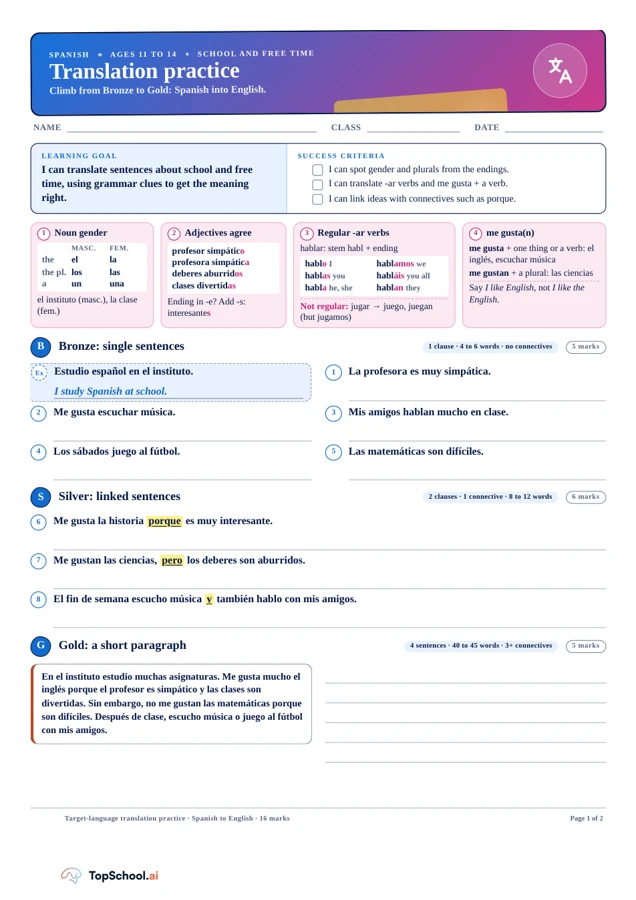
Activity. Use the preview for diagrams and layout.
Page 1
NAME
CLASS
DATE
LEARNING GOAL
I can translate sentences about school and free
time, using grammar clues to get the meaning
right.
SUCCESS CRITERIA
I can spot gender and plurals from the endings.
I can translate -ar verbs and me gusta + a verb.
I can link ideas with connectives such as porque.
1
Noun gender
MASC.
FEM.
the
el
la
the pl. los
las
a
un
una
el instituto (masc.), la clase
(fem.)
2
Adjectives agree
profesor simpático
profesora simpática
deberes aburridos
clases divertidas
Ending in -e? Add -s:
interesantes
3
Regular -ar verbs
hablar: stem habl + ending
hablo I
hablas you
habla he, she
hablamos we
habláis you all
hablan they
Not regular: jugar → juego, juegan
(but jugamos)
4
me gusta(n)
me gusta + one thing or a verb: el
inglés, escuchar música
me gustan + a plural: las ciencias
Say I like English, not I like the
English.
B
Bronze: single sentences
1 clause · 4 to 6 words · no connectives
5 marks
Ex
Estudio español en el instituto.
I study Spanish at school.
1
La profesora es muy simpática.
2
Me gusta escuchar música.
3
Mis amigos hablan mucho en clase.
4
Los sábados juego al fútbol.
5
Las matemáticas son difíciles.
S
Silver: linked sentences
2 clauses · 1 connective · 8 to 12 words
6 marks
6
Me gusta la historia porque es muy interesante.
7
Me gustan las ciencias, pero los deberes son aburridos.
8
El fin de semana escucho música y también hablo con mis amigos.
G
Gold: a short paragraph
4 sentences · 40 to 45 words · 3+ connectives
5 marks
En el instituto estudio muchas asignaturas. Me gusta mucho el
inglés porque el profesor es simpático y las clases son
divertidas. Sin embargo, no me gustan las matemáticas porque
son difíciles. Después de clase, escucho música o juego al fútbol
con mis amigos.
Target-language translation practice · Spanish to English · 16 marks
SPANISH
AGES 11 TO 14
SCHOOL AND FREE TIME
Translation practice
Climb from Bronze to Gold: Spanish into English.
Page 1 of 2
Page 2
WORD BANK
Connectives:
y and
pero but
porque because
también also
sin embargo however
el instituto
school
las matemáticas
maths
las ciencias
science
el profesor
teacher (man)
la profesora
teacher (woman)
los deberes
homework
jugar al fútbol
to play football
ver la tele
to watch TV
después de clase
after school
el fin de semana
at the weekend
con mis amigos
with my friends
simpático
nice, friendly
divertido
fun
aburrido
boring
grande
big
B
Bronze: single sentences
1 clause · 4 to 6 words · no connectives
5 marks
Ex
I listen to music at home.
Escucho música en casa.
1
The teacher (a man) is very nice.
2
I like watching TV.
3
We study English at school.
4
My friends play football.
5
Science is interesting.
S
Silver: linked sentences
2 clauses · 1 connective · 8 to 12 words
6 marks
6
I like music because the teacher is fun.
7
I like maths, but I don't like homework.
8
After school we listen to music and we also talk a lot.
G
Gold: a short paragraph
4 sentences · 40 to 45 words · 3+ connectives
5 marks
I study at a big school. I like Spanish because the teacher (a
woman) is very nice. However, I don't like science because it is
boring. After school I listen to music, but at the weekend I play
football with my friends.
Hint: science is plural in Spanish.
Spot the false friend
5 marks
They look English but are not. Circle the real meaning.
embarazada
pregnant
embarrassed
librería
library
bookshop
carpeta
folder
carpet
éxito
exit
success
constipado
has a cold
constipated
Self-check
el, la, los, las match each noun.
Adjectives agree: -o, -a, -os, -as.
Verbs fit the person: -o I, -amos we, -an they.
me gustan only before a plural.
Accents in: inglés, música, fútbol.
Not yet
Getting there
Got it
Target-language translation practice · English to Spanish · 21 marks
ENGLISH TO SPANISH
SAME THREE BANDS
Now say it in Spanish
Use the word bank and page 1's toolkit. Accents and ñ count.
Page 2 of 2
A teaching sequence
Use grammar and vocabulary clues to translate sentences about school and free time accurately, connect ideas and check spelling and accents.
Translate Spanish through grammar clues
Translate the Spanish Bronze, Silver and Gold items into English. Use noun endings, adjective agreement, verb forms and the connective list as clues.
Which noun, adjective, verb or connective clue helps preserve the meaning?
Write Spanish with the taught variety
Complete the English-to-Spanish items with the word bank. Check noun articles, adjective endings, verb person and whether me gusta or me gustan is needed.
Do articles, adjective endings and verb persons fit the intended meaning?
Check five false friends
Translate the five false friends by selecting the real meaning rather than the similar-looking English word.
Which supplied meaning differs from the similar-looking English word?
Review and discuss acceptable alternatives
Use the self-check to review agreement, verb endings and accent marks. Compare a response with a teacher-approved answer or discuss why another translation may also work.
What supports the translation under the teacher-approved model and course conventions?
Before you teach
Look for the thinking behind an answer, choose the support your class needs and leave room for an independent response.
What to look for
Check that the translation preserves meaning rather than matching word order mechanically. Look for accurate article/adjective agreement, verb endings and accents, and ask pupils to explain one grammar choice. Accept another accurate translation that preserves the same meaning.
Give a little support
Start with one Bronze sentence, underline the subject and verb, and identify the noun article before translating. Provide a small word bank, sentence frame or oral rehearsal, then build toward linked clauses.
Take the idea further
Ask pupils to translate a sentence without the word bank and explain the grammar clue they used. They can compare two valid translations and discuss where word order or phrasing differs.
Things to keep in mind
The word bank and grammar explanations are brief and may not cover every valid translation. Examples use forms such as vosotros; align the language variety, vocabulary and spelling conventions with the course being taught. Have a Spanish educator review translations before use.
Keep the idea. Make it yours.
Bring your topic, learning goal and class context to PLAI™, then review what you create.
Ideas to try with your class
Sample teaching perspectives on what to try, what to adapt and what to watch for.
Meet The Creators
Meet a creator whose teaching interests connect with this template.

The Curious Pencil
This two-page Spanish translation sheet focuses on school and free time, with prompts for gender, plural forms, adjective agreement, -ar verbs and “me gusta” plus an infinitive. Connectives such as porque help link ideas.
Little Lightbulbs
The examples show how noun endings and adjective forms carry grammar information before pupils translate full sentences. The success criteria make the targeted structures visible.
Calm Table
Mark the noun and its article before translating, then check adjective agreement and verb form. Use the connective bank after the core sentence is clear.
Notes Between Bells
This is a selected grammar practice page, not a full Spanish language assessment. Confirm the taught vocabulary and accent marks, and judge meaning as well as form.