
Study and learning skills
Beyond the syllabus
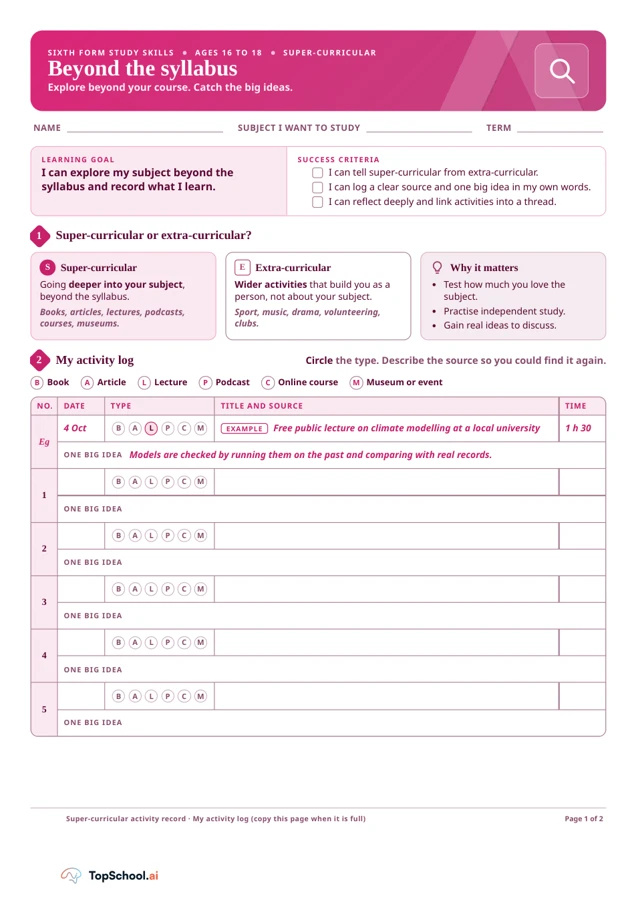
Record subject-related activities, note a source and one idea in your own words, then reflect on what changed your thinking. The final prompts help pupils connect several activities through a question they want to explore.
Read the material
Record subject-related activities, note a source and one idea in your own words, then reflect on what changed your thinking. The final prompts help pupils connect several activities through a question they want to explore.
Activity. Use the preview for diagrams and layout.
Page 1
NAME
SUBJECT I WANT TO STUDY
TERM
LEARNING GOAL
I can explore my subject beyond the
syllabus and record what I learn.
SUCCESS CRITERIA
I can tell super-curricular from extra-curricular.
I can log a clear source and one big idea in my own words.
I can reflect deeply and link activities into a thread.
Super-curricular or extra-curricular?
S
Super-curricular
Going deeper into your subject,
beyond the syllabus.
Books, articles, lectures, podcasts,
courses, museums.
E
Extra-curricular
Wider activities that build you as a
person, not about your subject.
Sport, music, drama, volunteering,
clubs.
Why it matters
Test how much you love the
subject.
Practise independent study.
Gain real ideas to discuss.
My activity log
Circle the type. Describe the source so you could find it again.
B
Book
A
Article
L
Lecture
P
Podcast
C
Online course
M Museum or event
NO.
DATE
TYPE
TITLE AND SOURCE
TIME
Eg
4 Oct
B
A
L
P
C
M
EXAMPLE
Free public lecture on climate modelling at a local university
1 h 30
ONE BIG IDEA
Models are checked by running them on the past and comparing with real records.
1
B
A
L
P
C
M
ONE BIG IDEA
2
B
A
L
P
C
M
ONE BIG IDEA
3
B
A
L
P
C
M
ONE BIG IDEA
4
B
A
L
P
C
M
ONE BIG IDEA
5
B
A
L
P
C
M
ONE BIG IDEA
Super-curricular activity record · My activity log (copy this page when it is full)
SIXTH FORM STUDY SKILLS
AGES 16 TO 18
SUPER-CURRICULAR
Beyond the syllabus
Explore beyond your course. Catch the big ideas.
1
2
Page 1 of 2
Page 2
Deep reflection on my best activity
Pick the one that made you think hardest, not the most impressive.
My best activity (log number and title)
Why I chose it
Follow a thread
Link three activities so each one grows from a question the last one raised.
Example thread: a podcast on how new medicines are tested, then an article on the placebo effect, then a statistics
course unit. Interest: how we know a treatment really works.
GO FURTHER
Find a serious source that argues against part of your thread. Note its strongest point and your answer.
Super-curricular activity record · Reflect and connect
SUPER-CURRICULAR
AGES 16 TO 18
REFLECTION
Go deeper: reflect and connect
One activity thought through well is worth more than ten listed.
3
A
What did I learn?
Before this I thought... Now I think...
B
How does it connect to my subject?
This links to ... in my course because...
C
What do I disagree with
or want to explore next?
I am not convinced that... because...
D
How might I use this in a
personal statement or interview?
If someone asked me about it, I would explain...
4
1
Where it started: activity
The question it raised
2
What I followed up
The question it raised
3
Where it took me
The question I am left with
My developing interest, in one sentence
Page 2 of 2
A teaching sequence
Distinguish subject-deepening activities from wider extra-curricular experiences, record useful sources and ideas, and explain how an activity connects with a developing interest.
Log a findable source
Log the date, activity type, title or source and time for each experience. Use the example row as a model for recording a source another person could find.
Could someone else locate the activity from your title and source?
Capture one big idea
Write one big idea in the pupil’s own words rather than copying a description of the activity.
Can you explain the idea without copying the activity description?
Reflect on the strongest question
Choose the activity that prompted the most thought, explain why and respond to the reflection prompts about new learning, subject links and questions.
What changed between “Before this I thought” and “Now I think”?
Follow and challenge a thread
Connect three activities by showing what question one raised, what was followed up and what the pupil wants to explore next. Then use the further prompt to seek a serious source that disagrees with part of the thread and record its strongest point.
Which new question connected one activity to the next?
Before you teach
Look for the thinking behind an answer, choose the support your class needs and leave room for an independent response.
What to look for
Check that each log entry includes enough source detail to revisit and that the reflection explains a specific idea or question. Ask how each activity deepened the subject rather than only how impressive it may look.
Give a little support
Offer a short menu of subject-related sources and let pupils record one activity at a time. Provide a sentence frame such as “Before I thought… now I think…” and accept an oral reflection before writing.
Take the idea further
Ask pupils to compare two sources with different conclusions, explain what evidence each uses and identify a question that could guide a further reading or course.
Things to keep in mind
The examples describe possible activities but do not establish that any specific activity improves admission chances or guarantees a course place. Encourage genuine subject curiosity and follow current school guidance on personal statements and application writing.
Keep the idea. Make it yours.
Bring your topic, learning goal and class context to PLAI™, then review what you create.
Ideas to try with your class
Sample teaching perspectives on what to try, what to adapt and what to watch for.
Meet The Creators
Meet a creator whose teaching interests connect with this template.

Chalk Dust & Checklists
This two-page record distinguishes going deeper into a subject through books, articles, lectures, podcasts, courses or museums from wider extra-curricular activities. Pupils log a source, capture a big idea in their own words and connect activities to an emerging interest.
Good Question
The distinction gives pupils a way to reflect on how an activity relates to a subject, rather than count experiences. Recording a source and idea creates a concrete basis for a later discussion.
Steady Marker
Model one entry using a source the pupil has actually used, then ask what idea stayed with them. A pupil who is still exploring can record a question instead of claiming a fixed pathway.
Glue Stick Club
The record does not assess an application or predict admission. Check that sources are accurately named and current, and avoid implying that expensive activities are required for subject interest.