
Study and learning skills
Plan my week: study and revision planner
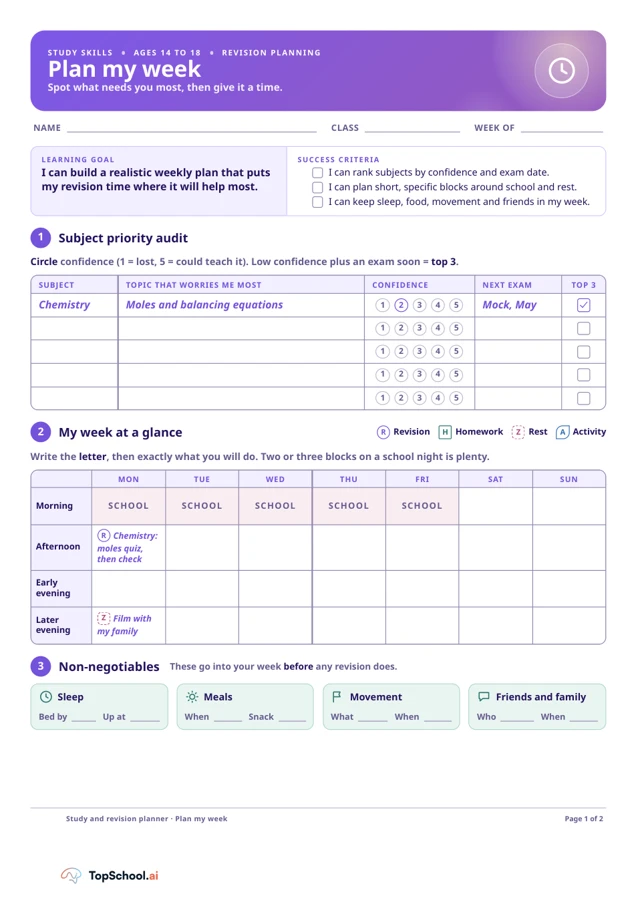
Prioritise subjects, fit short revision blocks around commitments and protect time for sleep, meals, movement and relationships. A second page introduces five study techniques and a session plan, then invites a weekly review with a pupil.
Read the material
Prioritise subjects, fit short revision blocks around commitments and protect time for sleep, meals, movement and relationships. A second page introduces five study techniques and a session plan, then invites a weekly review with a pupil.
Activity. Use the preview for diagrams and layout.
Page 1
NAME
CLASS
WEEK OF
LEARNING GOAL
I can build a realistic weekly plan that puts
my revision time where it will help most.
SUCCESS CRITERIA
I can rank subjects by confidence and exam date.
I can plan short, specific blocks around school and rest.
I can keep sleep, food, movement and friends in my week.
1
Subject priority audit
Circle confidence (1 = lost, 5 = could teach it). Low confidence plus an exam soon = top 3.
SUBJECT
TOPIC THAT WORRIES ME MOST
CONFIDENCE
NEXT EXAM
TOP 3
Chemistry
Moles and balancing equations
1
2
3
4
5
Mock, May
1
2
3
4
5
1
2
3
4
5
1
2
3
4
5
1
2
3
4
5
2
My week at a glance
R
Revision
H
Homework
Z
Rest
A
Activity
Write the letter, then exactly what you will do. Two or three blocks on a school night is plenty.
MON
TUE
WED
THU
FRI
SAT
SUN
Morning
SCHOOL
SCHOOL
SCHOOL
SCHOOL
SCHOOL
Afternoon
R
Chemistry:
moles quiz,
then check
Early
evening
Later
evening
Z
Film with
my family
3
Non-negotiables
These go into your week before any revision does.
Sleep
Bed by
Up at
Meals
When
Snack
Movement
What
When
Friends and family
Who
When
Study and revision planner · Plan my week
STUDY SKILLS
AGES 14 TO 18
REVISION PLANNING
Plan my week
Spot what needs you most, then give it a time.
Page 1 of 2
Page 2
4
Five techniques that work
R
Retrieval
practice
What: pull information out of memory instead of rereading it. The effort
of remembering makes it stick.
How: notes closed, write all you can, then check and fill gaps in another
colour.
TRY IT THIS WEEK
Topic and day
S
Spaced
practice
What: spread a topic over several short sessions with gaps between,
instead of cramming it in one go.
How: return to it after a day, then a few days, then a week or so.
TRY IT THIS WEEK
Topic and day
I
Interleaving
What: mix related topics or question types in one session, so you practise
choosing the method.
How: instead of ten questions on one topic, try a mixed set such as
A B C A C B.
TRY IT THIS WEEK
Topic and day
D
Dual coding
What: pair words with a simple visual (labelled diagram, timeline,
flowchart) for two ways to remember.
How: turn a page of notes into one sketch, then explain it aloud.
TRY IT THIS WEEK
Topic and day
E
Elaborative
questioning
What: ask why and how questions about an idea and answer them, linking
it to what you know.
How: for each key fact ask "Why is this true?" and "How does it connect?"
TRY IT THIS WEEK
Topic and day
5
My 30-minute session
1 Recall
5 min
Recall last time
2 Focus
20 min
One topic, one technique
3 Check
5 min
Mark the gaps
Break
5 min
Move, drink, look away
Subject and topic
My recall task
Technique
R
S
I
D
E
circle one or two
Gaps to come back to on
Phone in another room
Water and kit ready
Timer set
6
End of week reflection
Study and revision planner · Revise well
STUDY SKILLS
AGES 14 TO 18
TECHNIQUES
Revise well
Five techniques with strong research behind them. Try at least two.
WHAT WORKED
WHAT I WILL CHANGE
HOW I FELT
Stretched
Mixed
Steady
Blocks planned
Blocks done
Page 2 of 2
A teaching sequence
Create a realistic weekly study plan, choose focused revision actions and reflect on what to adjust after trying the plan.
Plan specific, manageable study blocks
Fill the week grid around school, homework, rest and activities. Write the exact task for each revision block, keeping the printed suggestion of two or three blocks on a school night in view.
Which task fits the available time around school and homework?
Protect rest and everyday needs
Add sleep, meals, movement and time with friends or family before placing extra study sessions.
Have sleep, meals, movement and family time been placed before extra study?
Choose a technique for a topic
Choose from the technique cards: retrieval practice, spaced practice, interleaving, dual coding or elaborative questioning. Write a specific topic and day to try each chosen method.
What exactly will you recall, sketch, mix or explain on the chosen day?
Plan the session and review the week
Plan five minutes of recall, twenty of focused work and five of checking, followed by the separate five-minute break. Review what worked, what to change and how the week felt before planning another manageable week.
Have you allowed thirty minutes of study plus the separate five-minute break?
Before you teach
Look for the thinking behind an answer, choose the support your class needs and leave room for an independent response.
What to look for
Check that each block names a subject or task, fits around the pupil’s real schedule and leaves time for rest and other commitments. Ask whether the session timings add up and whether the pupil can change the plan when circumstances shift.
Give a little support
Start with one priority subject and two short blocks. Use a timetable with fixed commitments already entered, offer a choice of two revision techniques and help the pupil write a small, observable task for each block.
Take the idea further
Ask pupils to compare their intended plan with the week they actually had, identify one reason for a difference and adjust only what needs changing. They can choose a technique and explain why it suits the task.
Things to keep in mind
The technique cards describe approaches but provide no research citations for the claim that they have “strong research” behind them; review that wording and sources before presenting it as evidence. The session is labelled 30 minutes, but its printed segments total 35 minutes when the break is included. Avoid overloading pupils and adapt around wellbeing and support needs.
Keep the idea. Make it yours.
Bring your topic, learning goal and class context to PLAI™, then review what you create.
Ideas to try with your class
Sample teaching perspectives on what to try, what to adapt and what to watch for.
Meet The Creators
Meet the creators whose teaching interests connect with this template. Find an approach to try with your class.

Ngozi Adeyemi
I bring Year 11 pastoral attention together with Biology teaching, noticing difficulty early and using questions, diagrams and explanations to decide where a follow-up or support is needed.
Meet the creator
Ravi Chandran
If a scheme of learning and its assessment point in different directions, the assessment can end up shaping the classroom more strongly.
Meet the creator
Five More Minutes
This two-page weekly planner asks pupils to rank subjects by confidence and exam date, identify a worrying topic, schedule short revision blocks around school and rest, and reflect on what to adjust after trying the plan.
Clear Example
The prompt to prioritise topics with low confidence and an approaching exam gives a practical starting rule. The plan explicitly includes sleep, food, movement and friends alongside study.
Organised Pile
Agree a realistic number of short blocks, add breaks and leave room for changes to the week. Use the first plan as a trial, then adjust based on what the pupil actually completed and found useful.
Coffee Before Copies
This planner organises time but does not establish which revision strategy works best for a subject or pupil. Check dates against the school timetable and protect rest rather than treating every open space as study time.