
Geography
River data: calculate a fictional discharge
For Year 8 Geography pupils, use a fictional river data set to find mean depth, cross-section area, mean velocity and discharge with units.
Read the material
For Year 8 Geography pupils, use a fictional river data set to find mean depth, cross-section area, mean velocity and discharge with units.
Pupil activity and after-attempt self-check. Use the preview for diagrams and layout.
Page 1
River data: calculate a fictional discharge
Pupil activity and after-attempt self-check
Audience: Year 8 Geography pupils
Use a fictional river data set to find mean depth, cross-section area, mean velocity and discharge with units.
Fictional Site 2 data
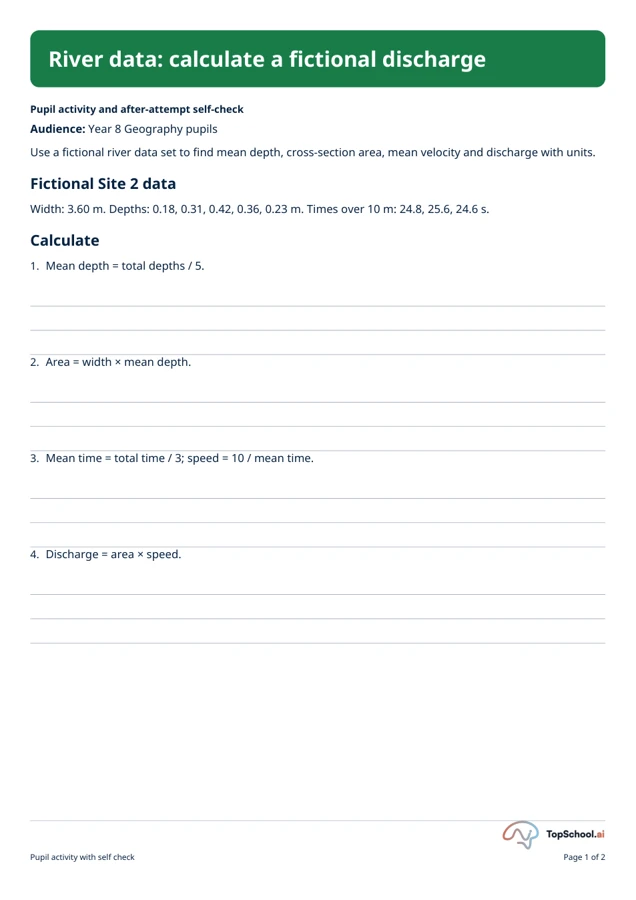
Width: 3.60 m. Depths: 0.18, 0.31, 0.42, 0.36, 0.23 m. Times over 10 m: 24.8, 25.6, 24.6 s.
Calculate
1. Mean depth = total depths / 5.
2. Area = width × mean depth.
3. Mean time = total time / 3; speed = 10 / mean time.
4. Discharge = area × speed.
Pupil activity with self check
Page 1 of 2
Page 2
River data: calculate a fictional discharge
Self-check: use after your first attempt
Worked answers
Depth total = 1.50 m; mean = 0.30 m. Area = 3.60 × 0.30 = 1.080 m2. Mean time = 75.0 / 3 = 25.0 s. Speed = 10 /
25 = 0.40 m/s. Discharge = 1.080 × 0.40 = 0.432 m3/s.
Pupil activity with self check
Page 2 of 2
A teaching sequence
Use a fictional river data set to find mean depth, cross-section area, mean velocity and discharge with units.
Find the mean of five depths
Find the mean of five depths: 0.18, 0.31, 0.42, 0.36 and 0.23 m.
Have you divided the depth total by five and kept metres?
Calculate the cross-section area
Multiply width 3.60 m by mean depth.
What unit results from width multiplied by mean depth?
Calculate mean time and velocity
Find mean time from 24.8, 25.6 and 24.6 s, then speed over 10 m.
Have you divided ten metres by the mean time rather than one trial?
Calculate discharge and then self-check
Multiply area by mean velocity and write the discharge in m³/s. Use the worked self-check only after completing your first attempt.
Area × mean velocity = discharge; m² × m/s = m³/s
Does area multiplied by velocity give your answer in cubic metres per second?
Before you teach
Look for the thinking behind an answer, choose the support your class needs and leave room for an independent response.
What to look for
Mean depth is 0.30 m; area 1.080 m2; mean time 25.0 s; speed 0.40 m/s; discharge 0.432 m3/s. Ask, “Which measurement contributes to discharge?”
Give a little support
Show one mean calculation and keep unit conversions visible.
Take the idea further
Compare another data set and explain why width alone does not prove greater discharge.
Things to keep in mind
Alder Brook is fictional. This activity does not authorise river access; fieldwork requires local staff permission.
Keep the idea. Make it yours.
Bring your topic, learning goal and class context to PLAI™, then review what you create.
Ideas to try with your class
Sample teaching perspectives on what to try, what to adapt and what to watch for.
Meet The Creators
Meet a creator whose teaching interests connect with this template.

Step by Step
The fictional Site 2 data gives width, five depths and three times over 10 metres, then sequences mean depth, area, mean time, speed and discharge. The self-check shows 0.30 m mean depth and 0.432 m³/s discharge.
Quietly Curious
The Year 8 task isolates calculation from a field visit by supplying all measurements and a worked answer page. Pupils can see how each intermediate value feeds the next formula.
Board Eraser
Keep metres, seconds and cubic metres per second beside each calculation. Completing the steps in order helps pupils check whether multiplying area by speed produces the stated discharge unit.
Tea at Breaktime
The measurements are fictional and the second page is a self-check after an attempt. The calculation does not validate real river data or replace safety approval for fieldwork.