
Wellbeing and personal development
Think It Through: restorative reflection
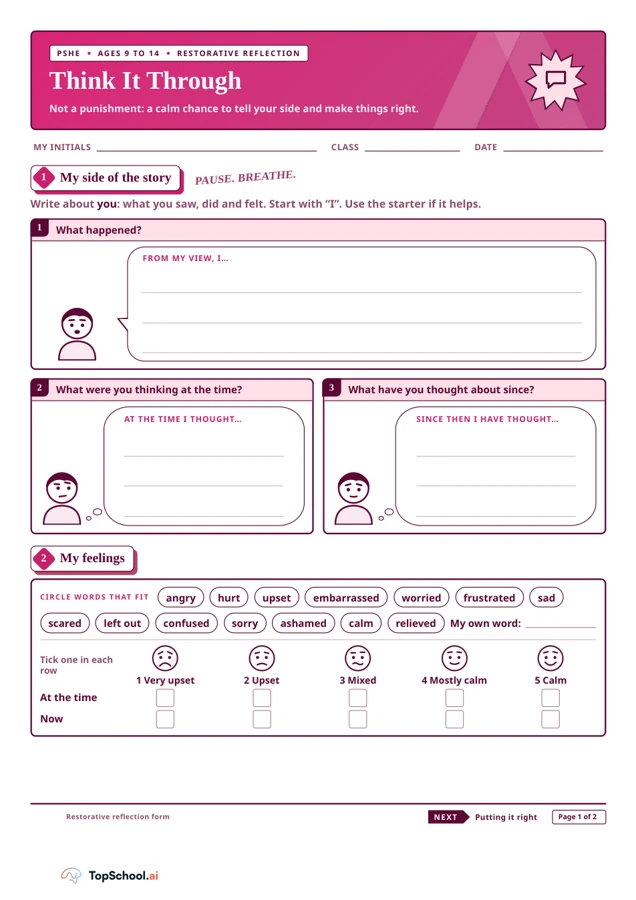
A calm reflection sequence invites a pupil to describe their own perspective, consider who was affected and identify a possible next step. Use it only with skilled adult support, time to listen and a clear route for concerns that need safeguarding attention.
Read the material
A calm reflection sequence invites a pupil to describe their own perspective, consider who was affected and identify a possible next step. Use it only with skilled adult support, time to listen and a clear route for concerns that need safeguarding attention.
Shared activity record. Use the preview for diagrams and layout.
Page 1
MY INITIALS
CLASS
DATE
My side of the story
Write about you: what you saw, did and felt. Start with “I”. Use the starter if it helps.
My feelings
Restorative reflection form
Putting it right
PSHE
AGES 9 TO 14
RESTORATIVE REFLECTION
Think It Through
Not a punishment: a calm chance to tell your side and make things right.
1
PAUSE. BREATHE.
What happened?
FROM MY VIEW, I…
What were you thinking at the time?
AT THE TIME I THOUGHT…
What have you thought about since?
SINCE THEN I HAVE THOUGHT…
2
CIRCLE WORDS THAT FIT
angry
hurt
upset
embarrassed
worried
frustrated
sad
scared
left out
confused
sorry
ashamed
calm
relieved
My own word:
Tick one in each
row
1 Very upset
2 Upset
3 Mixed
4 Mostly calm
5 Calm
At the time
Now
NEXT
1
2
3
Page 1 of 2
Page 2
Others and next steps
Think about everyone involved, including you. Be fair.
Restorative reflection form
Staff guide
PSHE
RESTORATIVE REFLECTION
Putting it right
3
Who has been affected and in what way?
I THINK … FELT…
What do you need now?
RIGHT NOW, I NEED…
What needs to happen to put things right?
I THINK IT WOULD HELP IF…
My putting-it-right plan (initials or roles only, never full names)
A
An apology idea
If and when I am ready: how could I say sorry?
B
One thing I will do
Something that helps. Start with “I will…”
C
Who can help
D
Follow-up date
Our agreement
We have each been heard. We will try this plan and meet again on the follow-up date.
MY INITIALS
OTHER PUPIL, IF PRESENT
STAFF INITIALS
NEXT
4
5
6
Page 2 of 2
Page 1
Think It Through: restorative reflection
Teacher companion
PSHE | Pupils aged 9 to 14 with adult support
Use with the exact 2-page original file. Keep pupil or staff activity pages separate from this teacher companion.
When to use it
Use this only when a pupil is ready to reflect and a trained adult can support the conversation
without pressure. It may help structure a restorative discussion after an incident, but it is not a
disciplinary investigation or a substitute for safeguarding, pastoral or behaviour procedures.
Purpose
Describe what happened from one’s own perspective, recognise feelings and effects on
others, identify current needs and consider a voluntary plan for putting things right.
Start here
Set a calm, private and supported context. Explain that the pupil can pause or ask for help,
and that the form is not a punishment. Follow school procedures if a pupil shares a safety
concern.
A teaching sequence
1. Invite the pupil to use “I” statements to describe what they saw, did or felt and what they
were thinking at the time.
2. Offer the feelings list and the two rating rows as optional ways to name how the pupil felt
then and feels now.
3. Discuss who may have been affected and what the pupil needs now; avoid asking the pupil
to guess another person’s feelings as fact.
4. If appropriate and freely chosen, consider an apology idea or one helpful action. Record
initials or roles only, as the sheet directs. Then agree any follow-up only when the people
involved are ready and school policy supports it. Record roles, adult support and a review date
without adding unnecessary personal details.
Checking guidance
Check that the pupil’s own account is heard in their words, that feelings are not judged, and
that any next step is safe, specific and voluntary. Confirm that a staff member owns follow-up
and knows how to respond if the discussion raises a safeguarding concern.
Use the pupil’s own account and a freely chosen next step. A restorative conversation must
not replace the school’s safeguarding or incident procedures, or require an apology or
meeting.
Support
Read prompts aloud and let the pupil answer by speaking, drawing or writing. Offer a neutral
phrase such as “From my view…” and give time to pause. The pupil may choose not to
complete a prompt or may use a trusted adult to record their words.
Take it further
When appropriate, ask the pupil to identify what would help repair trust and how they will
know whether the next step has happened. Keep the plan small, realistic and agreed by the
people responsible for it.
Things to keep in mind
Do not require a pupil to disclose, apologise, meet another person or sign an agreement. This
form does not replace a safeguarding response, incident record, investigation or school policy.
Handle completed reflections as sensitive information and store or dispose of them under
school rules.
Think It Through: restorative reflection
Teacher companion | Page 1
A teaching sequence
Describe what happened from one’s own perspective, recognise feelings and effects on others, identify current needs and consider a voluntary plan for putting things right.
Offer a voluntary first-person account
Invite the pupil to use “I” statements to describe what they saw, did or felt and what they were thinking at the time.
What would the pupil like to say about their own view or leave unshared?
Offer optional feeling words and ratings
Offer the feelings list and the two rating rows as optional ways to name how the pupil felt then and feels now.
Would the pupil prefer a listed word, their own word or no rating?
Discuss effects and current needs
Discuss who may have been affected and what the pupil needs now; avoid asking the pupil to guess another person’s feelings as fact.
Which statement is known, and which is only a possible view of another person's feelings?
Agree a freely chosen next step and follow-up
If freely chosen and appropriate, record an apology idea or helpful action using permitted initials or roles. Agree adult support and a review date only when those involved are ready and school policy supports the plan.
Are the people ready, and does the proposed action fit school policy?
Before you teach
Look for the thinking behind an answer, choose the support your class needs and leave room for an independent response.
What to look for
Check that the pupil’s own account is heard in their words, that feelings are not judged, and that any next step is safe, specific and voluntary. Confirm that a staff member owns follow-up and knows how to respond if the discussion raises a safeguarding concern. Use the pupil’s own account and a freely chosen next step. A restorative conversation must not replace the school’s safeguarding or incident procedures, or require an apology or meeting.
Give a little support
Read prompts aloud and let the pupil answer by speaking, drawing or writing. Offer a neutral phrase such as “From my view…” and give time to pause. The pupil may choose not to complete a prompt or may use a trusted adult to record their words.
Take the idea further
When appropriate, ask the pupil to identify what would help repair trust and how they will know whether the next step has happened. Keep the plan small, realistic and agreed by the people responsible for it.
Things to keep in mind
Do not require a pupil to disclose, apologise, meet another person or sign an agreement. This form does not replace a safeguarding response, incident record, investigation or school policy. Handle completed reflections as sensitive information and store or dispose of them under school rules.
Keep the idea. Make it yours.
Bring your topic, learning goal and class context to PLAI™, then review what you create.
Ideas for using this resource
Sample teaching perspectives on what to try, what to adapt and what to watch for.
Meet The Creators
Meet the creators whose teaching interests connect with this template. Find an approach to try with your class.

Bernadette Cheong
Transition into secondary school is not just a change of timetable; it can change how pupils see themselves and how they experience familiar strengths.
Meet the creator
Fiona McArdle
I use Year 8 English teaching to examine how whole-school routines work in class, looking for patterns in context and communicating next steps calmly and specifically to families.
Meet the creator
Clear Example
The two-page form for ages 9 to 14 asks a pupil to describe events from their perspective, name feelings and effects, identify current needs and consider a plan for putting things right. It frames the process as a calm chance, not a punishment.
Chalk Dust & Checklists
The first-person starters focus reflection on what the pupil saw, did and felt. The restorative framing can support a conversation about impact and repair when participation is appropriate and voluntary.
Gentle Reminder
Use the form with a trained, supportive adult after the pupil is ready to reflect. Offer oral responses or a pause, and make sure the pupil can describe their own view without being coached into an admission.
Page-Turner Planner
A reflection sheet cannot determine what happened, replace safeguarding or disciplinary procedures, or guarantee agreement between pupils. Follow school policy, keep accounts private and do not force a meeting or restorative plan.