
Study and learning skills
Evaluating a study
Break down a study example, report what its results do and do not show, and evaluate validity, reliability, generalisability and ethics. The fictional memory-study numbers are clearly marked as invented practice material, so pupils can rehearse evaluation without mistaking them for research findings.
Read the material
Break down a study example, report what its results do and do not show, and evaluate validity, reliability, generalisability and ethics. The fictional memory-study numbers are clearly marked as invented practice material, so pupils can rehearse evaluation without mistaking them for research findings.
Complete resource. Use the preview for diagrams and layout.
Page 1
NAME
CLASS
DATE
LEARNING GOAL
Summarise a study
fairly, then judge how far
to trust it.
SUCCESS CRITERIA
I can say what a study set out to find and how.
I can name the variables and report the results.
I can judge the study with evidence.
Study X
Read this once. Its answers
sit in the margin beside
each part.
INVENTED
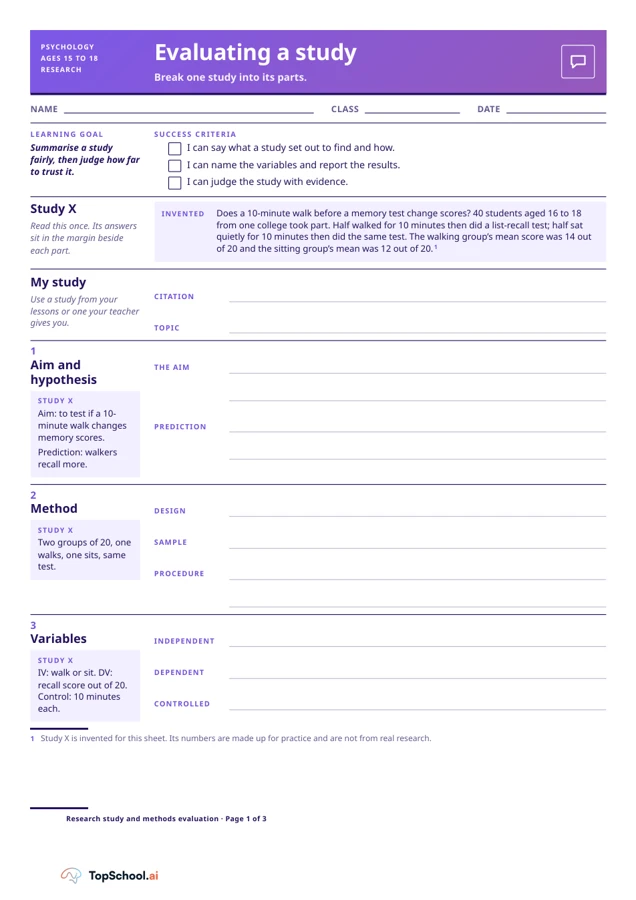
Does a 10-minute walk before a memory test change scores? 40 students aged 16 to 18
from one college took part. Half walked for 10 minutes then did a list-recall test; half sat
quietly for 10 minutes then did the same test. The walking group’s mean score was 14 out
of 20 and the sitting group’s mean was 12 out of 20.1
My study
Use a study from your
lessons or one your teacher
gives you.
CITATION
TOPIC
1
Aim and
hypothesis
STUDY X
Aim: to test if a 10-
minute walk changes
memory scores.
Prediction: walkers
recall more.
THE AIM
PREDICTION
2
Method
STUDY X
Two groups of 20, one
walks, one sits, same
test.
DESIGN
SAMPLE
PROCEDURE
3
Variables
STUDY X
IV: walk or sit. DV:
recall score out of 20.
Control: 10 minutes
each.
INDEPENDENT
DEPENDENT
CONTROLLED
1 Study X is invented for this sheet. Its numbers are made up for practice and are not from real research.
Research study and methods evaluation · Page 1 of 3
PSYCHOLOGY
AGES 15 TO 18
RESEARCH
Evaluating a study
Break one study into its parts.
Page 2
4
Results and
conclusion
STUDY X
Means 14 and 12 out
of 20, a difference of 2
marks. The walking
group did a little
better.
THE NUMBERS
SHOW
SO THE STUDY
SUGGESTS
Mean difference
STUDY X
14 − 12 = 2 marks.
WORKING
Higher mean
 − lower mean
 =
 marks
01
Validity Did it test what it
claims to? Use evidence
from the study.
POINT
EVIDENCE
SO WHAT?
02
Reliability Could someone
repeat it and get the same?
Use evidence from the
study.
POINT
EVIDENCE
SO WHAT?
03
Generalisability Do the
results fit people beyond
the sample? Use evidence
from the study.
POINT
EVIDENCE
SO WHAT?
Research study and methods evaluation · Page 2 of 3
PSYCHOLOGY
AGES 15 TO 18
RESEARCH
Results and first evaluation
Page 3
04
Ethics Were the people
treated with care? Use
evidence from the study.
POINT
EVIDENCE
SO WHAT?
Sampling
Tick the method your study
used.
Random equal chance for all.
Opportunity whoever is easy to
reach.
Volunteer people choose to take
part.
Stratified groups in fair proportions.
What I would
change
One improvement and the
problem it would fix.
I WOULD
CHANGE
Evaluation
Write a paragraph. Use
point, evidence, so what for
at least two headings.
MY PARAGRAPH
Verdict
Circle one number.
1
not at all
2
a little
3
partly
4
mostly
5
completely
I TRUST THIS
STUDY THIS
MUCH BECAUSE
Research study and methods evaluation · Page 3 of 3
PSYCHOLOGY
AGES 15 TO 18
RESEARCH
Evaluating the study
A teaching sequence
Summarise a study’s aim, prediction, design, sample, procedure, variables and results; then evaluate validity, reliability, generalisability and ethics with evidence.
Describe the study design
Complete the aim and prediction fields, then describe the two groups, sample, shared test procedure and independent, dependent and controlled variables.
Which variable is changed, measured and kept the same?
Report the invented means
Report the means of 14 and 12 out of 20 and show the subtraction that gives a two-mark difference. State that the walking group scored higher in this invented example, without claiming the walk caused it.
What does the two-mark difference show without establishing cause?
Evaluate a cited study
Choose a real lesson study or one provided by a teacher. Record its citation, method, sample, procedure and variables; for each evaluation heading, cite evidence and explain why it matters.
Which specific study evidence supports your validity or reliability point?
Judge and improve the method
Select the sampling method that best matches the study, propose one improvement and write a short evaluation using at least two headings.
What problem would your proposed improvement address?
Before you teach
Look for the thinking behind an answer, choose the support your class needs and leave room for an independent response.
What to look for
Check that pupils distinguish a result from a causal conclusion and that each evaluation paragraph links a claim to a specific study detail. Ask what further evidence would make the judgement stronger rather than accepting a rating without a reason.
Give a little support
Provide a study summary with key details highlighted and a four-part frame: point, evidence, explanation and limitation. Let pupils rehearse one evaluation aloud before writing. Review the independent and dependent variable definitions with a concrete example.
Take the idea further
Ask pupils to compare the sampling method with the study’s target population and explain what a larger or more diverse sample might change. They can identify an alternative explanation for the score difference and suggest a control to address it.
Things to keep in mind
Study X and its numerical results are invented and must not be cited as published evidence. A difference between group means alone does not establish causation. Evaluation depends on the design and evidence of the study pupils choose; the template does not supply a real study or answer key.
Keep the idea. Make it yours.
Bring your topic, learning goal and class context to PLAI™, then review what you create.
Ideas to try with your class
Sample teaching perspectives on what to try, what to adapt and what to watch for.
Meet The Creators
Meet a creator whose teaching interests connect with this template.

Organised Pile
This three-page study evaluation asks pupils to summarise aim, prediction, design, sample, procedure, variables and results, then judge validity, reliability, generalisability and ethics. Study X is explicitly labelled invented and uses 40 college students aged 16 to 18.
Little Lightbulbs
The supplied case allows pupils to practise evaluating method and evidence without confusing it with a published finding. The prompt to judge how far to trust the study encourages a qualified conclusion.
Paperclip Perspective
Mark each study feature in the margin before evaluating it, then connect one strength or limitation to the claim it affects. Keep “invented” visible when discussing or reproducing the example.
Coffee Before Copies
Study X is fictional and cannot support a real claim about walking or memory. For evaluation practice it is a worked case; for subject knowledge, use a real study and check its full method and findings.