
Languages and literacy
Reading vocabulary and strategy bookmark
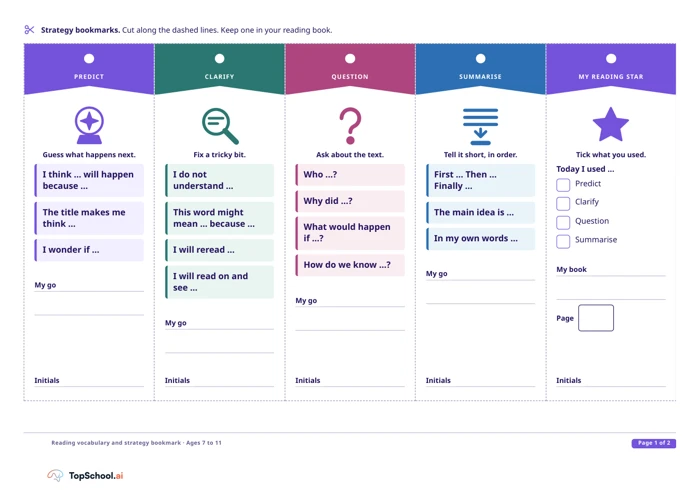
Keep a strategy bookmark in a reading book to prompt prediction, clarification, questioning and summarising. A second page provides word bookmarks for recording meanings, words that create an image and words looked up. Keep it close during independent reading.
Read the material
Keep a strategy bookmark in a reading book to prompt prediction, clarification, questioning and summarising. A second page provides word bookmarks for recording meanings, words that create an image and words looked up. Keep it close during independent reading.
Complete resource. Use the preview for diagrams and layout.
Page 1
Strategy bookmarks. Cut along the dashed lines. Keep one in your reading book.
Guess what happens next.
I think ... will happen
because ...
The title makes me
think ...
I wonder if ...
Fix a tricky bit.
I do not
understand ...
This word might
mean ... because ...
I will reread ...
I will read on and
see ...
Ask about the text.
Who ...?
Why did ...?
What would happen
if ...?
How do we know ...?
Tell it short, in order.
First ... Then ...
Finally ...
The main idea is ...
In my own words ...
Tick what you used.
Today I used ...
Predict
Clarify
Question
Summarise
Page
Reading vocabulary and strategy bookmark · Ages 7 to 11
Page 1 of 2
PREDICT
CLARIFY
QUESTION
SUMMARISE
MY READING STAR
My go
Initials
My go
Initials
My go
Initials
My go
Initials
My book
Initials
Page 2
Word bookmarks. Cut out one strategy bookmark and one word bookmark. Glue them back to back to make one bookmark with two sides.
Initials
Page
Initials
Page
Initials
Page
Initials
Page
Initials
Page
Reading vocabulary and strategy bookmark · Ages 7 to 11
Page 2 of 2
WORDS TO REMEMBER
WORDS TO REMEMBER
WORDS TO REMEMBER
WORDS THAT MADE A PICTURE
WORDS I LOOKED UP
Word
Meaning
Word
Meaning
Word
Meaning
Word
Meaning
Word
Meaning
Word
Meaning
Word
Meaning
Word
Meaning
Word
Meaning
My sentence
Word
Meaning
Word
Meaning
Word
Meaning
Word
Meaning
Word
Meaning
Word
Meaning
Word
Meaning
Word
Meaning
Word
Meaning
Word
Meaning
Word
Meaning
Word
Meaning
Word
Meaning
Word
Meaning
Word
Meaning
A teaching sequence
Choose a useful reading strategy, use a prompt to apply it and record vocabulary with a meaning or example for later reading.
Choose a reading strategy prompt
Choose a strategy prompt and use its sentence starter, such as “I think ___ will happen because ___”. Explain how the prompt connects to the reading.
How does this starter help with the section being read?
Record the strategy used
Tick the strategy used and initial the bookmark as directed.
Which action did the pupil actually try before ticking it?
Collect a useful word and meaning
On a word bookmark, record a word and its meaning, an image-creating word or a word looked up.
What nearby words help explain this selected word?
Make and use the two-sided bookmark
Glue one strategy bookmark and one word bookmark back to back, then keep it in the reading book. Try the prompt during reading, then note which words or details helped the pupil understand the next section.
Which word or detail helped with the next section after using the prompt?
Before you teach
Look for the thinking behind an answer, choose the support your class needs and leave room for an independent response.
What to look for
Look for a pupil to name the strategy they used and show where it helped with the text. Ask, “What did this prompt help you do?” If the pupil records a word without a meaning or context, invite them to add a sentence or source from the reading.
Give a little support
Offer one strategy prompt that matches the reading challenge and model a response. Pupils can point to the prompt or say an answer aloud before recording it; then fade the prompt as they become familiar with it.
Take the idea further
Ask pupils to compare which strategy helped at two different points in a text. They can choose one vocabulary word and write a new sentence that shows its meaning with a partner.
Things to keep in mind
The bookmark supports strategy use but does not assess comprehension on its own. Pupils may need a suitable book, scissors and glue. Do not require a pupil to look up every unfamiliar word if that interrupts the reading goal.
Keep the idea. Make it yours.
Bring your topic, learning goal and class context to PLAI™, then review what you create.
Ideas to try with your class
Sample teaching perspectives on what to try, what to adapt and what to watch for.
Meet The Creators
Meet a creator whose teaching interests connect with this template.

Gentle Reminder
These two-page bookmarks prompt readers to predict, repair a confusing part, ask about the text, retell in order and record vocabulary. The cut-and-keep format lets a pupil keep a strategy cue in a reading book.
Quietly Curious
Each prompt offers language for a specific reading move, such as rereading or using a clue to guess a word. The retell strip, “First … Then … Finally,” supports concise sequencing.
Paperclip Perspective
Choose one bookmark prompt that fits the current text and model it aloud. A pupil can point to a question or record one unfamiliar word before trying the full written response.
One Last Sticky Note
A prompt is a strategy reminder, not proof that the reader understood the text. Check the answer against the passage and let the pupil switch strategies when the first one does not help.