
Planning template
Project brief and production planner
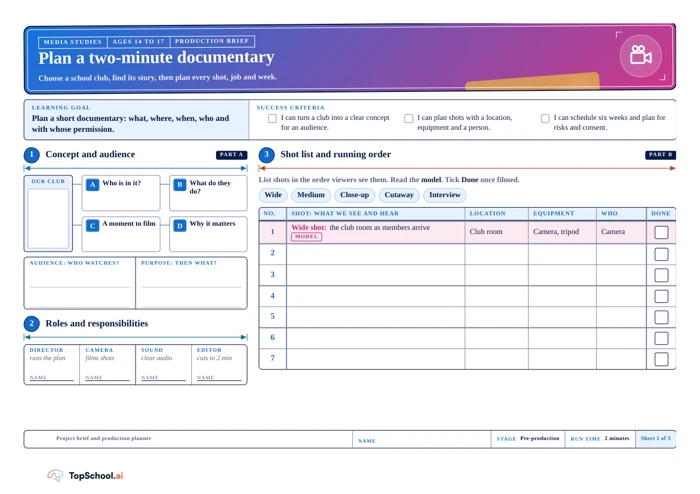
Plan a two-minute documentary about a school club by defining the audience and purpose, assigning production roles and listing shots. A six-week schedule, risk plan and permissions checklist help pupils organise filming and review before any screening or publication.
Read the material
Plan a two-minute documentary about a school club by defining the audience and purpose, assigning production roles and listing shots. A six-week schedule, risk plan and permissions checklist help pupils organise filming and review before any screening or publication.
Complete resource. Use the preview for diagrams and layout.
Page 1
LEARNING GOAL
Plan a short documentary: what, where, when, who and
with whose permission.
SUCCESS CRITERIA
I can turn a club into a clear concept
for an audience.
I can plan shots with a location,
equipment and a person.
I can schedule six weeks and plan for
risks and consent.
OUR CLUB
AUDIENCE: WHO WATCHES?
PURPOSE: THEN WHAT?
DIRECTOR
runs the plan
NAME
CAMERA
films shots
NAME
SOUND
clear audio
NAME
EDITOR
cuts to 2 min
NAME
List shots in the order viewers see them. Read the model. Tick Done once filmed.
Wide
Medium
Close-up
Cutaway
Interview
NO.
SHOT: WHAT WE SEE AND HEAR
LOCATION
EQUIPMENT
WHO
DONE
1
Wide shot: the club room as members arrive
MODEL
Club room
Camera, tripod
Camera
2
3
4
5
6
7
Project brief and production planner
NAME
STAGE Pre-production
RUN TIME 2 minutes
Sheet 1 of 3
MEDIA STUDIES
AGES 14 TO 17
PRODUCTION BRIEF
Plan a two-minute documentary
Choose a school club, find its story, then plan every shot, job and week.
1
Concept and audience
PART A
A
Who is in it?
B
What do they
do?
C
A moment to film
D
Why it matters
2
Roles and responsibilities
3
Shot list and running order
PART B
Page 2
TASK
WHO LEADS
WK 1 W/C
WK 2 W/C
WK 3 W/C
WK 4 W/C
WK 5 W/C
WK 6 W/C
1
PRE-PRODUCTION
Research and permissions
Director
MODEL
2
FILMING
Interviews and action
3
EDITING
Rough cut
4
REVIEW
Feedback and final cut
5
PUBLISH
Approval and screening
Write each week's start date (w/c) and who leads
Shade the weeks a task takes
Draw a diamond where a milestone is due
WHAT COULD GO WRONG?
PLAN B: WHAT WE WILL DO
MODEL The interviewee is off sick on
filming day.
Film the club activity first and use our spare day in
week 4.
Get permission before filming anyone. Ask every person first.
Follow the school's policy on filming and images.
Check with your teacher who can and cannot appear on camera.
Use only music and images you have permission to use.
Do not publish without approval. Your teacher signs it off first.
M1
Plan and consent
agreed
M2
All filming done
M3
Rough cut shown
M4
Final film signed off
Project brief and production planner
APPROVED BY (TEACHER)
DATE
REV
Sheet 2 of 3
MEDIA STUDIES
AGES 14 TO 17
SCHEDULE
Map your six weeks, risks and permissions
5
Six-week production timeline
PART C
6
Risks and plan B
PART D
7
Permissions and milestones
A
A teaching sequence
Create a production plan that assigns roles, orders shots, schedules tasks, anticipates risks and records permissions needed before filming or sharing.
Define the documentary and roles
Write the documentary purpose and audience, then assign director, camera, sound and editor roles.
What should the intended audience understand from this two-minute film?
Plan the shots in viewing order
List shots in viewing order, including location, equipment and who is involved. Use the model as a planning example.
Does each shot name what is seen and heard, where, and with what equipment?
Schedule milestones and a plan B
Fill the six-week timeline with start dates, leads and milestones, then identify a risk and a plan B.
Which lead and spare opportunity address the risk you identified?
Confirm recording and release permissions
Review consent, image and music permissions with the teacher. Do not publish or screen until the required approval is recorded, and note who confirms it for each planned release.
Who must approve appearances, images, music and the final screening or publication?
Before you teach
Look for the thinking behind an answer, choose the support your class needs and leave room for an independent response.
What to look for
Look for a plan that identifies who is involved, where filming occurs, what permission is needed and how a disruption would be handled. Ask, “Who must agree before this person or music appears?” If the answer is unclear, pause the plan and consult the school's process.
Give a little support
Start with a familiar club and a small number of shots. Use the model shot and timeline as examples, then ask the teacher to guide any consent or location decision before the group proceeds.
Take the idea further
Ask pupils to compare the documentary's intended audience with its purpose and adjust the shot list accordingly. Add an alternative plan for a key person being unavailable and specify how the final version will be checked before approval.
Things to keep in mind
Filming, images, music, consent and publication involve school policies and permissions. This planner does not itself grant consent or approve a film for sharing. Confirm the required permissions with the teacher before recording anyone or using material.
Keep the idea. Make it yours.
Bring your topic, learning goal and class context to PLAI™, then review what you create.
Ideas for using this resource
Sample teaching perspectives on what to try, what to adapt and what to watch for.
Meet The Creators
Meet the creators whose teaching interests connect with this template. Find an approach to try with your class.

Rebecca Tan Wei Ling
I coordinate sixth-form enrichment through independent research, service and a skills portfolio, using clear milestones to protect time for these commitments alongside A Level study and revision.
Meet the creator
Yusuf Karim
I coordinate Art, Music and Drama while keeping each discipline’s assessment criteria distinct, using moderation and shared preparation to support practical work without flattening the separate craft.
Meet the creator
Chalk Dust & Checklists
This two-page documentary planner asks pupils to define an audience and purpose, assign director, camera, sound and editor roles, order shots, plan six weeks, identify risks and record permissions. The goal is a short club documentary.
Open Book Pause
The sequence takes a concept through roles, shots and scheduling while making consent and risk planning visible before filming or sharing. A two-minute edit limit gives pupils a concrete production constraint.
Little Lightbulbs
Agree the intended audience and the people who may appear before pupils list shots. Break the six-week schedule into small tasks and ask an adult to review location, equipment and permission needs.
Storytime Sidekick
The planner does not grant permission to film, record or publish anyone. Confirm school policy, consent, location and equipment arrangements with responsible adults before production.