
Languages and literacy
Phonics sound cards
Use picture cards to practise saying initial sounds and connect each sound with short example words. The first two pages show sound cards for s, a, t, p, i, n, m and d; the third provides blank cards for sounds taught next in school. The sheet is intended for an adult to read and prepare.
Look, listen and say the sound. Keep the letter, picture word and pronunciation prompt together.
Read the complete materialRead the material
Use picture cards to practise saying initial sounds and connect each sound with short example words. The first two pages show sound cards for s, a, t, p, i, n, m and d; the third provides blank cards for sounds taught next in school. The sheet is intended for an adult to read and prepare.
Complete resource. Use the preview for diagrams and layout.
Page 1
listen
say
cut
ADULT READS
Cut out the cards. Look at the picture. Say the
sound.
all done
Phonics sound cards · Play Studio
Page 1 of 3
PHONICS
AGES 4 TO 6
FIRST SOUNDS
Sound cards
Sound cards
Look, listen and say the first sounds.
sat
sip
say: sss
sun
at
an
say it short
ant
tap
tin
say it short
tent
pat
pin
say it short
pig
Page 2
listen
say
cut
ADULT READS
Cut out the cards. Look at the picture. Say the
sound.
all done
Phonics sound cards · Play Studio
Page 2 of 3
PHONICS
AGES 4 TO 6
FIRST SOUNDS
More sound cards
More sound cards
Look, listen and say the next sounds.
it
in
say it short
igloo
nap
nip
say: nnn
net
map
mat
say: mmm
mouse
dad
dip
say it short
dog
Page 3
write
cut
ADULT READS
Write a sound, draw a picture, add two short words, then cut.
Phonics sound cards · Play Studio
Page 3 of 3
PHONICS
AGES 4 TO 6
NEXT SOUNDS
Blank sound cards
Blank sound cards
Make cards for the next sounds your school teaches.
sound
picture
say:
sound
picture
say:
sound
picture
say:
sound
picture
say:
A teaching sequence
Say the initial sound for each pictured item and connect that sound with the supplied example words, using clear oral practice with familiar names.
Look, listen and say the sound. Keep the letter, picture word and pronunciation prompt together.
Read the complete materialName the picture and say the sound
Show one card and name the picture clearly. Ask the pupil to say the first sound rather than the letter name where that is the task.
Can you say the initial sound without replacing it with the letter name?
Look, listen and say the sound. Keep the letter, picture word and pronunciation prompt together.
Read the complete materialRead the example words
Use the short example words printed on each card to reinforce the target sound. Listen for the initial sound in each word.
Where can you hear the selected first sound?
Revisit the selected taught cards
Repeat with a few cards from pages 1 and 2, then sort or revisit them according to the school's current sound sequence.
Which cards need another spoken model before practice?
Prepare an adult-selected new card
Use the blank cards on page 3 only for sounds the teacher has selected. Add a sound, picture, two short words and a spoken cue.
Does its picture, cue and two words match the agreed sound and pronunciation?
Before you teach
Look for the thinking behind an answer, choose the support your class needs and leave room for an independent response.
What to look for
Listen for the intended first sound in the named picture and example words. Ask, “What sound do you hear first?” If a picture name is unclear or differs across home languages, agree the word before evaluating the sound. Avoid treating the card as evidence of broader reading mastery.
Give a little support
Start with one familiar sound and two clear pictures. Say the word naturally, then repeat its first sound without adding an extra vowel. Let pupils point or say the sound before asking them to write anything.
Take the idea further
Invite pupils to name another word beginning with one of the taught sounds and draw a picture for it on a blank card. Check the word with the teacher's phonics sequence before adding it to a shared set.
Things to keep in mind
Picture names and pronunciation may vary, and a sound card set is not a complete phonics sequence. Follow the school's chosen order and verify words before using them to assess a sound. The blank cards depend on adult preparation; no additional audio or answer key is included.
Keep the idea. Make it yours.
Bring your topic, learning goal and class context to PLAI™, then review what you create.
Another starting point
Explore a different teaching task from this selection.
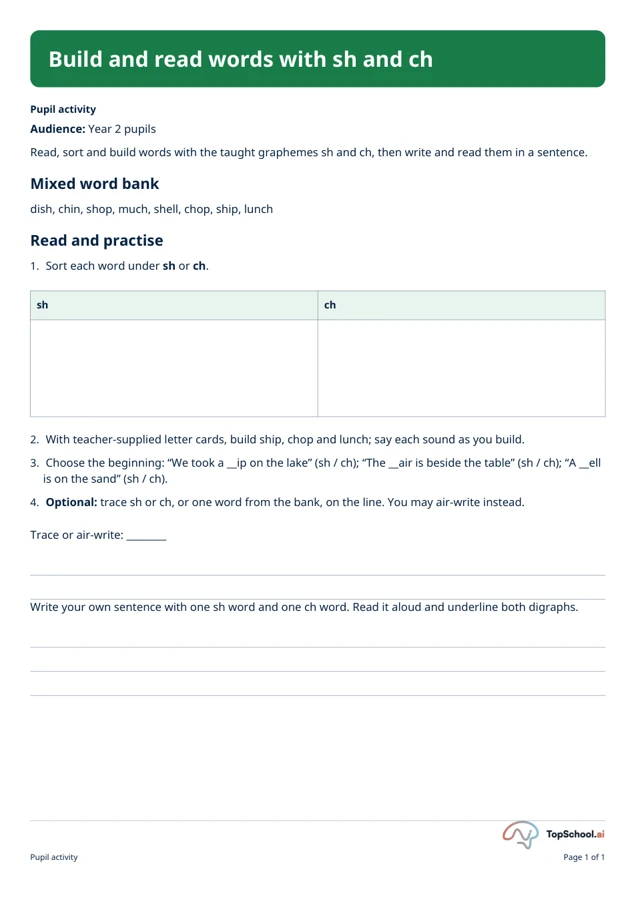
Build and read words with sh and ch
Say /sh/ and /ch/; read the word cards aloud before pupils build them.
Explore resourceIdeas for using this resource
Sample teaching perspectives on what to try, what to adapt and what to watch for.
Meet The Creators
Meet the creators whose teaching interests connect with this template. Find an approach to try with your class.
Katie Marchbank
I want reading materials to match what a child is currently learning in phonics, so pupils can practise new knowledge without being asked to decode patterns they have not met yet.
Meet the creator
Lucy Bramwell
Clear explanations and respectful questions give pupils room to learn about relationships and wellbeing without being asked to speak for a family.
Meet the creator
Owen Griffiths
Children can handle materials, explain an idea and take part physically while their phonics and number learning becomes more structured.
Meet the creator
Glue Stick Club
The three-page cards pair pictures with examples for early sounds, including s, t, n, m and short-vowel words; the final page leaves blanks for sounds the school teaches next. Adults are asked to name the picture and prompt the first sound.
Chalk Dust & Checklists
For ages 4 to 6, the cards support short oral practice and can be extended by creating new examples. The blank cards are explicitly for the school’s next sound sequence rather than a fixed continuation.
Storytime Sidekick
Use a familiar picture name, say the sound clearly and let the child look before responding. The adult-read direction keeps the task oral and allows repeated practice with the same card set.
Good Question
Check each pictured word and target sound against local phonics teaching before printing. The open cards should be completed with the school’s sequence, not treated as an authoritative order of sounds.