
Study and learning skills
Personal statement planner
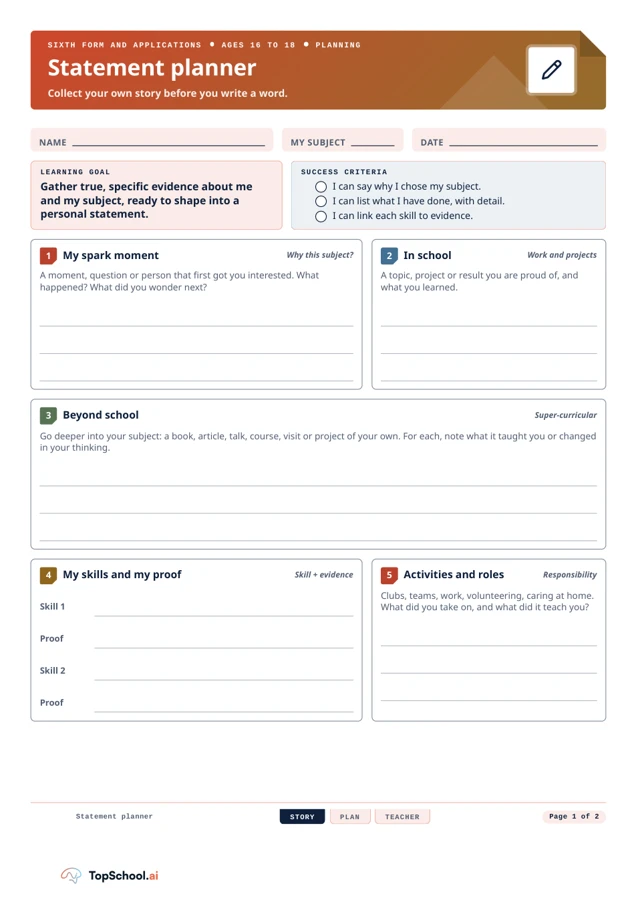
Gather specific evidence about subject interest, study, wider reading, skills and experience before planning a personal statement. The second page offers a five-part structure and a clearly labelled invented example. Pupils are asked to keep claims accurate and in their own words.
Read the material
Gather specific evidence about subject interest, study, wider reading, skills and experience before planning a personal statement. The second page offers a five-part structure and a clearly labelled invented example. Pupils are asked to keep claims accurate and in their own words.
Complete resource. Use the preview for diagrams and layout.
Page 1
NAME
MY SUBJECT
DATE
LEARNING GOAL
Gather true, specific evidence about me
and my subject, ready to shape into a
personal statement.
SUCCESS CRITERIA
I can say why I chose my subject.
I can list what I have done, with detail.
I can link each skill to evidence.
Statement planner
STORY
PLAN
TEACHER
Page 1 of 2
SIXTH FORM AND APPLICATIONS
AGES 16 TO 18
PLANNING
Statement planner
Collect your own story before you write a word.
My spark moment
Why this subject?
A moment, question or person that first got you interested. What
happened? What did you wonder next?
1
In school
Work and projects
A topic, project or result you are proud of, and
what you learned.
2
Beyond school
Super-curricular
Go deeper into your subject: a book, article, talk, course, visit or project of your own. For each, note what it taught you or changed
in your thinking.
3
My skills and my proof
Skill + evidence
Skill 1
Proof
Skill 2
Proof
4
Activities and roles
Responsibility
Clubs, teams, work, volunteering, caring at home.
What did you take on, and what did it teach you?
5
Page 2
Statement planner
STORY
PLAN
TEACHER
Page 2 of 2
SIXTH FORM AND APPLICATIONS
AGES 16 TO 18
STRUCTURE
Paragraph plan
Opening hook
Specific, not grand
1
Academic interest
Ideas you enjoy
2
Wider reading
What it taught me
3
Skills and experience
With evidence
4
Closing
Look forward, do not repeat
5
Weak and strong
Invented example
WEAK
“I have always been passionate about science and I
am a hard-working person who loves learning.”
STRONG
“After a school trip to a stream, I tested the water
at three points and found more nitrate downstream of a field.
I read about run-off to find out why, then asked my teacher
how I could test my idea.”
6
Your turn
Show, do not tell
Write a “tell” about yourself, then rewrite it as a “show” with
one real detail.
7
Before I send it
Tick when true
Own words.
It sounds like me, not a template or a stranger.
Specific evidence.
Every claim has a real example behind it.
Reflection.
I say what I learned, not only what I did.
Accurate.
Everything is true and I could talk about it.
Proofread.
I read it aloud and someone I trust checked it.
8
A teaching sequence
Select truthful, specific examples, explain what they show about subject interest or skills, and organise them into a personal-statement plan.
Identify genuine subject interest
Complete the subject-interest prompts with a moment, question or person that genuinely prompted curiosity.
Which real moment or question explains your curiosity?
Reflect on your own experiences
List one school example and one optional wider subject activity, noting what each taught or changed in the pupil's thinking.
What did you learn or change through this activity?
Match a skill with real evidence
Match a skill to a specific piece of evidence, then plan an opening, academic interest, wider reading, experience and closing.
Which example shows the skill rather than simply naming it?
Check truth and application requirements
Use the checklist to confirm own words, specific evidence, reflection and accuracy before turning the plan into a draft. Ask whether each item shows genuine interest.
Is every example your own, and does the plan fit the current application?
Before you teach
Look for the thinking behind an answer, choose the support your class needs and leave room for an independent response.
What to look for
Look for each claim to be supported by a real example the pupil can explain. Ask, “What did you do, what did you learn and how does it connect to your subject?” If a sentence only names a quality, prompt for evidence rather than adding a stronger but unsupported claim.
Give a little support
Offer a conversation before writing and record key words the pupil chooses. They may skip the prompt about responsibilities at home or use another suitable experience. Help them distinguish what they did from what they learned.
Take the idea further
Ask pupils to revise one plan point so it explains how an experience shaped a question, interest or next step. Then have them check the current application guidance for any requirements that differ from the general structure on this sheet.
Things to keep in mind
The strong example is explicitly invented and must not be presented as a pupil's real experience. The worksheet includes a prompt about caring at home, which pupils should be free to omit. Application requirements vary by course and institution; this planner does not replace current official guidance.
Keep the idea. Make it yours.
Bring your topic, learning goal and class context to PLAI™, then review what you create.
Ideas to try with your class
Sample teaching perspectives on what to try, what to adapt and what to watch for.
Meet The Creators
Meet a creator whose teaching interests connect with this template.
Organised Pile
The two-page planner gathers a spark moment, school work, wider subject reading, skills and proof, activities and roles before organising five paragraphs. The final check asks that every claim be true and something the applicant could discuss.
Clear Example
For ages 16 to 18, the example contrasts a generic claim of passion with a specific account of testing stream water, reading about runoff and asking a follow-up question. It models showing what changed in the applicant’s thinking.
Bright Idea Break
Pupils can collect evidence before drafting, then link each skill to a concrete example. The “tell” to “show” exercise gives a direct revision step without asking them to exaggerate their experience.
Helpful Highlighter
The statement must remain in the pupil’s own words and reflect only true experience. Caring at home appears as one possible responsibility, not a required disclosure; choose relevant evidence and keep private details out if they are not needed.