
Wellbeing and personal development
Peer Appreciation and Community Cards
Choose a sentence starter to thank a classmate or recognise a helpful contribution, then make a card for someone in the school community. The examples show how to name an action and why it mattered. The cards provide prompts rather than messages that pupils must give.
Read the material
Choose a sentence starter to thank a classmate or recognise a helpful contribution, then make a card for someone in the school community. The examples show how to name an action and why it mattered. The cards provide prompts rather than messages that pupils must give.
Complete resource. Use the preview for diagrams and layout.
Page 1
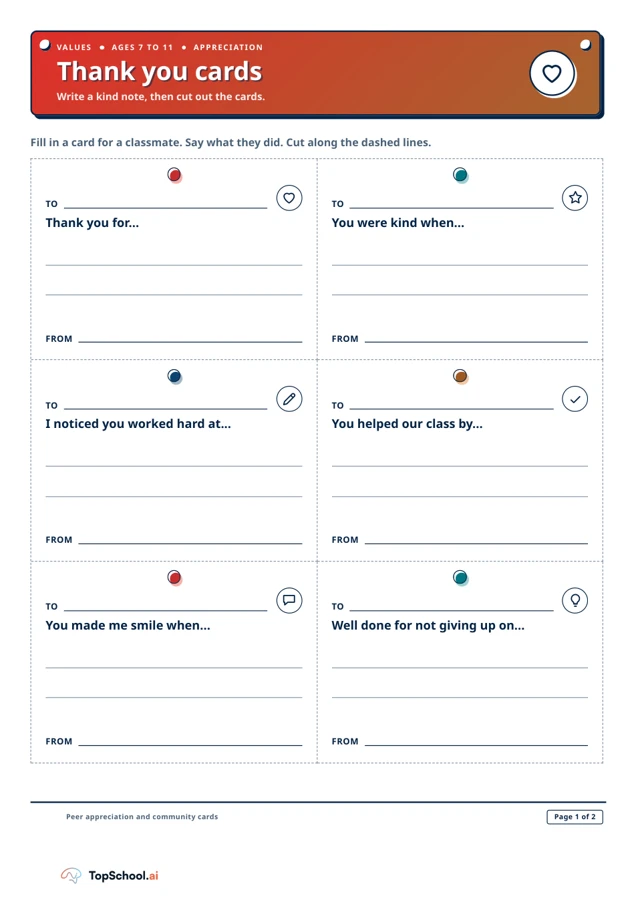
Fill in a card for a classmate. Say what they did. Cut along the dashed lines.
Peer appreciation and community cards
Page 1 of 2
VALUES
AGES 7 TO 11
APPRECIATION
Thank you cards
Thank you cards
Write a kind note, then cut out the cards.
TO
Thank you for...
FROM
TO
You were kind when...
FROM
TO
I noticed you worked hard at...
FROM
TO
You helped our class by...
FROM
TO
You made me smile when...
FROM
TO
Well done for not giving up on...
FROM
Page 2
Peer appreciation and community cards
Page 2 of 2
VALUES
AGES 7 TO 11
COMMUNITY CARDS
Thank you to our community
Good appreciation is specific: say
what they did and why it mattered.
Example
“Thank you for showing me how to start the fractions question. It helped me finish.”
Thank you to our lunchtime team
FROM
Thank you to our site
and cleaning team
FROM
Thank you to our office team
FROM
Thank you, teacher
FROM
A teaching sequence
Write a short appreciation message that names a specific action and explains why it mattered to the writer or community.
Choose an appreciation prompt
Choose a printed appreciation prompt, such as Thank you for or I noticed. Select one that fits an action you actually observed.
Would 'Thank you for' or 'I noticed' fit your message?
Name an observed action
Write about something the recipient actually did, using an observation rather than invented praise.
What did the recipient actually do?
Explain why it mattered
Use the example on page 2 to add why the action mattered, then choose a card for a classmate or community team.
How did that action help you or the community?
Deliver the message appropriately
Cut out the card if it is appropriate to the activity and deliver it privately or through the teacher's agreed process.
Will a private handover or the teacher's agreed process suit the recipient?
Before you teach
Look for the thinking behind an answer, choose the support your class needs and leave room for an independent response.
What to look for
Look for a message that names an observable action and gives a reason for the thanks. Ask, “What did the person do?” If the note says only “You are nice”, invite the writer to name a particular helpful or kind action instead.
Give a little support
Offer pupils a choice of two sentence starters and let them dictate a message before writing. A pupil can draw a card or keep it private if that is more comfortable. Help them describe an action without making a judgement about a classmate.
Take the idea further
Ask pupils to write a thank-you message to a school team, naming a specific contribution they have noticed. They can compare how a message changes when it is addressed to one person or to a group.
Things to keep in mind
The cards prompt positive peer communication but do not guarantee that a message is welcome or appropriate in every situation. Use discretion about recipients and sharing, and do not require pupils to disclose personal feelings or deliver a card publicly.
Keep the idea. Make it yours.
Bring your topic, learning goal and class context to PLAI™, then review what you create.
Ideas to try with your class
Sample teaching perspectives on what to try, what to adapt and what to watch for.
Meet The Creators
Meet a creator whose teaching interests connect with this template.

After the Bell
Six peer prompts ask pupils to name a helpful action and why it mattered; separate cards tailor wording for lunchtime, site and cleaning, office and teaching teams. The printed guidance keeps appreciation specific.
Extra Page
For ages 7 to 11, the examples connect a specific helpful action to its effect, such as showing how to start a fractions question. That models a message more meaningful than a general “well done”.
Tea Break Notes
The “TO” and “FROM” fields make the card’s recipient clear, and a pupil can choose which prompt fits the observed action. Community cards extend appreciation beyond classmates.
Pocketful of Stories
A card should describe something actually observed and remain kind; do not require pupils to praise someone or disclose a private reason. Keep recipients and names appropriate to the classroom context.