
PE and health
PE performance rubric
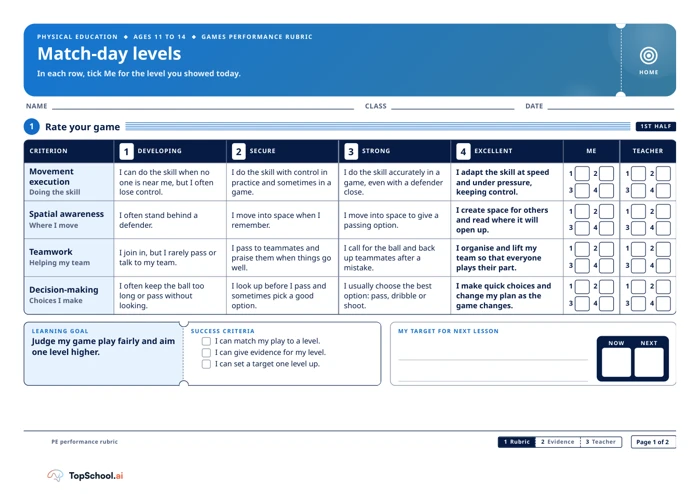
Assess game performance against four observable criteria: movement execution, spatial awareness, teamwork and decision-making. Pupils and teachers can select a level, while the evidence log records what happened in a lesson and supports a next-step target.
Read the material
Assess game performance against four observable criteria: movement execution, spatial awareness, teamwork and decision-making. Pupils and teachers can select a level, while the evidence log records what happened in a lesson and supports a next-step target.
Shared activity record. Use the preview for diagrams and layout.
Page 1
NAME
CLASS
DATE
1
Rate your game
1ST HALF
CRITERION
DEVELOPING
SECURE
STRONG
EXCELLENT
ME
TEACHER
Movement
execution
Doing the skill
I can do the skill when no
one is near me, but I often
lose control.
I do the skill with control in
practice and sometimes in a
game.
I do the skill accurately in a
game, even with a defender
close.
I adapt the skill at speed
and under pressure,
keeping control.
1
2
3
4
1
2
3
4
Spatial awareness
Where I move
I often stand behind a
defender.
I move into space when I
remember.
I move into space to give a
passing option.
I create space for others
and read where it will
open up.
1
2
3
4
1
2
3
4
Teamwork
Helping my team
I join in, but I rarely pass or
talk to my team.
I pass to teammates and
praise them when things go
well.
I call for the ball and back
up teammates after a
mistake.
I organise and lift my
team so that everyone
plays their part.
1
2
3
4
1
2
3
4
Decision-making
Choices I make
I often keep the ball too
long or pass without
looking.
I look up before I pass and
sometimes pick a good
option.
I usually choose the best
option: pass, dribble or
shoot.
I make quick choices and
change my plan as the
game changes.
1
2
3
4
1
2
3
4
LEARNING GOAL
Judge my game play fairly and aim
one level higher.
PE performance rubric
1 Rubric
2 Evidence
3 Teacher
PHYSICAL EDUCATION
AGES 11 TO 14
GAMES PERFORMANCE RUBRIC
Match-day levels
In each row, tick Me for the level you showed today.
HOME
1
2
3
4
SUCCESS CRITERIA
I can match my play to a level.
I can give evidence for my level.
I can set a target one level up.
MY TARGET FOR NEXT LESSON
NOW
NEXT
Page 1 of 2
Page 2
NAME
CLASS
2
Evidence log
2ND HALF
After each lesson, write one thing you did that someone could see. Circle the criterion, then write your level (1 to 4). Row 1 is an example.
LESSON
SKILL OR ACTIVITY
WHAT I DID (MY EVIDENCE)
CRITERION
LEVEL
EXAMPLE
Passing in a 4 v 1 practice
I moved to the side of the defender so my partner had a clear
pass to me.
Movement
Space
Teamwork
Decisions
Movement
Space
Teamwork
Decisions
Movement
Space
Teamwork
Decisions
Movement
Space
Teamwork
Decisions
Movement
Space
Teamwork
Decisions
SEASON SCOREBOARD: START OF UNIT
MOVEMENT
SPACE
TEAMWORK
DECISIONS
SEASON SCOREBOARD: END OF UNIT
MOVEMENT
SPACE
TEAMWORK
DECISIONS
What helped me move up a level?
Play safe: warm up first, work at your own level, stop if anything hurts and tell your teacher.
PE performance rubric
1 Rubric
2 Evidence
3 Teacher
PHYSICAL EDUCATION
MATCH-DAY LEVELS
Evidence log: prove your level
1
3
2
3
4
5
Page 2 of 2
Page 1
PE performance rubric
Teacher companion
Physical Education | Pupils aged 11 to 14 and their teachers
Use with the exact 2-page original file. Keep pupil or staff activity pages separate from this teacher companion.
When to use it
Use this during a unit when pupils can identify the skill or activity being assessed. Read the
descriptors before selecting a level and agree what counts as visible evidence. The second
page is designed to record progress across lessons rather than rely on one score alone.
Purpose
Use shared PE descriptors to select a performance level, support it with observable evidence
and choose a realistic next target.
Start here
Read the four criteria and compare the level descriptors for one row. Clarify how pupils and
teachers will use the two rating columns before the activity begins.
A teaching sequence
1. Choose a criterion such as spatial awareness and explain what each level looks like in a
game.
2. After an activity, select a level in the pupil and teacher columns and identify the evidence
that supports each judgement.
3. Use the evidence log to record one visible action, the criterion it relates to and the level
shown in that lesson.
4. At the start and end of the unit, complete the scoreboards and choose a next target. Use
the printed safety reminder for the activity.
Checking guidance
Look for a level linked to an observable action, such as moving into space to offer a passing
option. Ask, “What did you do or see that fits this descriptor?” If pupil and teacher ratings
differ, compare the evidence calmly before changing a score.
Illustrative evidence: “I moved into a passing space before the ball arrived.” Compare that
action with the selected descriptor; discuss different pupil/teacher ratings through the
evidence.
Support
Focus on one criterion at a time and use the worked evidence example to model a specific
observation. Pupils can explain their rating orally before recording it. Separate feedback about
an action from judgement about the pupil.
Take it further
Ask pupils to compare their evidence from the start and end of the unit, then explain which
practice or decision may have contributed to a change. Keep the explanation tied to recorded
examples rather than assuming the score alone explains progress.
Things to keep in mind
A score is a structured reflection prompt, not a validated measure of ability or progress.
Discuss differences between pupil and teacher ratings through evidence; do not use the score
alone to draw conclusions about improvement.
PE performance rubric
Teacher companion | Page 1
A teaching sequence
Use shared PE descriptors to select a performance level, support it with observable evidence and choose a realistic next target.
Explain one game criterion
Choose a criterion such as spatial awareness and explain what each level looks like in a game.
What does this level look like in the selected game?
Compare ratings through evidence
After an activity, select a level in the pupil and teacher columns and identify the evidence that supports each judgement.
Which visible action supports the pupil and teacher judgements?
Keep a lesson evidence log
Use the evidence log to record one visible action, the criterion it relates to and the level shown in that lesson.
Which criterion does the recorded action relate to?
Review a supported target
At the start and end of the unit, complete the scoreboards and choose a next target. Use the printed safety reminder for the activity.
What does the evidence suggest to practise without relying on the score alone?
Before you teach
Look for the thinking behind an answer, choose the support your class needs and leave room for an independent response.
What to look for
Look for a level linked to an observable action, such as moving into space to offer a passing option. Ask, “What did you do or see that fits this descriptor?” If pupil and teacher ratings differ, compare the evidence calmly before changing a score. Illustrative evidence: “I moved into a passing space before the ball arrived.” Compare that action with the selected descriptor; discuss different pupil/teacher ratings through the evidence.
Give a little support
Focus on one criterion at a time and use the worked evidence example to model a specific observation. Pupils can explain their rating orally before recording it. Separate feedback about an action from judgement about the pupil.
Take the idea further
Ask pupils to compare their evidence from the start and end of the unit, then explain which practice or decision may have contributed to a change. Keep the explanation tied to recorded examples rather than assuming the score alone explains progress.
Things to keep in mind
A score is a structured reflection prompt, not a validated measure of ability or progress. Discuss differences between pupil and teacher ratings through evidence; do not use the score alone to draw conclusions about improvement.
Keep the idea. Make it yours.
Bring your topic, learning goal and class context to PLAI™, then review what you create.
Another starting point
Explore a different teaching task from this selection.
Overarm throw: observe, practise, improve
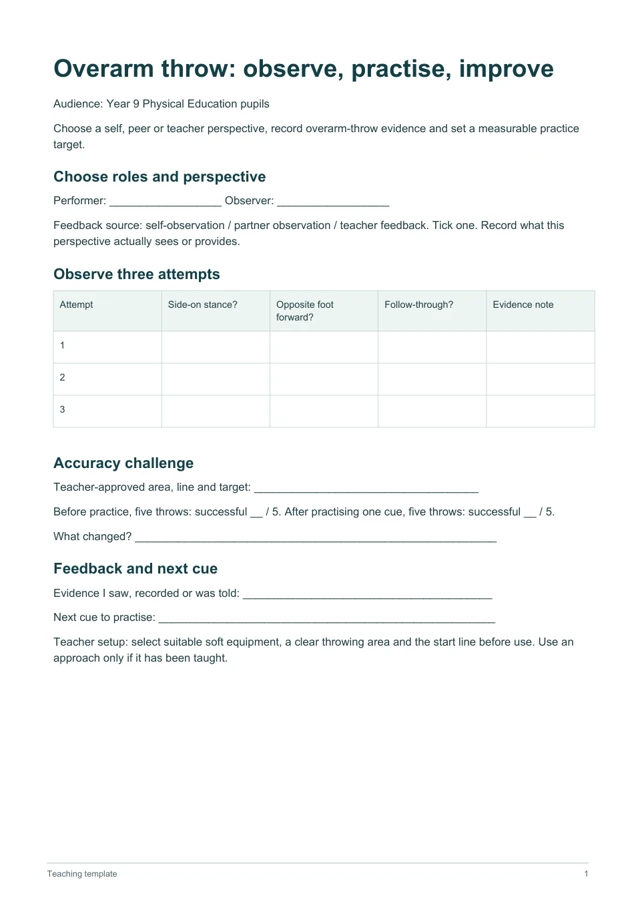
Agree the throwing line, target and soft equipment under the teacher’s direction, then choose whose perspective will be recorded.
Explore resourceIdeas for using this resource
Sample teaching perspectives on what to try, what to adapt and what to watch for.
Meet The Creators
Meet a creator whose teaching interests connect with this template.

Bright Margins
The two-page games rubric rates movement, spatial awareness, teamwork and decision-making, then asks pupils to cite one visible action for a chosen level. The example describes moving beside a defender to give a passing option.
Notes Between Bells
For ages 11 to 14, the pupil and teacher columns support comparison, while the evidence log carries skill observations across lessons. A target one level higher gives the score a next-step purpose.
One More Question
The descriptors name actions, such as looking up before passing or moving into space, so pupils can reflect on more than the final result of a game. The warm-up and stop-if-pain instructions stay on the evidence page.
Storytime Sidekick
A level should be backed by observable evidence in the specific activity, not used as a permanent ability label. Keep the season scoreboard tied to the unit and adapt game contexts where a descriptor does not fit.