
Wellbeing and personal development
Our Year 8 agreement: respect in practice
For Year 8 pupils and class teacher, translate shared values into observable actions and agree one class routine to practise.
Read the material
For Year 8 pupils and class teacher, translate shared values into observable actions and agree one class routine to practise.
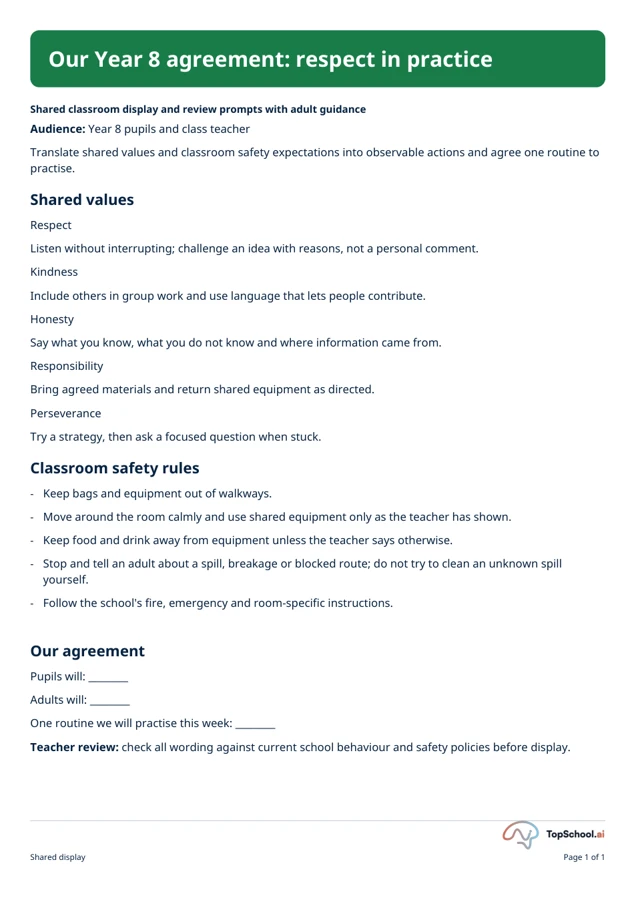
Shared classroom display and review prompts with adult guidance. Use the preview for diagrams and layout.
Page 1
Our Year 8 agreement: respect in practice
Shared classroom display and review prompts with adult guidance
Audience: Year 8 pupils and class teacher
Translate shared values and classroom safety expectations into observable actions and agree one routine to
practise.
Shared values
Respect
Listen without interrupting; challenge an idea with reasons, not a personal comment.
Kindness
Include others in group work and use language that lets people contribute.
Honesty
Say what you know, what you do not know and where information came from.
Responsibility
Bring agreed materials and return shared equipment as directed.
Perseverance
Try a strategy, then ask a focused question when stuck.
Classroom safety rules
-
Keep bags and equipment out of walkways.
-
Move around the room calmly and use shared equipment only as the teacher has shown.
-
Keep food and drink away from equipment unless the teacher says otherwise.
-
Stop and tell an adult about a spill, breakage or blocked route; do not try to clean an unknown spill
yourself.
-
Follow the school's fire, emergency and room-specific instructions.
Our agreement
Pupils will: ________
Adults will: ________
One routine we will practise this week: ________
Teacher review: check all wording against current school behaviour and safety policies before display.
Shared display
Page 1 of 1
A teaching sequence
Translate shared values into observable actions and agree one class routine to practise.
Review values against school policy
Read each value and safety rule. Teacher checks wording against school policy before display.
Which example needs local behaviour or safety wording before display?
Choose an observable action
Choose one observable action to practise this week.
What would someone see or hear if you practise this action?
Agree the reporting routine
Agree a routine for reporting a spill, breakage or blocked walkway.
Who should be told about a spill, breakage or blocked route?
Before you teach
Look for the thinking behind an answer, choose the support your class needs and leave room for an independent response.
What to look for
A useful commitment names an observable action, such as keeping walkways clear or telling the teacher about a spill. Ask, “What would someone see you do?”
Give a little support
Offer sentence stems and select class language together.
Take the idea further
Review which routine helped a group task and propose a specific improvement.
Things to keep in mind
The class and teacher must check these examples against current school behaviour, emergency and safety procedures before display.
Keep the idea. Make it yours.
Bring your topic, learning goal and class context to PLAI™, then review what you create.
Ideas to try with your class
Sample teaching perspectives on what to try, what to adapt and what to watch for.
Meet The Creators
Meet a creator whose teaching interests connect with this template.

Glue Stick Club
The one-page display turns values into observable Year 8 actions, such as challenging an idea with reasons rather than a personal comment. It also states concrete room-safety rules for walkways, shared equipment, spills and emergency instructions.
Organised Pile
The blank agreement asks both pupils and adults to name responsibilities and choose one routine to practise this week. That gives the display a reviewable focus beyond listing Respect, Kindness, Honesty, Responsibility and Perseverance.
Pencil Case Pal
The honesty wording (say what is known, unknown and where information came from) can support classroom discussion as well as source work. A teacher can choose one routine for practice instead of asking pupils to take on every value at once.
Paperclip Perspective
The sheet explicitly requires a teacher to check wording against current behaviour and safety policies before display. Its sample rules are not a substitute for the school’s fire, emergency or room-specific procedures.