
Languages and literacy
Oral presentation rubric
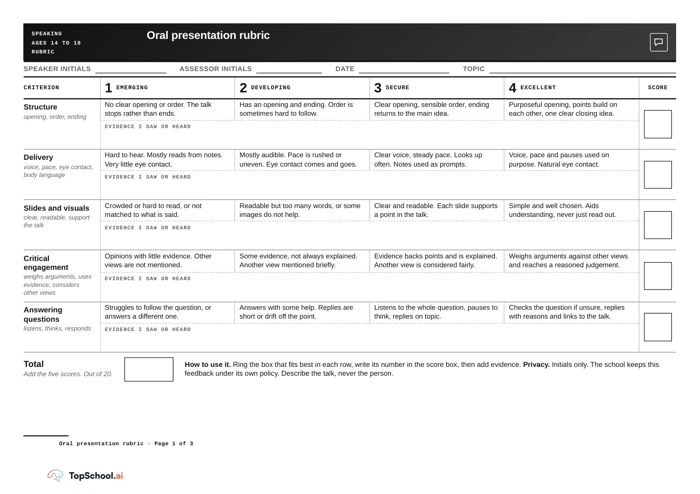
Use the rubric to assess a short presentation against structure, delivery, visuals, critical engagement and answers to questions. Two landscape pages provide a scoring table for two speakers; a third page supports peer comments and the speaker's own reflection. The sheet asks for initials and evidence about the talk, not the person.
Read the material
Use the rubric to assess a short presentation against structure, delivery, visuals, critical engagement and answers to questions. Two landscape pages provide a scoring table for two speakers; a third page supports peer comments and the speaker's own reflection. The sheet asks for initials and evidence about the talk, not the person.
Complete resource. Use the preview for diagrams and layout.
Page 1
SPEAKER INITIALS
ASSESSOR INITIALS
DATE
TOPIC
CRITERION
1 EMERGING
2 DEVELOPING
3 SECURE
4 EXCELLENT
SCORE
Structure
opening, order, ending
No clear opening or order. The talk
stops rather than ends.
Has an opening and ending. Order is
sometimes hard to follow.
Clear opening, sensible order, ending
returns to the main idea.
Purposeful opening, points build on
each other, one clear closing idea.
Delivery
voice, pace, eye contact,
body language
Hard to hear. Mostly reads from notes.
Very little eye contact.
Mostly audible. Pace is rushed or
uneven. Eye contact comes and goes.
Clear voice, steady pace. Looks up
often. Notes used as prompts.
Voice, pace and pauses used on
purpose. Natural eye contact.
Slides and visuals
clear, readable, support
the talk
Crowded or hard to read, or not
matched to what is said.
Readable but too many words, or some
images do not help.
Clear and readable. Each slide supports
a point in the talk.
Simple and well chosen. Aids
understanding, never just read out.
Critical
engagement
weighs arguments, uses
evidence, considers
other views
Opinions with little evidence. Other
views are not mentioned.
Some evidence, not always explained.
Another view mentioned briefly.
Evidence backs points and is explained.
Another view is considered fairly.
Weighs arguments against other views
and reaches a reasoned judgement.
Answering
questions
listens, thinks, responds
Struggles to follow the question, or
answers a different one.
Answers with some help. Replies are
short or drift off the point.
Listens to the whole question, pauses to
think, replies on topic.
Checks the question if unsure, replies
with reasons and links to the talk.
Total
Add the five scores. Out of 20.
How to use it. Ring the box that fits best in each row, write its number in the score box, then add evidence. Privacy. Initials only. The school keeps this
feedback under its own policy. Describe the talk, never the person.
Oral presentation rubric · Page 1 of 3
SPEAKING
AGES 14 TO 18
RUBRIC
Oral presentation rubric
EVIDENCE I SAW OR HEARD
EVIDENCE I SAW OR HEARD
EVIDENCE I SAW OR HEARD
EVIDENCE I SAW OR HEARD
EVIDENCE I SAW OR HEARD
Page 2
SPEAKER INITIALS
ASSESSOR INITIALS
DATE
TOPIC
CRITERION
1 EMERGING
2 DEVELOPING
3 SECURE
4 EXCELLENT
SCORE
Structure
opening, order, ending
No clear opening or order. The talk
stops rather than ends.
Has an opening and ending. Order is
sometimes hard to follow.
Clear opening, sensible order, ending
returns to the main idea.
Purposeful opening, points build on
each other, one clear closing idea.
Delivery
voice, pace, eye contact,
body language
Hard to hear. Mostly reads from notes.
Very little eye contact.
Mostly audible. Pace is rushed or
uneven. Eye contact comes and goes.
Clear voice, steady pace. Looks up
often. Notes used as prompts.
Voice, pace and pauses used on
purpose. Natural eye contact.
Slides and visuals
clear, readable, support
the talk
Crowded or hard to read, or not
matched to what is said.
Readable but too many words, or some
images do not help.
Clear and readable. Each slide supports
a point in the talk.
Simple and well chosen. Aids
understanding, never just read out.
Critical
engagement
weighs arguments, uses
evidence, considers
other views
Opinions with little evidence. Other
views are not mentioned.
Some evidence, not always explained.
Another view mentioned briefly.
Evidence backs points and is explained.
Another view is considered fairly.
Weighs arguments against other views
and reaches a reasoned judgement.
Answering
questions
listens, thinks, responds
Struggles to follow the question, or
answers a different one.
Answers with some help. Replies are
short or drift off the point.
Listens to the whole question, pauses to
think, replies on topic.
Checks the question if unsure, replies
with reasons and links to the talk.
Total
Add the five scores. Out of 20.
How to use it. Ring the box that fits best in each row, write its number in the score box, then add evidence. Privacy. Initials only. The school keeps this
feedback under its own policy. Describe the talk, never the person.
Oral presentation rubric · Page 2 of 3
SPEAKING
AGES 14 TO 18
RUBRIC
Rubric: second speaker
EVIDENCE I SAW OR HEARD
EVIDENCE I SAW OR HEARD
EVIDENCE I SAW OR HEARD
EVIDENCE I SAW OR HEARD
EVIDENCE I SAW OR HEARD
Page 3
1
Two stars and a wish
Be specific. Point to a moment in
the talk.
STAR ONE
STAR TWO
WISH
2
Speaker: my own view
Fill in after your own talk, before you
read any feedback.
HOW I FELT
1
very
nervous
2
nervous
3
fairly
calm
4
confident
NEXT TIME I WILL
3
Peer feedback slip
Finish each starter in your own
words. Initials only.
I LIKED IT WHEN YOU
I WAS CONVINCED BY
I WOULD LIKE TO KNOW
NEXT TIME, TRY TO
FROM (INITIALS)
Oral presentation rubric · Page 3 of 3
SPEAKING
AGES 14 TO 18
RUBRIC
Feedback and reflection
A teaching sequence
Use shared descriptors to evaluate a spoken presentation, record evidence for a score and identify one practical next step for the speaker.
Agree observable criteria
Read the structure and delivery descriptors before the presentation. Ask assessors what observable evidence would fit one level.
What seen or heard detail would support this descriptor?
Record evidence during the talk
During the talk, note something seen or heard for each criterion and select the closest descriptor for the first speaker.
Which exact moment supports the selected level?
Use a separate second-speaker record
Use the second rubric page for another speaker. Add the chosen score and a specific piece of evidence in the matching row.
Is the evidence attached to the correct speaker and criterion?
Give specific feedback and reflection
Afterwards, complete the feedback slip with two specific strengths and one useful wish, then let the speaker record their own view before reading feedback.
What moment supports each strength and the useful next step?
Before you teach
Look for the thinking behind an answer, choose the support your class needs and leave room for an independent response.
What to look for
Look for a score linked to a moment in the presentation, such as a clear closing idea or a response that addresses the question. Ask, “What did you see or hear that supports this level?” If the note describes personality, redirect it to the structure, delivery or evidence in the talk.
Give a little support
Model one descriptor and evidence note together, then allow assessors to focus on two criteria before using all five. Offer a spoken feedback rehearsal using the sentence starters. A pupil may complete the reflection privately or with an adult.
Take the idea further
Ask the speaker to compare feedback across the same criterion and choose one observable practice target for the next talk. The assessor can explain how a particular choice affected the audience, referring to a specific moment rather than making a general judgement.
Things to keep in mind
The rubric provides criteria and descriptors but does not define a school's grading policy or replace teacher judgement. It collects feedback that should be handled under the school's own policy. Use initials as directed and avoid personal comments or sensitive details in the evidence boxes.
Keep the idea. Make it yours.
Bring your topic, learning goal and class context to PLAI™, then review what you create.
Ideas for using this resource
Sample teaching perspectives on what to try, what to adapt and what to watch for.
Meet The Creators
Meet a creator whose teaching interests connect with this template.

Helpful Highlighter
The three-page rubric covers structure, delivery, visuals, critical engagement and answers, with evidence boxes for what the assessor saw or heard. Page 3 adds two stars and a wish, the speaker’s own view and a peer slip.
Board Eraser
For ages 14 to 18, two parallel speaker pages allow an assessor to record feedback for each person. The privacy note calls for initials only and says to describe the talk rather than the person.
Calm Table
Each score has a written descriptor, and the rubric asks for evidence as well as a number. The pupil completes their own view before reading feedback, which separates self-reflection from peer response.
Page-Turner Planner
The total is out of 20 across five criteria and should be interpreted with the evidence beside it. Handle feedback under school policy, and use eye-contact language carefully so it does not become a judgement about personality or disability.