
Business and economics
Market research: plan, ask and analyse
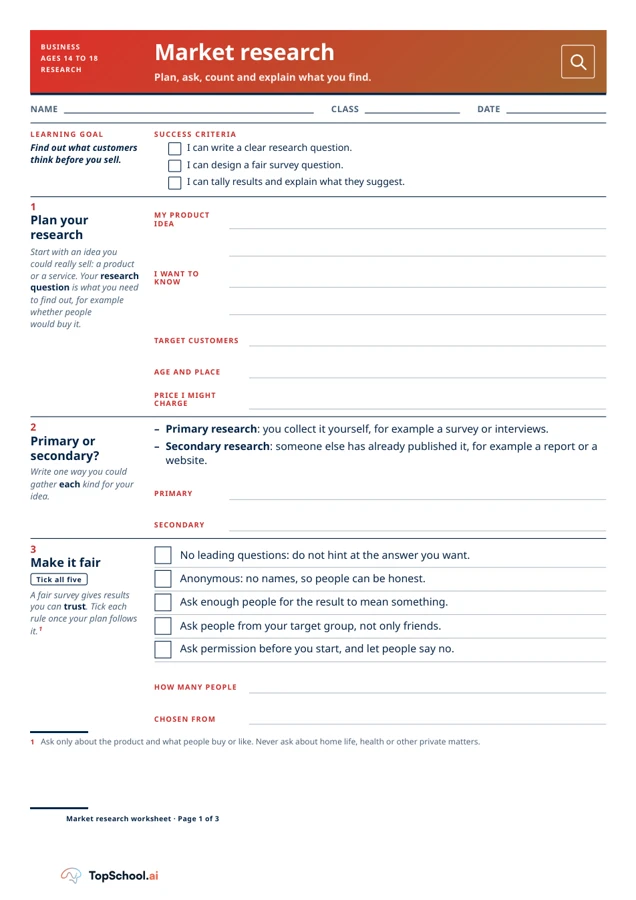
Plan a small market-research project, write fair questions, record anonymous answers and explain what the results suggest. The three-page worksheet introduces primary and secondary research, models question types and includes an invented survey tally before pupils build their own chart.
Read the material
Plan a small market-research project, write fair questions, record anonymous answers and explain what the results suggest. The three-page worksheet introduces primary and secondary research, models question types and includes an invented survey tally before pupils build their own chart.
Complete resource. Use the preview for diagrams and layout.
Page 1
NAME
CLASS
DATE
LEARNING GOAL
Find out what customers
think before you sell.
SUCCESS CRITERIA
I can write a clear research question.
I can design a fair survey question.
I can tally results and explain what they suggest.
1
Plan your
research
Start with an idea you
could really sell: a product
or a service. Your research
question is what you need
to find out, for example
whether people
would buy it.
MY PRODUCT
IDEA
I WANT TO
KNOW
TARGET CUSTOMERS
AGE AND PLACE
PRICE I MIGHT
CHARGE
2
Primary or
secondary?
Write one way you could
gather each kind for your
idea.
PRIMARY
SECONDARY
3
Make it fair
Tick all five
A fair survey gives results
you can trust. Tick each
rule once your plan follows
it.1
No leading questions: do not hint at the answer you want.
Anonymous: no names, so people can be honest.
Ask enough people for the result to mean something.
Ask people from your target group, not only friends.
Ask permission before you start, and let people say no.
HOW MANY PEOPLE
CHOSEN FROM
1 Ask only about the product and what people buy or like. Never ask about home life, health or other private matters.
Market research worksheet · Page 1 of 3
BUSINESS
AGES 14 TO 18
RESEARCH
Market research
Plan, ask, count and explain what you find.
Primary research: you collect it yourself, for example a survey or interviews.
–
Secondary research: someone else has already published it, for example a report or a
website.
–
Page 2
01
Closed: a short set of
answers, such as Yes,
Maybe, No.
QUESTION
TYPE
Closed
Multiple choice
Rating scale
Open
02
Multiple choice: three or
four answers to pick from.
QUESTION
TYPE
Closed
Multiple choice
Rating scale
Open
03
Rating scale: for example
1 (low) to 5 (high).
QUESTION
TYPE
Closed
Multiple choice
Rating scale
Open
04
Open: people answer in
their own words.
QUESTION
TYPE
Closed
Multiple choice
Rating scale
Open
05
Mix the types. Keep every
question short and neutral.
QUESTION
TYPE
Closed
Multiple choice
Rating scale
Open
Worked example
Each stroke is one answer;
every fifth crosses the four
before it. Percentage =
answers ÷ total × 100.
“Would you buy a reusable water bottle with our school logo for £6?” Survey of 40 students
(invented for this sheet).
ANSWER
TALLY
TOTAL
PERCENTAGE
Yes
IIII IIII IIII IIII IIII I
26
26 ÷ 40 = 0.65 = 65%
Maybe
IIII III
8
8 ÷ 40 = 0.2 = 20%
No
IIII I
6
6 ÷ 40 = 0.15 = 15%
All
Every answer counted once
40
65 + 20 + 15 = 100%
Market research worksheet · Page 2 of 3
BUSINESS
AGES 14 TO 18
RESEARCH
Survey designer
Page 3
1
My tally
Use a question from page
2. Write the answers people
could give. Keep every
response anonymous.
MY QUESTION
ANSWER
TALLY
TOTAL
PERCENTAGE
(WORKING)
All
should be 100%
2
My bar chart
Write a scale up the left.
Label both axes. Write
each answer under its bar,
then draw and shade the
bars.
UP AXIS
ACROSS AXIS
3
What I found
Use numbers from your
tally. Say what the results
suggest, not just what
they are.
The most popular answer was…
This suggests that…
One thing I did not expect was…
Market research worksheet · Page 3 of 3
BUSINESS
AGES 14 TO 18
RESEARCH
Tally and analyse
A teaching sequence
Plan a fair market-research question, record responses anonymously and interpret results with appropriate limits.
Plan the research evidence
Record the idea, intended customers and possible price, then define what evidence would answer the research question. Plan one primary method and one secondary source, noting where published information comes from.
What do you need to learn about the target customer and price?
Write neutral questions
Draft short, neutral questions using a mix of closed, multiple-choice, rating-scale and open formats. Avoid wording that pushes respondents towards an answer.
Could the wording push a respondent towards the answer you want?
Confirm voluntary participation
Before asking anyone, check that questions are relevant, anonymous, age-appropriate and limited to product preferences. Ask permission, make participation optional and follow school rules.
Who may decline, and are all questions limited to product preferences?
Tally and explain the small sample
Tally each anonymous response once, calculate percentages and draw a labelled bar chart. Explain what the small sample suggests and what it cannot establish.
Has every answer been counted once before calculating the percentages?
Before you teach
Look for the thinking behind an answer, choose the support your class needs and leave room for an independent response.
What to look for
Check that the question is neutral, the survey is voluntary and no names or private information are collected. Reconcile the tally with the number of responses and ensure percentages add to about 100% after rounding. Interpret results as evidence from the people asked, not proof of what all customers will do.
Give a little support
Model how a leading question can be rewritten neutrally. Use a small set of age-appropriate answer choices, and allow pupils to practise tallying sample data before collecting responses. Provide a graph scale template if needed.
Take the idea further
Ask pupils to compare their sample with a different group or method and explain how the results change. They can identify a sampling bias, propose a more representative approach and state what further evidence a business would need.
Things to keep in mind
A small classroom survey does not predict sales or represent every customer. Results depend on who was asked, wording, timing and sample size. The worked survey and responses are explicitly invented, and any real research must follow school privacy and consent procedures.
Keep the idea. Make it yours.
Bring your topic, learning goal and class context to PLAI™, then review what you create.
Ideas to try with your class
Sample teaching perspectives on what to try, what to adapt and what to watch for.
Meet The Creators
Meet the creators whose teaching interests connect with this template. Find an approach to try with your class.

Ho Thi Chi
Business concepts become more useful when pupils can apply them to a decision or explain how one factor affects another.
Meet the creator
Farhan Malik
I use recognisable local work and community cases in Business and Applied Learning, giving students concrete material to analyse while preserving each subject’s questions and different possible pathways.
Meet the creator
Notes Between Bells
The three-page worksheet moves from product idea and target customer to a fair survey, tally, analysis and next step. Its first fairness checks prohibit leading questions and names, require permission and allow respondents to say no.
Paperclip Perspective
For ages 14 to 18, it distinguishes primary research pupils collect from secondary information already published. The anonymity and target-group prompts help keep a small survey focused on a business question.
Bright Margins
Pupils can draft the research question before choosing response options, then test whether each question hints at a preferred answer. The worksheet also explicitly rules out questions about home life, health or other private matters.
Extra Page
A survey of a few convenient respondents cannot establish a whole market. Ask enough people from the intended group with permission, record responses anonymously and explain what the results do and do not suggest.