
Languages and literacy
Las asignaturas: vocabulario y opiniones
Learn ten Spanish school-subject names, identify singular and plural noun phrases, and give an opinion with a reason.
Read the material
Learn ten Spanish school-subject names, identify singular and plural noun phrases, and give an opinion with a reason.
Pupil worksheet. Use the preview for diagrams and layout.
Page 1
Las asignaturas: vocabulario y opiniones
Pupil activity
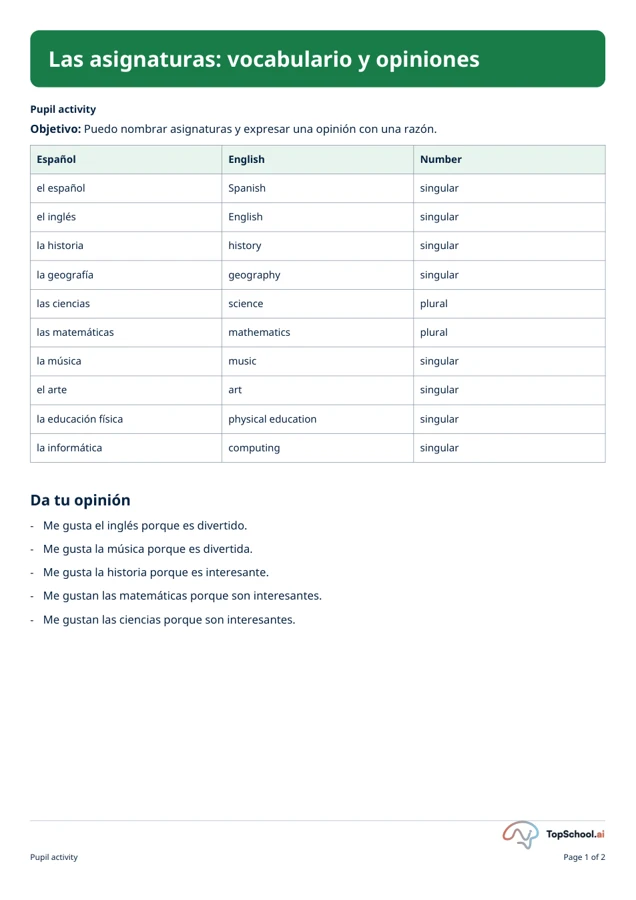
Objetivo: Puedo nombrar asignaturas y expresar una opinión con una razón.
Español
English
Number
el español
Spanish
singular
el inglés
English
singular
la historia
history
singular
la geografía
geography
singular
las ciencias
science
plural
las matemáticas
mathematics
plural
la música
music
singular
el arte
art
singular
la educación física
physical education
singular
la informática
computing
singular
Da tu opinión
-
Me gusta el inglés porque es divertido.
-
Me gusta la música porque es divertida.
-
Me gusta la historia porque es interesante.
-
Me gustan las matemáticas porque son interesantes.
-
Me gustan las ciencias porque son interesantes.
Pupil activity
Page 1 of 2
Page 2
Las asignaturas: vocabulario y opiniones
Ahora tú
Copy a subject name with its article. Complete “Me gusta ______ porque ______” for a singular subject or “Me
gustan ______ porque ______” for a plural subject. Then translate your sentence into English.
Desafío
Compare two subjects with “Prefiero… porque…”. Give a second reason, then explain why “las matemáticas”
and “las ciencias” take a plural verb and adjective.
Pupil activity
Page 2 of 2
Page 1
Las asignaturas: vocabulario y opiniones
Teacher key and guidance supporting this exact edition
Teacher check
Use me gusta with a singular noun phrase and me gustan with a plural noun phrase. The table has eight
singular names and two plural names: las ciencias and las matemáticas. Check adjective agreement in
divertido, divertida and interesantes.
Teacher companion
Page 1 of 1
A teaching sequence
Recognise ten Spanish school-subject names and state a preference with a reason, using me gusta with a singular noun phrase and me gustan with a plural noun phrase.
Read subjects with their articles
Read each Spanish subject name beside its English meaning in the table.
Which subject names are marked plural in the supplied table?
Choose gusta or gustan
Use the table’s singular or plural label to choose the me gusta or me gustan frame; the table has eight singular names and two plural names.
Does your verb match the singular or plural subject name?
Add an opinion and reason
Choose one subject and complete an opinion sentence with a reason.
Which model helps express the reason you chose?
Check adjective agreement
Check adjective number and gender against the model sentences, including the masculine form “Me gusta el inglés porque es divertido.”
Does the adjective match number and gender in the complete sentence?
Before you teach
Look for the thinking behind an answer, choose the support your class needs and leave room for an independent response.
What to look for
Expected models: “Me gusta el inglés porque es divertido” uses a masculine singular subject and adjective; “Me gusta la música porque es divertida” uses feminine singular agreement; “Me gustan las matemáticas porque son interesantes” uses plural agreement. Follow up: ask pupils to choose one other labelled subject, complete a matching opinion frame and explain how its article and adjective ending guided the verb and adjective.
Give a little support
Keep the English gloss visible, colour-code singular and plural noun phrases, and offer two opinion choices before pupils write independently.
Take the idea further
Compare two subjects with “Prefiero… porque…” and add a second reason. Ask pupils to explain how the plural ending changes the sentence.
Things to keep in mind
This set practises ten school-subject names and short opinions. Course vocabulary can vary; use the subject names taught by your class.
Keep the idea. Make it yours.
Bring your topic, learning goal and class context to PLAI™, then review what you create.
Ideas to try with your class
Sample teaching perspectives on what to try, what to adapt and what to watch for.
Meet The Creators
Meet a creator whose teaching interests connect with this template.

Kind Check-In
The Spanish sheet distinguishes singular subjects using “me gusta” from plural “las matemáticas” and “las ciencias” using “me gustan”. Pupils copy a subject with its article, add a reason, translate it and compare two subjects in the challenge.
Calm Table
This edition gives Spanish school-subject vocabulary and model adjective agreement, such as “la música es divertida” versus “las matemáticas son interesantes”. The plural-verb question makes number agreement part of the extension.
One Last Sticky Note
Start with one model sentence, then let pupils choose a subject from the bilingual list and complete the matching frame. The challenge can be attempted after singular and plural patterns have been practised separately.
Step by Step
The examples are a bounded vocabulary task, not a full account of Spanish adjective agreement. Check the plural forms and translation in each response, especially where the subject noun changes number.